
Every year, hundreds of thousands of U.S. workers take on seasonal jobs during the holidays. This is one of the most popular aggregate planning strategies that firms use to deal with capacity, as is noted in Chapter 13 of your Heizer/Render/Munson text.
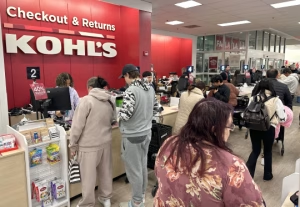
The retail and transportation-and-warehousing sectors typically rush to hire as they staff up for the holidays and let those workers go once the season is over. In the final three months of last year, the two sectors added 912,000 jobs. They then shed 858,000 jobs over January and February.
This year, some of the companies that do the most holiday hiring have broken from their usual practice of advertising how many holiday workers they plan to hire. United Parcel Service, for example, said last year that it would hire 125,000 workers in its “holiday hiring spree.” This year, it hasn’t made an announcement. Also holding off: Macy’s, which said in 2024 that it would hire more than 31,500 seasonal workers, and Target, which said last year that it would add 100,000 seasonal jobs. (Both UPS and Target have laid off regular employees this year.)
Through October this year large companies have announced plans to hire 372,520 seasonal workers. That compares with 660,150 at the same point last year.
But Portugalia Marketplace in Fall River, Mass., which nets about 30% of its annual business in November and December, calls for “all hands on deck”—as it wrote in a recent seasonal hiring posting for its warehouse that fills online orders. The grocer’s staff typically grows from 50 people to 60 near year-end as families shop for holiday groceries and the store hosts more events to attract visitors.
Classroom discussion questions:
- What other capacity options do firms have?
- Why is seasonal hiring slowing this year? Is it an AI issue?
 Temple U. Professor Misty Blessley shares her insights today, on Black Friday.
 Supply chains have stabilized after years of disruption. Thus, core products have been efficiently moved from warehouses to retail locations to ensure availability for traditional retail customers. Additionally, e-commerce channels are poised to efficiently fulfill customer orders. Many retailers are adopting cost-effective delivery strategies tailored to peak shopping events like Black Friday and Cyber Monday. Instead of defaulting to same- or next-day shipping, retailers are spreading deliveries over several days to reduce costs and balance labor.
 Today’s Guest Post comes from Dr. Albena Ivanova, who is Professor of OM at Robert Morris University in Pennsylvania.
 The first thing that I do is show students how to arrange their tabs so they can have the two screens open at the same time next to each other. I usually pick algorithmic problems for class practice, where we are all working on the same problem, but with different numbers. I use the Study Plan for class practice and then give similar questions (but with different numbers) for homework and for the exam. My homework is not time limited, however, the students have only one (1) attempt. If they need to practice, they can do that in the Study Plan before completing the homework.


