Guest Post: Hiring Workers to Meet Demand

Our Guest Post today comes from Howard Weiss, Professor of Operations Management Emeritus at Temple University.

The city of Philadelphia is one of many cities that due to COVID-19 are experiencing increasing volumes of residential trash that needs to be collected, reports The Philadelphia Inquirer (Aug. 26, 2020). Because people have been spending more time at home there has been a dramatic increase of household trash. The problem is compounded by the fact that some of the trash collectors are not showing up for work because they have the virus, fear getting the virus or are self-quarantining because they have been exposed to someone who has the virus.

In Aggregate Planning, Chapter 13 in your Heizer/Render/Munson OM text, one option suggested is to hire workers as needed to meet the demand. This may be easier said than done. In July, the mayor of Philadelphia announced that between 120 and 150 workers would be hired into the Streets Department. The city maintains a list of 3,455 labor candidates but at the moment there are only 45 of these candidates employed for trash collection. Fifty-five have been hired but 10 have quit.

The Inquirer notes that “The city has faced challenges at every step of the hiring process. Issues include finding workers from the city’s existing list of laborer civil service candidates who are interested in taking the job, getting them to show up for and pass medical assessments, and then keeping them at work once they begin.”

Baltimore is using a different option of collecting trash but not recyclables. For recyclables, Baltimore is using a self-service option as discussed in Chapter 7 in which citizens are expected to take their recyclables to a drop-off center. Dallas is considering ending collections in alleyways because collecting on streets is more efficient in terms of labor.

Classroom discussion questions:
1. What other options do cities have to increase their trash collection?
2. What other resources are required if more trash collectors are hired?


OM in the News: McDonald’s New Dining Experience

Steve Easterbrook, McDonald’s chief executive, demonstrating how ordering is done at a self-service kiosk in NY
Steve Easterbrook, McDonald’s CEO, demonstrating a self-service kiosk in NY

McDonald’s just announced changes that could reshape the diner’s experience, saying that it would expand its digital self-serve ordering stations and table service to all of its 14,000 American restaurants. The company said once people order at one of the stations — sleek, vertical touchscreens — they will get a digital location device and can take a seat. When their burgers and fries are ready, the technology will guide a server to the table to deliver the food with a big smile and a thank you.

Customers will still be able to order food the old-fashioned way, at the counter. But the move to self-order systems and table service is one way to address one of the biggest problems the company’s restaurants have faced in recent years: slower food delivery to customers, caused by more items on the menu. The thinking is that customers will be more willing to wait if they are sitting at a table instead of waiting at a counter.

“McDonald’s has tested the order system in 500 revamped restaurants,” writes The New York Times (Nov. 18, 2016), and is now introducing it around the globe. Some 44,000 customers have been served at tables using the new system, with families and groups being the biggest users so far. The self-serve stations seem to make it easier to customize an order. Many of the company’s customers, though, do not enter the restaurant. About 60-70% of sales come from its drive-through lanes.

The vast majority of McDonald’s locations are owned by franchisees, and they will be responsible for paying for the changes. Equipment and installation of the 8 order screens cost upward of $56,000, and franchisees are often loath to make such investments at a time when sales are stagnant.

Classroom discussion questions:

  1. Draw a process chain network (see Ch.5) for this system.
  2. How has the company added “service efficiency”?

OM in the News: The Self-Service Airport

Airlines are laying the groundwork for the next big step in the increasingly automated airport experience: a trip from the curb to the plane without interacting with a single airline employee, writes The Wall Street Journal (Aug.28, 2012).

For years, travelers have been checking in online or at airport kiosks and airlines have been converting paper boarding passes into electronic ones. Now carriers are turning to technology that enables travelers to check their own bags and scan those boarding passes, a topic we discuss in Chapter 5 on service design.

At the airport of the near future, “your first interaction could be with a flight attendant,” said Ben Minicucci, COO of Alaska Airlines. Alaska Air has been at the forefront of self-service in the U.S., recently introducing self-tagging of baggage in Seattle and San Diego with 8 more airports planned this year. Airlines say the  technology will quicken the airport experience for travelers—shaving 1-2 minutes from the checked-baggage process alone—and freeing airline employees to focus on fliers with questions.

Airline-employee unions say the machines are a way for carriers to cut staff by outsourcing pre boarding tasks to fliers. But a recent survey found self-boarding appeals to 70% of passengers and almost as many travelers want to tag their own bags. Self-tagging and self-boarding have each been implemented in 115 instances around the world.

U.S. airlines and airports are catching up to their counterparts in Europe, where  Lufthansa began testing self-boarding in the late 1990s. That airline officially implemented the technology last year in its three main hubs in Germany, where customers have readily adapted to it. “A lot of our passengers are frequent fliers who really prefer not to talk with staff all the time,” says Lufthansa. Last month in Las Vegas, JetBlue Airways became the first U.S. airline to officially implement self-boarding gates, where fliers scan their own tickets to board the plane.

Discussion questions:

1. In what ways can OM make airline check-in/boarding more efficient?

2. Will the concepts described become standard procedure in a decade? Why or why not?

OM in the News: Reversing Self-Service Technology in Supermarkets

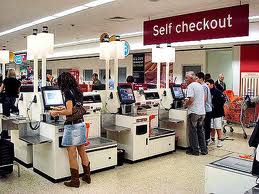
Supermarket chains started introducing self-service lanes about 10 years ago, touting them as an easy way for shoppers to scan their own items’ bar codes, pay, bag their bounty and head on their way. Retailers also anticipated  labor savings, potentially reducing the number of cashiers as they encouraged shoppers to use the do-it-yourself technology (one of our topics in Ch.7, Process Strategy). But Forbes (Sept. 26, 2011) is reporting that some grocery chains nationwide are bagging this “wave of the future” option by eliminating self-serve lanes.

Big Y, a Northeast US chain, just announced it was phasing out self-checkout lanes. Albertsons is also reducing its unstaffed lanes and adding more clerks to traditional lines. Why? Because a recent Food Marketing Institute study found that only 16% of supermarket transactions in 2010 were done at self-checkout lines in stores providing that option–down from a high of 22% three years ago. Overall, people reported being much more satisfied with their shopping experience when they used cashiers. Big Y  found that its self-service lines caused delays because of coupons and payments. Intentional and accidental theft  and misidentifying products also helped reach the tipping point.

Other chains plan to keep the self-service option in place because they think giving shoppers that choice is an important part of customer service. “People shop in different ways”, says a Stop & Shop spokeswoman. Home Depot and some other businesses that cater to a do-it-yourself mentality, have had more success with their self-service lanes. And it may all come down to demographics–such as whether the store is in a tech-savvy region. “It is a match between technology and the customer base”, says a St. Joseph U. prof.

Discussion questions:

1. What other businesses have reversed direction in terms of new technology?

2. Why have ATMs succeeded at airports and banks?