OM in the News: America Now Has an EV Rust Belt

At first, North America’s biggest auto-parts supplier was thrilled to snag the job of making enclosures for the batteries in GM’ new electric pickup. The contract was so big—and promised to be for years to come—that Magna International built a new  $575 million factory in a Michigan cornfield. And Michigan even offered a $44 million incentive package to draw the promise of new jobs–a topic in Chapter 8.

Five years later, that million-square-foot plant is mostly empty and losing money, a casualty of America’s messy breakup with EVs, reports The Wall Street Journal (April 1, 2026). It is one of dozens of now desolate EV parts plants across the country. It can take years to pivot a factory and supply chain from one type of vehicle to another. And it would take 4-6 months of higher gas prices for most Americans to reconsider more fuel-efficient vehicles– an unlikely prospect. Detroit automakers have scrapped their boldest EV dreams—and are looking beyond $50 billion in charges tied to broken supplier contracts and wasted investments.

The deserted Magna factory in St. Clair was expected to stay busy for years.

Magna, which has more than 300 factories around the globe and parts in nearly every car on the road today, has been left holding the keys to the St. Clair, Michigan  building that is bigger than 20 football fields. The Canadian company needs to find a second life for the factory and the hulking rows of assembly-line robots. A few years ago, Magna had plans to build an entirely new business unit around EV battery enclosures.

The EV slide is reverberating through the automotive industry’s sprawling supply chain. Multinational companies such as Magna, Dana and BorgWarner slashed jobs and closed plants due to the EV pullback, while a string of smaller manufacturers shut down altogether. Last year, more than $20 billion in previously announced investments in EV and battery facilities were wiped out.

Smaller suppliers have little recourse to recoup costs when automakers cancel a vehicle program and stop buying parts. They typically absorb the upfront cost of setting up an assembly line with the expectation of recouping it over time as parts are shipped. GM’s supplier contracts were struck with the expectation that GM would be building one million EVs a year. By December, 2025 the company was selling around 8,000 a month.

Classroom discussion questions:

  1. Discuss the typical incentives offered to attract a new plant.
  2. Why has the EV trucking business been especially hard hit?


OM in the News: The Magnet Supply Chain and Auto Production Problems

In the auto industry, rare-earths are what allow electric-vehicle motors to function at high speed. They are also used in less exotic, though no less critical, functions performed by such parts as windshield wipers and headlights.

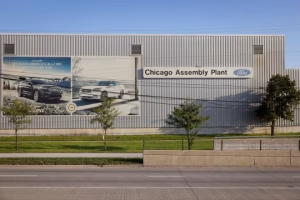
Ford shut down Explorer production at its Chicago plant in May because of a rare-earth shortage

China was supposed to have eased export controls on rare-earth magnets as part of a 90-day tariff truce agreement with the White House, but the country has slow walked license approvals for magnets. As exports of rare-earth magnets have virtually ground to a halt, carmakers face hard decisions about whether they can continue to keep some plants operating. Several production lines and plants across Europe have already closed, with more impacts expected in the coming weeks as inventories deplete, reports The Wall Street Journal (June 5, 2025). U.S., Japanese, and Indian vehicle production are also reducing or shutting down without more Chinese rare-earth components.

Car companies are looking at alternative sources for magnets in Europe and Asia, instead of purchasing them directly from Chinese factories as they do currently. But none of these sources would provide enough magnets to support the demand from the  industry. And  China controls almost all of the refining capability that transforms raw minerals into usable forms.

The lack of magnets hits EVs and hybrid vehicles harder than conventional cars and trucks. A typical EV contains far more rare-earths than a gasoline-powered model, but rare-earth magnets are found throughout any modern vehicle.

One option to conserve dwindling magnet supplies is reverting to older electric-motor technology that doesn’t make use of rare-earth magnets. Carmakers stopped using those motors because the current versions are cheaper and more efficient. They are also considering stripping out some premium features, such as adjustable seats, that make use of several tiny electric motors. High-end speaker systems that use rare-earth magnets could also be replaced with downgraded versions.

Classroom discussion questions:

  1. As Ford’s head of supply chains, what are your options?
  2. What is the long-term solution?

OM in the News: BMW’s Supply Chain Disruption

BMW’s plant in Rosslyn, South Africa.

BMW is halting or slowing production of certain models in response to a shortage of parts caused by delivery problems from first-tier parts supplier, Bosch. “The hiccups show how dependent manufacturers are on a global, smoothly running supply chain,” writes The Wall Street Journal (May 30, 2017). Even small disruptions anywhere along the line can cascade into delays in getting the company’s big money-making products off the assembly line and into showrooms.

In BMW’s case, the culprit is a “Lenkergetriebe,” or steering gear, manufactured by Stuttgart-based auto-parts giant Bosch and used in BMW’s Series-1,2,3, and 4 models. “Our supplier Bosch is not currently able to provide us with a sufficient number of steering gears,” said a BMW exec. Bosch, in turn, said the trouble arose when a 2nd-tier supplier in Italy experienced difficulties in delivering the casing for the steering gears.

As a result of the shortages, production is restricted at several BMW plants in Germany, China, and South Africa. “Automotive value chains are international. An interruption in delivery of parts from a partner in Europe can therefore also have implications in China,” said the BMW exec. “The vehicle is not complete until all parts, most of which are supplied just-in-time, are installed. It is, therefore, understandable how a missing part—even if only a small one, as in this case—can have a major impact.”

Classroom discussion questions:

  1. What can BMW do to prevent such supply chain disruptions in the future?
  2. What are the differences between 1st, 2nd, and 3rd tier suppliers? Provide an example of each in a non-automotive industry.

OM in the News: Toyota Shocks Its Keiretsu Network

Toyota's Akio Toyoda wants his firm's Japanese car-parts suppliers to be more globally competitive
Toyota’s Akio Toyoda wants his firm’s Japanese car-parts suppliers to be more globally competitive

Toyota launched a new Corolla in Japan this year that held a shock for its closely knit Japanese supplier network: a cutting-edge crash prevention system made by a German parts maker, reports The Wall Street Journal (Oct. 29. 2015). Until now, Toyota relied on Denso Corp., a major parts maker and key member of its traditional supplier network. The decision to go outside its traditional network highlights a growing concern within Japan’s auto industry: Parts suppliers, once considered the foundation of the country’s auto export prowess, are losing their edge, especially in next-generation software technologies for safety and autonomous driving.

The Japanese are lagging behind rivals in the innovation race in part due to their de facto control by the big auto makers, a system called keiretsu. This tight relationship enables close communications between car manufacturers and their suppliers, allowing them to fine-tune development of parts, but the insular nature of the groups may have stifled breakthroughs. “The globalization of Japan’s auto parts industry and competitive jockeying mean uncertainty and unpredictability” in a society that values stability,” says a U. of California prof.  Toyota is the last of Japan’s Big Three to fully maintain a keiretsu. Nissan dismantled its keiretsu about 15 years ago to slash costs.

“There is no Google, Apple or Uber in Japan to force a rethinking of mobility and the features in a car,” said an industry consultant. “So Mr. Toyoda really has no choice but to look outside of the keiretsu, which concentrates on traditional automotive parts.” Toyoda himself  adds: “If Toyota and its keiretsu members don’t get the best information and technologies and remain closed off to external influence, we won’t be able to survive.”

Classroom discussion questions:

  1. Describe the concept of keiretsu. Why is it widely used in Japan?
  2. Why is it not used in the U.S?

OM in the News: West Coast Port Disputes and Global Supply Chains

Some ships are anchored offshore because of West Coast port delays

Shipping companies say West Coast ports could shut down if a new contract isn’t reached with dock workers,” writes the Los Angeles Times (Feb. 14, 2015). A flotilla of ships — filled with cars, electronics and clothes from Asia — have anchored off the coast waiting for the docks to clear. Both sides blame each other for the severe traffic jam. A shutdown promises to delay numerous products from Asia including furniture, cars, toys, clothes and electronics. About 12.5% of U.S. gross domestic product is tied to goods that flow through the 29 West Coast ports. The ports of Los Angeles and Long Beach together handle 40% of the nation’s incoming container cargo. The dispute centers on a new contract for roughly 20,000 dock workers at the ports.

Businesses that rely on the ports for their goods are likely to face rising costs from delays and possibly lost sales. The last time the ports closed, in 2002, some manufacturing plants were idled because they relied on timely shipment of parts. Businesses can re-route some products by air or to East Coast ports. But that’s costly.  If customers ordered Asian-made electronics or other goods, they probably won’t receive them as quickly if they have not already arrived in the country. If the products did arrive, however, but are stuck on the docks, customers may have to wait even longer.

The impact on supply chains is massive. Honda and Toyota are cutting back production at several North American plants. Honda reduced production at plants in Ohio, Indiana and Ontario as the labor tension has slowed delivery of critical parts to keep the production lines running smoothly and efficiently. Parts such as electronics and transmissions are in low supply. Honda has been working to maintain the flow of parts to North American plants utilizing alternative means of transportation.

Classroom discussion questions:

1. What are the impacts on supply chains?

2. Why are the shipping alternatives limited?