OM in the News: GM’s $4.5B Supply Chain Deal to Secure Critical Parts

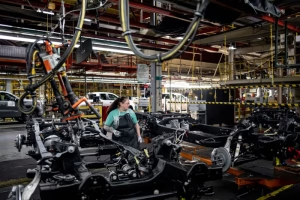
General Motors’ assembly plant in Fort Wayne

General Motors has entered a $4.5 billion purchasing facility with Procura Auto Parts to safeguard its supply chain against disruptions such as natural disasters, cyberattacks, or sudden demand surges. The automaker is aiming to secure supplies of high-risk components through a financing arrangement of prefunding the purchase of essential parts, reports The Wall Street Journal (Aug. 12, 2026). 

  • Procura’s Role: The London–Frankfurt–New York-based inventory management firm will buy and store critical parts from GM’s suppliers, acting as an intermediary to secure inventory.
  • Funding: A bank syndicate led by JPMorgan Chase and Banco Santander will finance Procura’s purchases.
  • GM’s Commitment: GM will issue irrevocable payment undertakings (IPUs) to repay Procura once the parts are used in production

GM has not disclosed the exact components, but past disruptions have involved semiconductor chipsrare earth metals, and wire harnesses.

The move follows years of global automotive supply chain shocks, including the COVID-19 pandemic and semiconductor shortages that halted production at multiple plants. By prepaying suppliers, GM aims to:

  • Preserve working capital by avoiding short-term cash outflows.
  • Maintain production continuity during unexpected shortages.
  • Reduce vulnerability to just-in-time delivery risks.

This complements earlier GM initiatives, such as a long-term chip supply agreement with Micron Technology for memory and storage components. It reflects a broader industry shift toward strategic inventory management and supplier diversification after repeated disruptions.

In summary: GM’s $4.5B deal with Procura is a proactive, multi-year supply chain hedge designed to ensure access to critical parts, protect cash flow, and maintain manufacturing resilience in a volatile global market.


Classroom discussion questions:

1. How does GM’s decision to invest heavily in securing critical components—such as semiconductors—illustrate the growing importance of supply chain resilience in modern operations management, and what risks is the company trying to mitigate?

2. GM’s partnership with suppliers like Procura reflects a shift toward deeper, long‑term collaboration. In what ways can strategic supplier relationships improve operational performance, and what challenges might arise when firms commit to such large, multi‑year agreements?

OM in the News: America Now Has an EV Rust Belt

At first, North America’s biggest auto-parts supplier was thrilled to snag the job of making enclosures for the batteries in GM’ new electric pickup. The contract was so big—and promised to be for years to come—that Magna International built a new  $575 million factory in a Michigan cornfield. And Michigan even offered a $44 million incentive package to draw the promise of new jobs–a topic in Chapter 8.

Five years later, that million-square-foot plant is mostly empty and losing money, a casualty of America’s messy breakup with EVs, reports The Wall Street Journal (April 1, 2026). It is one of dozens of now desolate EV parts plants across the country. It can take years to pivot a factory and supply chain from one type of vehicle to another. And it would take 4-6 months of higher gas prices for most Americans to reconsider more fuel-efficient vehicles– an unlikely prospect. Detroit automakers have scrapped their boldest EV dreams—and are looking beyond $50 billion in charges tied to broken supplier contracts and wasted investments.

The deserted Magna factory in St. Clair was expected to stay busy for years.

Magna, which has more than 300 factories around the globe and parts in nearly every car on the road today, has been left holding the keys to the St. Clair, Michigan  building that is bigger than 20 football fields. The Canadian company needs to find a second life for the factory and the hulking rows of assembly-line robots. A few years ago, Magna had plans to build an entirely new business unit around EV battery enclosures.

The EV slide is reverberating through the automotive industry’s sprawling supply chain. Multinational companies such as Magna, Dana and BorgWarner slashed jobs and closed plants due to the EV pullback, while a string of smaller manufacturers shut down altogether. Last year, more than $20 billion in previously announced investments in EV and battery facilities were wiped out.

Smaller suppliers have little recourse to recoup costs when automakers cancel a vehicle program and stop buying parts. They typically absorb the upfront cost of setting up an assembly line with the expectation of recouping it over time as parts are shipped. GM’s supplier contracts were struck with the expectation that GM would be building one million EVs a year. By December, 2025 the company was selling around 8,000 a month.

Classroom discussion questions:

  1. Discuss the typical incentives offered to attract a new plant.
  2. Why has the EV trucking business been especially hard hit?


OM in the News: The Electric F-150’s Short Life Cycle

The first Boeing 737 jet rolled off the assembly line 58 years ago, on April 9, 1967.  That is a long life cycle, given it has still not reached the “decline” phase in Figure 2.5 in your text. But the life cycle certainly looks a lot shorter for electric pickup trucks.

Ford is planning to scrap the electric version of its F-150 pickup, according to The Wall Street Journal (Nov. 7, 2025) which would make the money-losing truck America’s first major EV casualty. “The demand is just not there” for the F-150 Lightning and other electric trucks, said one dealer. Stellantis earlier this year called off plans to make an electric version of its Ram pickup. GM plans to  discontinue some electric trucks and sales of Tesla’s Cybertruck tanked this year. The trucks seemed a good bet amid booming EV demand and clean-air mandates that required automakers to sell fewer gas-guzzlers.

Ford halts production of the F-150 Lightning

The Lightning fell far short of expectations as American truck buyers skipped the electric version of the top-selling truck. Overall EV sales are plummeting in the absence of government subsidies.  Ford dealers sold 66,000 gas-powered F-Series pickups, and just 1,500 Lightnings, the fewest of any model. (Ford has racked up $13 billion in EV losses since 2023).

 When Ford launched the Lightning 5 years ago it promised a pickup as fast as a sports car and as affordable as a conventional truck. It would drive hundreds of miles on a single charge, and carry enough voltage to power a home for days. “It’s like a smartphone that can tow 10,000 pounds,” said  the CEO at the launch.

But truck buyers worried the pickups would run out of juice in the middle of a job or a long haul as their range is dramatically reduced when towing big loads or operating in cold weather.

GM has also lost billions on electric trucks after rolling out a string of them, including an electric version of the popular Chevrolet Silverado. GM has three electric pickups, and it sold about 1,800 of them last month.

Ford built up the capacity to make as many as 150,000 Lightnings a year. But the EVs cost billions to develop and manufacture, and are only profitable if they sell in large enough volumes, which they did not.

Classroom discussion questions:

  1. Where do you think all EVs are on the life cycle curve?
  2. Why did so many auto manufacturers misread the demand for electric pickups?

OM in the News: The Great Hummer Shortage

Remember about 20 years back, when the humongous General Motors Hummer was the king of the road? That triumph in automotive marketing died quickly when gas skyrocketed and the Hummer became an unofficial persona non grata of gas guzzling vehicles. But wait, it’s back! And this time the $85,000-$110,000 Hummer is an EV and the wait list just topped 77,000 perspective customers.

GM’s renovated Detroit factory, where about 700 workers build the Hummer, has been producing only around a dozen of the trucks a day, writes The Wall Street Journal (June 30, 2022). That is a 17.5 year wait and an unusually slow pace for a vehicle in production for more than 6 months. The Hummer trails rival offerings from Ford and Rivian Automotive.

Hummer production at GM’s Factory Zero, which underwent a $2.2 billion overhaul to build electric trucks, has been slower than normal in part because the truck was developed from scratch using a new electric-vehicle platform. “Our ability to satisfy that demand is only going to improve as we bring on vertical integration of battery cell production,” says a GM exec.

Auto makers are pushing to get electrics to market while also grappling with a computer-chip shortage and other supply-chain constraints (such as batteries) that have curbed vehicle output and sales. The Hummer EV’s battery pack is heavier than the overall weight of a Honda Civic, and is 1/3 of the vehicle’s weight.

Compared to the Hummer, Ford is making about 150 of its F-150 Lightning electric pickups per day at the company’s factory in nearby Dearborn, Mich. In the coming months, GM expects to fulfill deliveries at a much faster pace, particularly after it switches from using outsourced LG battery cells. It aims to start manufacturing its own battery cells later this summer in its new factory in Ohio. The company has been building multiple battery factories in the US over the past year, including one in Tennessee and another in Michigan in addition to its Ohio plant, as part of its efforts to achieve its goal of making more than a million EVs in the US every year by the end of 2025.

Classroom discussion questions:

  1. What are the main supply chain issues facing Hummer?
  2. Why is production so low?

OM in the News: Ford and GM Move into Chip Making with Vertical Integration

Detroit’s two biggest auto makers, writes The Wall Street Journal (Nov. 19, 2021)—Ford and GM—are looking to get into the semiconductor business, after a year of computer-chip shortages that snarled their global factory output. Ford just announced a strategic agreement with U.S.-based semiconductor manufacturer Global Foundries to develop chips, a pact that could lead to joint U.S. production. GM said it was forging ties with Qualcomm and NXP Semiconductors, to codevelop and manufacture computer chips.

The moves are the latest examples of how pandemic-related disruptions are prompting companies to exert greater control over their supply chains by moving production closer to home, or in some cases in-house. Multinational companies got an early shock in the health crisis when border closings, local restrictions and lockdowns caused chaos. Some have decided on permanent solutions.

Businesses have also continued to face shipping delays. In the auto industry, car companies are starting to unwind decisions made over decades to outsource key components to suppliers. Recent moves by auto makers to vertically integrate (a topic in Chapter 11) by getting into battery production and semiconductors are a modern day nod to when they owned huge parts divisions and operated steel mills.

The semiconductor shortage has scuttled output of millions of planned vehicles industrywide this year. Ford’s move would go a step further by eventually bringing some chip development inhouse. It said designing its own chips could improve some vehicle features—such as automated driving capabilities or battery systems for electric vehicles— and potentially help Ford sidestep future shortages.

GM and Ford exploring the chip business shows how car companies are selectively bringing key technologies in house to develop expertise in areas they see as critical to competitiveness. Better, faster chips, for example, will be needed for everything from multimedia touch screens to remote software updates to fix defects.

The auto industry’s pivot to electric vehicles is also accelerating a shift to vertical integration, with many car companies worried they won’t be able to secure enough battery supplies and raw materials to meet their growth targets. Ford, VW, GM and other major auto makers are teaming with battery companies to build new factories that they say will give them a technical advantage and more stable future supplies.

Classroom discussion questions:

  1. What are the advantages and disadvantages of bringing chip production inhouse?
  2. Explain what is meant by “vertical integration.”

OM in the News: Casting Aside Gas Engines

VW ID.3 electric cars assembled in Germany,

For more than a century, auto makers continually honed their gas and diesel engines, sparring over which had greater power, better fuel efficiency, more durability or delivered a smoother ride. Now, they are sending the combustion engine to the scrap heap and are pouring billions of dollars into electric motors and battery factories. Instead of powertrain specialists, they are hiring thousands of software engineers and battery experts.

The transition is upending the automotive workplace, writes The Wall Street Journal (July 24-25, 2021), from the engineering ranks and supply chain to the factory floor. Parts makers that for generations have made the same pieces for engines and transmissions are jockeying to supply electrical components.

Unions in the U.S. and Europe fear a steep loss of jobs tied to making engines and transmissions. The UAW has warned that the move to EVs, which require fewer parts and 30% less manpower to produce, could jeopardize tens of thousands of U.S. jobs. A Morgan Stanley report estimates full transition to EVs could lead to 3 million lost automotive jobs globally. EVs are simpler mechanically than gas-powered ones. Their drivetrains employ fewer than 20 moving parts, compared with hundreds for the gas-powered version.

“It’s been a fun ride,” said an engineer with 40 years in the industry. “But I think we’re coming into the homestretch for the conventional engine.” Auto executives have concluded that they can’t meet tougher tailpipe-emissions rules globally by continuing to improve gas or diesel engines. And they don’t intend to develop any new gas engines. “I don’t know where to spend money on them anymore,” said GM’s President. Developing a new gas engine can cost $1 billion and involves 100’s of suppliers. Over the past several decades, auto makers rolled out 20-70 new engines annually. That number will fall below 10 this year, and then essentially go to zero.

The industry’s rapid shift in focus has left suppliers that have long made parts for gas engines hustling to reinvent themselves. “We don’t want to be left making the best buggy whips,” said one Michigan auto supplier.

Classroom discussion questions:

  1. What strategy should auto parts makers take?
  2. Will the transition to EVs be complete this decade? Why or why not?

OM in the News: GM and Honda Now in Strategic Alliance

In Chapter 5, Design of Goods and Services, we note that as the speed of new products and their technological sophistication increases, so do risks.  One way to mitigate this risk is via alliances (page 175). This is exactly  what GM and Honda are doing as they invest billions in an “automotive alliance” in the North American market, including plans to co-develop a range of vehicles to be individually branded by each partner.

GM and Honda plan to share vehicle platforms, including both electric and internal combustion propulsion systems. Earlier this year they agreed to jointly develop two EVs to be branded by Honda, based on the General Motors’ EV platform and powered by its Ultium battery technology.

The two automakers have been partners in selected projects over more than 20 years, including their recent collaboration fuel cell and battery technologies and production, and the Cruise Origin autonomous vehicle.  Beyond the new vehicle technologies, GM and Honda will work to coordinate materials purchasing, logistics services, and localization activities, to create cost efficiencies by leveraging respective scale, insights, and best practices, reports American Machinist (Sept. 3, 2020). And, the two organizations will explore combining R&D related to advanced technology areas, including electrical architecture, advanced driver assist systems, infotainment, connectivity and vehicle-to-everything communication.

“Combining the strengths of each company, and by carefully determining what we will do on our own and what we will do in collaboration, we will strive to build a win-win relationship to create new value for our customers,” said Honda’s VP.

Classroom discussion questions:

  1. What is the definition of an ‘alliance’?
  2. What are the risks to GM and Honda when they establish such alliances?

OM in the News: GM Hustles to Pump Out Ventilators

Factory workers will assemble ventilators at an idled GM facility in Kokomo, Ind.

On March 19, four GM engineers boarded a late flight from Detroit to Seattle. By daybreak, they were huddled in a conference room at Ventec, a small maker of ventilators whose entire operation is smaller than a GM car dealership. Ventec execs had turned over blueprints for the roughly 700 parts that go into its ventilator to the GM engineers, hoping to get their help scaling up production. The GM contingent, which usually specializes in designing and sourcing parts for building vehicles, used their smartphones to take videos of the toaster-sized machines being built by hand. A box of parts was overnighted to Michigan.

A shortage of the machines for patients with the coronovirus has sent the government and private sectors scrambling, reports The Wall Street Journal (March 30, 2020). Manufacturers from GM, Ford and Tesla to medical-device giants like Medtronic, and even British vacuum-maker Dyson, are gearing up to boost production. GM said it would start producing ventilators at its Kokomo facility and ramp up to 10,000 machines a month. (The auto industry had also been drafted to help during World War II).

There is little overlap between making cars—a highly automated process involving fast-moving assembly lines and robotic welding machines, which plays out in vast factories—and the labor-intensive job of building ventilators, which are largely hand-built at small workstations.

But car companies are being called on to help because they typically work with thousands of parts suppliers—many making components similar to those needed for a ventilator—and are accustomed to manufacturing at a large scale. At the same time, car makers have been in crisis mode themselves from the new coronavirus. GM has shut most of its N. American factories to keep the virus from spreading among workers. Still 100’s of workers volunteered for the job to help the nation.

Classroom discussion questions:

  1. How do the manufacturing processes differ between a GM and a Ventec?
  2.  What strengths does GM bring to the table for this project?

OM in the News: Electric Cars are Here. Buyers Aren’t

Ford unveiled the all-electric Mustang Mach-E last month

“It is no surprise auto executives worldwide have announced nearly 75,000 layoffs this past year,” writes The Wall Street Journal (Dec.7-8, 2019). This downsizing isn’t driven by market-share wars or oil shocks or economic crisis but by the belief that electric cars will soon boom. (Just 2 days ago, our blog spoke of the shortage of EV batteries worldwide).

Stop me if you’ve heard this before. Auto executives say they really, really mean it this time, though, as they point to technological advances, looming regulation and pent-up demand. The trouble is that EVs cost more than their gasoline counterparts, are cumbersome to charge and sell fewer in the U.S. than the Toyota Camry. For every 8 pickups sold there is one pure-plug-in vehicle sold.

Still, companies are preparing for the electric age by cutting workers. This is partly to save money needed for development, but it is primarily to prepare for a vehicle design-and-production process that will be, as they say in Silicon Valley, “asset light.” EVs are less complex than gasoline or diesel rivals, requiring fewer parts, people and suppliers. Ford says 30% fewer hours of labor and 50% less factory space will be needed for EVs.

But even the smartest auto exec doesn’t have a clue when the EV revolution will happen. Could be 2025, or it could be 2050. To date, the customer’s appetite for big trucks and SUVs running on cheap gasoline has ruled the market. Hype for EVs persists even as car makers lose money on them. For instance, amid $4-a-gallon gasoline earlier in the decade, GM predicted it would have 500,000 electric cars on the road by 2017. It missed badly. The U.S. market needed until mid-2018 to hit the 1-million-EV mark, with each sale bolstered by at least $7,500 in tax incentives (that are now ending).

Car makers, at the same time, have raised fuel-economy numbers on conventional cars, trucks and SUVs by using turbochargers, lighter materials, and smaller engines. This has gone a long way toward pleasing regulators and customers demanding better efficiency.

Classroom discussion questions:

  1. What is your forecast for when EV sales will exceed traditional gas rivals.
  2. How is this an operations issue? (Refer to the OM decisions in Chapters 5, 7, 8, 9,10, and 11 in your Heizer/Render/Munson text).

OM in the News: The Key to Electric Cars is Batteries–And There Aren’t Enough of Them

GM and South Korea’s LG Chem plan to build a $2.3 billion battery factory in Ohio, the latest example of an auto maker plowing money into the development of electric cars. The new plant would be among the world’s biggest producing battery cells for electric cars, rivaling Tesla’s Gigafactory in the Nevada desert, reports The Wall Street Journal (Dec. 7, 2019). Auto makers have been joining forces with battery makers as they gear up to spend about $225 billion to develop new electric-vehicle models over the next several years. (GM plans to introduce at least 20 electric models globally by 2023).

GM said the new battery plant, which would employ more than 1,100 workers, would have a capacity to manufacture enough batteries annually to produce more than 30 gigawatt hours. (Tesla’s plant has output of about 24 gigawatt hours). GM and LG Chem will co-develop and assemble battery cells to be used in the auto maker’s electric vehicles, including a battery-powered truck GM plans to introduce in  2021. GM said the joint venture with LG will speed GM’s electric-vehicle development and reduce costs. Toyota, for example, is finding it hard to build enough batteries to keep up with rising demand for hybrids, which use a combination of gasoline and battery power. “We can assemble the cars,” said one Toyota exec.  “The assembly is not the bottleneck. It’s the battery itself.”

Auto union officials have expressed concern that the expansion of electric vehicles poses a long-term threat to auto-factory employment, because they require less manpower to produce than gasoline-powered cars. Battery-cell plants are highly automated and require different skills than those needed at traditional car factories. The plants’ employees include test technicians, computer programmers and equipment engineers.

Classroom discussion questions:

  1. Why is there a battery bottleneck?
  2.  Prepare a SWOT analysis of GM’s strategy.

OM in the News: GM, Capacity, and the UAW Strike

GM CEO Mary Barra

GM is pouring billions into electric cars and autonomous vehicles, and needs maximum flexibility to minimize the risk. Automobile design is headed for big changes, and a preference for shipping production out of the country threatens its ranks. Electric vehicles, which are less complex than gasoline counterparts, are expected to require 30% fewer workers—bad news for a UAW union that now only represents about 150,000 people at Big Three auto plants—a minority of American auto workers. The recent strike cost GM $3 billion and UAW members $8,700 per worker. The industry’s most profitable vehicles, meanwhile, are increasingly coming from Mexico.

Hence the factory-utilization rate. Long an indicator of a company’s underlying health, it measures the percentage of a plant’s capacity to churn out cars used during a 16-hour workday. Auto executives hate it when the lights are off on a plant. Every minute of those 16 hours that the assembly line isn’t running represents piles of wasted cash.

GM is responsible for 1/3 of the  auto industry’s unused production capacity, reports The Wall Street Journal (Nov. 2-3, 2019). That’s a disproportionate burden for a company with just 17% market share. It’s also why the company announced a plan last year to close several factories, including a facility in Lordstown, Ohio, and stuck to that plan even as government and union leaders criticized the move.

GM builds the electric Chevy Bolt and small cars, for instance, at a factory in Orion Township, Mich. The sprawling facility employs about 750 people and is capable of building tens of thousands of cars a month. It currently builds 170 a day, or less than 10% of what it is capable of building during a 2-shift workday. The industry average for capacity utilization? 88%. GM is keeping Orion open because it sees the factory as a test bed for electric vehicles, which currently are money losers because of the high cost of batteries.

Classroom discussion questions:

  1. What issues concern the UAW?
  2.  What OM issues concern auto manufacturers?

OM in the News: GM’s Risky OM Strategy

Building a GM Bolt EV.

“It becomes pretty clear that to win in the future, you’ve got to win with electric and driverless vehicles. This is the future of transportation,” says Mary Barra, CEO of GM, in the Businessweek (Sept. 23, 2019) cover story.

Taking vast resources from businesses that make money and moving them toward businesses that (so far) lose mountains of it is a very risky bet. But the real gamble is timing. GM, which is pushing hard into electrics and autonomy faster than any other carmaker, could be blowing cash for years before there’s any payoff. Already, its Cruise Automation unit has postponed plans to deploy autonomous cars this year. If driverless and EVs take off more slowly, then GM will have prematurely jettisoned thousands of skilled veterans and killed off its smaller gasoline models. Worse, it could cede a chunk of profits from the remaining decades of the internal combustion era.

Barra is adamant that GM will sell a million EVs a year in the very near future, while lowering costs and gaining an economy-of-scale edge that Tesla would envy. But Cruise Automation (which GM bought in 2016 for $1.5 billion), was losing money then and continues to do so. Some rivals, like Toyota, which thinks autonomous driving could be decades away, are moving with greater caution. But how could any CEO simply turn her back on a windfall in ride-hailing that McKinsey sees generating $1.3 trillion by 2030? And how could Barra discount the possibility that a too-timid GM could become the next Kodak or BlackBerry?

GM designers have come up with 18 different prototypes using the carmaker’s next-generation battery pack, including sedans, SUVs, sports cars, and autonomous vehicles. As GM lays off old-line engineers, it is hiring coders, software and AI engineers, and battery experts. While it’s a given that GM’s EVs need to get better fast (Chevy Bolts lose $9,000 apiece), Barra at the same time has to keep money flowing even as U.S. and China vehicle sales slide.

Classroom discussion questions:

  1. Conduct a brief SWOT analysis on GM’s strategy.
  2. What are student impressions about the timing of EV’s acceptance?

OM in the News: GM’s Strike and the Auto Supply Chain

Companies that supply parts to General Motors are being forced to idle plants and lay off workers, as a result of the national strike called by the United Auto Workers. Nearly 46,000 GM workers walked off the job last week after the UAW and GM were unable to agree on a new 4-year labor agreement. The strike is now the longest nationwide strike against GM since the 1970s.

By stopping all production at GM’s U.S. plants, the strike is also beginning to affect the web of manufacturers that produce parts that go into the company’s cars. With no vehicles being made, those companies can do little but wait until the strike ends. Every automotive assembly job impacts between 5 and 8 other jobs, reports The Wall Street Journal (Sept. 20, 2019). The companies most affected so far are those that operate on a “just-in-time” basis, delivering difficult-to-ship parts like seats and door panels to GM’s assembly plants from factories located nearby.

At least three companies around Lansing, Mich., have shut down their plants that supply the two GM assembly plants nearby. Already there are signs that the work stoppage is rippling beyond just those nearby plants and into the broader automotive supply chain. A typical finished vehicle is made from roughly 30,000 individual parts manufactured by hundreds of different companies, and companies that provide products to GM will themselves have networks of suppliers.

The strike is having cross-border implications as well. GM laid off 1,200 workers at an assembly plant in Oshawa, Ontario, on account of a shortage of necessary parts that would come from the company’s U.S. plants. In the U.S., given the importance of the automotive supply chain to the country’s Midwest, a prolonged strike of more than a month could have serious implications for the region’s economy.

Classroom discussion questions:

  1. What are the OM implications of a long strike?
  2.  Which suppliers are most affected?

OM in the News: Honda to Invest $2.75 Billion in GM’s Self-Driving Cars

Honda’s investment will give the auto maker a 5.7% stake in GM Cruise.

Honda is investing $2.75 billion in GM’s self-driving car unit, for the joint development of a mass-produced fully autonomous car, writes The Wall Street Journal (Oct. 7, 2018). Auto makers and technology giants have been scrambling to plant stakes in a transportation landscape that is swiftly being reshaped by technology. Honda will work with GM Cruise LLC to develop a driverless car from the ground up that can be manufactured in high volumes and deployed globally. (GM set up Cruise as a separate business unit to draw in investors who don’t want exposure to the cyclical, low-margin business of manufacturing cars).

Honda’s decision to invest in GM’s self-driving arm reflects a culture change under way at the Japanese car maker, which long prided itself on its engineering prowess, shunning technologies developed by outside companies. One industry analyst said he expects only a handful of “winners” to emerge from the race to commercialize driverless vehicles. That prospect and the large capital outlays required to develop the technology could lead to more collaboration among automotive competitors.

Car companies have been teaming up with tech firms and suppliers to develop driverless technology. GM’s pact with Honda is a further sign that traditional auto makers will look to join forces with one another as they try to fend off Waymo and others vying to lead in a technology that could upend the transportation sector.

Fiat Chrysler has joined a BMW-led consortium to develop self-driving car technology with the aim of producing fully automated vehicles by 2021. BMW launched the partnership with Intel and Israeli car-camera software provider Mobileye. Toyota just announced it would invest $500 million in Uber to work jointly on autonomous vehicles. Uber will integrate its self-driving technology into Toyota minivans for use in Uber’s ride-hailing network.

Classroom questions:

  1. Name other companies that are forming “alliances” ( a topic in Chapter 5).
  2. Why are such alliances useful in designing goods and services?

OM in the News: GM Wrestles With Excess Capacity

Despite its drastic downsizing a decade ago under a federally funded bailout and bankruptcy restructuring, General Motors again finds itself with too many U.S. factories that can turn out too many vehicles. GM’s factory-utilization rate in North America averaged 95.1% over the past two years, below Ford’s 111.9% and Toyota ’s 101.4%. (Rates can exceed 100% when factories work a 3rd shift or schedule overtime work on weekends.) The auto industry often runs its factories dawn-till-dusk or even around the clock to boost their efficiency, writes The Wall Street Journal (Oct.10. 2017).

Factory-utilization rates typically measure how much production capacity a plant uses based on a 16-hour workday. GM says its utilization rate is 100% on average when its round-the-clock truck and SUV lines are figured in with the relatively sleepy factories making cars. GM said it is working to “drive further improvements” in its plant utilization, including adding crossover SUVs to more factory lines. A plant in the Kansas City area that now makes only the Malibu is scheduled to begin assembling a small Cadillac SUV by late 2018. But such a switch-over typically takes car makers several years of lead time, to order and install new assembly-line equipment and tooling.

GM operates 17 vehicle-assembly plants in North America, after closing several during its bankruptcy. Most, except for 5 that operate around the clock to build trucks and SUVs, have ample unused capacity.

Classroom discussion questions:

  1. How is capacity computed in the auto industry?
  2. What can GM do to bring capacity in line with demand?