OM Podcast #26: Operations Management at the Port of Philadelphia

In this latest podcast Barry Render interviews Dominic O’Brien, an executive at the Port of Philadelphia–called Philaport.  Dominic and Barry discuss why the port system is so important to supply chains in the US and worldwide.


Transcript

A Word document of this podcast will download by clicking the word Transcript above.


Did you know our podcast is now available on Apple podcasts? Just go to your Apple podcasts app, search “Heizer Render OM Podcast,” and subscribe to get all our podcasts on your mobile device as soon as they come out!

Instructors, assignable auto-graded exercises using this podcast are available in MyLab OM. See our earlier blog post with a recording of author and user Chuck Munson to learn how to find these, or contact your Pearson rep to learn more! https://www.pearson.com/en-us/help-and-support/contact-us/find-a-rep.html

OM in the News: The Port Strike and Automation

An economically devastating port strike was averted last week after a 3-day work stoppage. Dockworkers secured a 62% pay raise, but the central dispute was never solely about wages, even though the tentative deal that averted the strike will result in dockworkers at the NY-NJ port earning more than $500,000 a year on average.

Port automation could ease supply chains

The ocean carriers, which pay the bills at U.S. ports, can perhaps afford that level of increase. What they can’t afford, and the U.S. economy can’t either, is a ban on the future use of automated cargo-handling technology at ports along the East and Gulf coasts. “Absolute, airtight language that there will be no automation or semi-automation” remains a key demand of the Longshoremen’s union that still must be negotiated ahead of a new Jan. deadline.

Why is this such a crucial issue, and why do port managers adamantly oppose the demand? The key reason is the need to create future port capacity. Since the U.S. is building new port facilities at a snail’s pace, the only way to expand capacity is by handling more cargo more quickly through existing facilities. The only way to do that is with automated cargo handling.

The lack of automation in the U.S.—only 3 port facilities are fully automated, all on the West Coast—exposes ports as an Achilles’ heel of U.S. trade competitiveness. High costs and inefficiency have long been the status quo. Not one U.S. port ranks in the top 50 globally in productivity, reports The Wall Street Journal (Oct. 8, 2024). Charleston is the highest at No. 53.  The consequence of low port productivity is that “instead of facilitating trade, the port increases the cost of imports and exports, reduces competitiveness, and inhibits economic growth,” says the World Bank.

The purpose of automation isn’t to lower costs by replacing workers with machines but to increase it within existing port footprints to accommodate growth. The fully automated Long Beach Container Terminal can handle 12,000 to 15,000 20-foot equivalent units per acre per year versus 1/2 that at a nonautomated terminal.

Classroom discussion questions:

  1. What are the top-ranked ports in the world and how does the U.S. differ from them?
  2. What can the U.S. do to be more competitive?

OM in the News: The (Short) Port Strike and Supply Chains

Dockworkers at dozens of U.S. ports in the Eat and Gulf Coasts are digging in for a massive pay increase, seeking to flex their power in a strike that aims to strangle the flow of trade across much of the country, reports The Wall Street Journal (Oct. 2, 2024). “Nothing is going to move without us,” said the head of the longshoremen’s union. The union wants to raise the base hourly rate for its roughly 45,000 members to $69 from $39, a 77% pay increase. It argues that its members deserve a big raise after working through the pandemic.

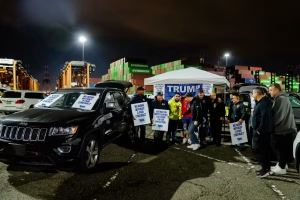
Members of the Longshoremen’s union began picketing this week.

Dockworkers typically earn a six-figure annual salary because of work rules and overtime requirements. More than half of  dockworkers at the Port of New York and New Jersey earn more than $150,000, with 1/5 earning over $250,000. Republican lawmakers have stepped up calls for the administration to invoke federal law to keep the ports open. After wages are agreed, the two sides still need to bargain over thorny issues such as expanded use of automation, which the union wants to prohibit.

The walkout shuts down some of the country’s main gateways for imports of food, vehicles, heavy machinery, construction materials, chemicals, furniture, clothes and toys. Big retailers, with their busy fall shopping season just starting to kick in, say that for now they can withstand the slowdown because they brought in products earlier than usual this year and diverted other cargoes to West Coast ports in case of a strike. (Container imports into U.S. West Coast ports expanded 22% over last month).

But a walkout lasting a week or longer would push up shipping costs and might trigger product shortages. A strike lasting even one week would tie up ships for much longer periods, which could exacerbate shipping delays, eat up capacity and drive up freight rates, leading to logistical challenges for businesses relying on East Coast and Gulf ports. About 60% of containerized trade moves through these ports where dockworkers last year unloaded about $588 billion of imports.

One Florida importer that sells asparagus to supermarkets is having to fly in vegetables that would usually arrive by containership. It is adding 50 cents a pound to the prices to cover the higher airfreight costs.

Classroom discussion questions:

  1. What can supply chain managers do in a situation such as this?
  2. What are the major issues behind the strike?


OM in the News: The Role Ports Play in Global Supply Chains

I am taping a podcast in a few weeks with an executive of the Port Of Philadelphia (PA), and in preparation have been learning about how ports operate and how efficient they are.

Maritime transport, it turns out, forms the foundation of global trade and the manufacturing supply chain. The maritime industry provides the most cost-effective, energy-efficient, and dependable mode of transportation for long distances. More than 80% of global merchandise trade is transported via sea routes. A considerable and increasing proportion of this volume (35% of total volumes and 60% of commercial value) is carried in containers.

Containerization brought about significant changes in how and where goods are manufactured and processed, a trend that is likely to continue with digitalization. Major container ports, of which there are 405 in the world, are critical nodes in global supply chains and essential to the growth strategies of many emerging economies. The development of high-quality container port infrastructure operating efficiently has been a prerequisite for successful export-led growth strategies. Such ports facilitate investment in production and distribution systems, expand manufacturing and logistics, create jobs, and raise income levels.

But inefficient ports and terminals cause shipment delays, disruptions in supply chains, additional expenses, and reduced competitiveness. The negative effect of poor performance in a port can extend beyond as container shipping services follow a fixed schedule with specific berth windows at each port of call on the route. Poor performance at one port can disrupt the entire schedule. This, in turn, increases the cost of imports and exports, reduces country competitiveness, and hinders economic growth.

Comparing operational performance across ports has been a major challenge for improving global value chains. But new technologies and industry willingness to work toward systemwide improvements now provide an opportunity to measure and compare port performances (such as vessel time in port) in a reliable manner. The World Bank and S&P’s Global Market Intelligence have recently produced the 2023 Container Port Performance Index (CPPI).

The top-ranked container ports in the CPPI 2023 are Yangshan (China), followed by Salalah (Oman), Cartagena (Columbia), and Tangiers (Morocco). Where do U.S. ports fall in the rankings? None are in the top 10%: Charleston (53), Philadelphia (55), Miami (77), Boston (75), Wilmington (81), NY/NJ (92), Jacksonville (99), New Orleans (167), Mobile (173), Baltimore (189), Tampa (219), Honolulu (224), Virginia (301), Houston (312), Seattle (360), Long Beach (373), LA (375), and Savannah (395).

Why don’t our ports rank higher? Good question. Listen to our upcoming podcast and find the answer!

Classroom discussion questions:

  1. Why is port efficiency an important OM issue?
  2. Why do you think the U.S. ports are not the most highly ranked?

OM in the News: Maritime Supply Chains Begin to Break

Tugboats guide the MSC Mia container ship arriving at the Port of Los Angeles i

There have been delays once again in processing ships at the Ports of Los Angeles and Long Beach. One shipping expert told CNBC (June 9, 2023) that current vessel wait times are stressing the maritime supply chain in a way not seen since the Covid peak. The number of vessels due to dock at these two major ports is increasing as labor slowdowns on the West Coast have impacted supply chain operations, from trucks to rails and ocean carriers. Some docked vessels are now occupying space for as many as 9 days.  Vessels have yet to be loaded/offloaded and sent away, which is critical to make room for the next wave of ships arriving.

At the Los Angeles area ports, the CGN Lyra has been at the dock since May 31;  CGM Amerigo Vespucci has been there since June 1; YM Unicorn since May 31; and One Hangshou Bay since June 2. When ships go off schedule, the delays slide the arrival to additional ports, impacting their container deliveries, and ultimately contributing to container congestion, which was seen in the extreme during the Covid pandemic.

These developments come as shipping enters it peak inventory build season ahead of back-to-school and the holidays, a period which runs from July to October.

Inflationary spikes from new supply chain hiccups are a fear. Vessel delays, while up recently, are nowhere near the Covid port “parking lots.

Throughout the recent spike in labor tensions, some union workers have refused to show up for shifts, while others have been pulled off the job by port management. The Port of Seattle relieved union labor gangs working on vessels for the third day in a row due to “low productivity.” In maritime terms, a terminal can “fire” a labor gang for one shift if they perceive the work to be slow, and the workers can return the next day. The Port of Tacoma reports worker productivity at 50%, and my coauthor Chuck Munson tells me his new car has been caught up there. It was supposed to arrive several weeks ago.

Classroom discussion questions:

  1. What are the OM implications of a slowdown in West Coast ports?
  2. How bad was the port congestion during Covid? (Hint: see prior posts for details).


Guest Post: Supply Chains and Transportation Options

Prof. Howard Weiss is providing Guest Posts while I am travelling abroad.

There have been many articles detailing the supply chain problems at the California coast. In particular, this blog has an article detailing the ship backup at ports and an article detailing the recent unclogging at those ports. There are three main methods for manufacturers to acquire capacity for shipping their goods. They can contract out for space from a shipping company; they can charter an entire vessel; or they can own their own container ships.

Several large companies have recently changed from booking space with a shipper to chartering entire vessels. These include Amazon, Ikea, Walmart, Costco, Target and Home Depot for some of their shipping. For example, chartering accounts for roughly 25% of Costco’s shipping from Asia to North America. Chartering a ship gives these companies control over the sailings because as Target states, “As co-managers of the ship, we can avoid delays from additional stops and steer clear of particularly backed-up ports.” Another possible problem with contracting space is that the shipping company may not honor a contract as OJ Commerce, a furniture distributor, found out when Hamburg Süd shipping said it had no room on its vessels even though OJ Commerce had a contract with Hamburg Sud.

To gain even more control, some companies, such as Walmart, are chartering smaller ships in order to be able to use smaller ports. The tradeoff to chartering smaller ships is that it increases the shipping costs, which range in the area of $40,000 per day for vessels carrying 3,000 twenty-foot containers. In addition, some of these companies are also purchasing their own containers, which gives the company more flexibility but is costlier.

Others are going a step further than chartering by starting their own shipping line. For example, Lidl, the giant German retailer (with 11,000 stores in 32 countries and more than 200 warehouses in 30 countries), is starting its own shipping line in order to have more control over the transportation of its goods. It decided that this was preferable to other options. The obvious purpose is to reduce shipping delays but the new line should also reduce freight costs and increase shipping consistency and flexibility.

Classroom discussion questions:
1. Use Google to name Lidl’s major competitors.
2. What is a possible downside of chartering or owning your own ship?

OM in the News: Port Supply Chains Unclog

Back in January, 109 container ships waited off the California coast to unload cargo in Los Angeles and Long Beach, the nation’s two largest ports. Consumers, stuck at home amid the pandemic, had unleashed an avalanche of orders for goods that overwhelmed factories and ports.

A container ship is unloaded at the Port of Los Angeles

Importers were paying $20,000 to send a single container from China to the U.S. — sometimes more than the goods inside were worth. Businesses had to backorder everything from bedroom furniture to kitchen fryers, if they could get them at all.

These days? No freighters are lingering off the Southern California coast. Containers from China go for just $2,000. Restaurants can order fryers and have them delivered in a couple of weeks.

The supply backlogs of the past two years — and the delays, shortages and outrageous prices that came with them — have improved dramatically since summer, reports AP News (Dec. 7, 2022). “We are in a very different place than we were,” said a supply chain exec. “If you ask, how long does it take to move stuff, there has been notable improvement. If you measure it by how long would it take to get a cargo from Asia to a destination port, dramatically better.”

The web of factories, railroads, ports, warehouses and freight yards that link goods to customers have nearly regained their pre-pandemic levels. The main factor behind the improvement has been diminished demand for manufactured goods. And having splurged on everything from lawn furniture and sporting goods to appliances and electronic gear during the COVID shutdowns, consumers have increasingly shown a desire to venture out and spend on experiences rather than goods. Demand has shifted toward services — restaurant dinners and plane tickets, hotel rooms and entertainment.

At the sprawling Southern California ports, the shipping backup has eased, in part because companies have sent cargo to Gulf Coast and Atlantic ports to avoid delays. Port Houston says its cargo volume is up 18% from this time last year. In addition to the reduced demand that has lightened the strain on supply chains, ports have become more efficient. Additional ships have increased the transportation options.

Classroom discussion questions:

  1. What caused the longstanding backlog at California ports?
  2. What options did operations managers have when unloadings were delayed by many weeks?

OM in the News: Shanghai’s Covid Lockdown Leads to Logistics Disarray

Transport of goods into one of China’s biggest manufacturing and export hubs has almost ground to a halt, reports The Wall Street Journal (April 21, 2022). As Shanghai’s lockdown to stamp out a raging coronavirus outbreak extends into its fourth week, logistics services in that industrial area have faced severe disruptions.

Containers piled up at the port of Shanghai.

Trucking has been the worst hit, as strict local pandemic policies and arbitrary implementation of rules choke off the transport of goods. At Shanghai’s port, normally the busiest container port in the world, empty containers are stacked on docks waiting for trucks to deliver cargo.

The logistics snarls in and around Shanghai further add pressure to an already battered global supply chain and to rising prices of goods in the U.S. They also complicate the Chinese government’s efforts to reopen factories shuttered due to lockdowns. Logistics managers expect weeks to months before some international shipments return to normal.

On April 1, Shanghai authorities locked down the entire city to stem the spread of the virus, asking its 25 million residents to stay at home. This stringent act has had a ripple effect on businesses in the nearby region, an area of more than 160 million people. The region accounts for a fifth of China’s national gross domestic product. Daily truck volumes moving through Shanghai were down 70%  compared with last month. Trucking costs have risen significantly as requirements for a negative Covid test result within 48 hours of travel and a host of bureaucratic approvals have discouraged truckers from taking loads to Shanghai.

Completed goods are accumulating in factories because of trucking delays and warehouse closures, while others have halted production after delivery of raw materials and supplies were disrupted. The trucking snafu has spilled over into other logistics areas. While Shanghai’s port remains operational, the shortage of trucks that could deliver cargo there meant containers were increasingly lying idle.

While the lull in Shanghai’s port activity would give overworked ports in the U.S. and Europe some breathing room in the short term, in the longer term, Shanghai’s cargo buildup is a bubble waiting to burst.

Classroom discussion questions:

  1. How does this impact U.S. supply chains?
  2. Why the stringent lockdown?

OM in the News: Spring Is Here but Sandals and Shorts Aren’t

Seasonal items are slow to hit store shelves at Luluemon

It is almost spring, yet many retailers are still waiting for deliveries of shorts, sandals and other warm weather gear, a sign that the supply-chain problems of the past two years haven’t abated. It is estimated that retailers will see average delays of one to two months on shipments this spring.

Retail chains, including Lululemon Athletica, Kohl’s, and Abercrombie & Fitch, said that supply-chain delays hurt holiday sales. Those problems are continuing well into the new year.

Macy’s said the chain is facing shortages of women’s shoes, handbags and toys. “There’s still a fair amount of supply-chain disruption when you think about between 60 and 70 vessels still anchored off Long Beach in L.A. trying to get in,” says the Foot Locker CEO.

Exacerbating the crunch is strong consumer spending that is pitting surging demand against limited supplies, writes The Wall Street Journal (March 10, 2022). After two years of Covid-19-related restrictions, retailers are betting that consumers are eager to update their wardrobes as they head back to the office, travel and attend more social engagements.

While large chains such as Walmart and Home Depot worked to sidestep some of the delays by chartering their own ships, the problem now is less about transporting goods across the ocean and more about a shortage of truckers in the U.S. Many chains are placing orders with overseas factories earlier, and paying hefty sums to fly the goods to the U.S. But that isn’t necessarily solving the problem, and it ties up capital in inventory.

As of last month, Untuckit was waiting for 177,000 items that should have arrived at the end of December, equating to about $15 million in lost revenue. For the spring, Untuckit bumped up orders by two months and is flying in goods for as much as $10 a shirt.

Classroom discussion questions:

  1. What are the signs that supply lines will improve this year?
  2. Signs that they will stay strained?

OM in the News: What’s Really Behind all the Empty Shelves?

Pictures of more than 70 container ships anchored near the government-owned ports of Los Angeles and Long Beach, which process 40% of all containers of goods entering the U.S., are all over the news. Thousands upon thousands of containers are onboard, full of everything from car parts to baby diapers. New ships arriving there are facing 3-week delays in unloading and processing. The system is in crisis mode, writes The Daily Signal (Oct. 29, 2021).

Meanwhile, Americans are facing shortages. Schools are having a hard time sourcing food for lunch programs. Food producers are missing inputs for packaging, while small businesses are facing shortages of bulk items like utensils, cups and to-go boxes. The government attributes these delays and shortages to worldwide factory disruptions during the pandemic and increased consumer demand. While these play a role, that is not the whole story.

What led to this crisis is a system of government-imposed regulations and red tape that seemed innocuous when the economy was healthy. A series of barriers in California, and at the federal level, prevented the market from responding efficiently to the demand at the ports. First and foremost, union hour rules for longshoremen and truckers have resulted in port operations not matching the influx of ships. The Port of LA has been operating at only 60%- 70% of capacity, closed evenings and Sundays. While Long Beach promised months ago to go 24/7, it’s still only running 4 days per week.

At the same time, California law is restricting independent contractors, which includes many truckers, from stepping in. And that state’s new emissions mandates limit the number of trucks able to even operate there. Amid such rules, California now has half the trucker density as states such as Texas, Pennsylvania and Ohio. To add insult to injury, these 2 ports just announced a new fine system for containers that remain at the ports too long, even though there aren’t enough trucks on the road to transport the containers. An impending vaccine mandate could worsen the ports’ labor shortage.

Classroom discussion questions:

  1. What are the the solutions?
  2. What other factors (besides the ports) are creating these supply chain problems?

OM in the News: Shipping Woes Snarl Global Supply Chains

Congestion at Ningbo is spreading as big operators divert ships away from Ningbo.

A major container terminal at China’s Ningbo Port remained shut a week after operations were suspended from a single Covid-19 case, with dozens of ships lining up to load cargo for western markets ahead of the year-end shopping season. The congestion is spreading to other ports like Shanghai and Hong Kong as big operators divert ships away from Ningbo.

The cascading effect will lead to crowding at ports along the Asia-to-Europe and trans-Pacific routes that could further slow the flow of goods. writes The Wall Street Journal (Aug. 21-22, 2021). It will also hit cargo owners from giant retailers like Walmart and Amazon to mom-and-pop shops, which will have to deal with late deliveries and higher transport costs as they work to restock ahead of the holidays.

Ningbo is the world’s third-largest container port and a big gateway for Chinese exports like furniture, home goods, toys and auto parts headed to markets in the U.S. and Europe. A growing number of Chinese warehouses are filled with finished goods they can’t ship out as containers and shipping costs keep surging.

About 10% of the global container capacity is stacked on ships stuck outside congested ports. The backlog has stretched across the Pacific Ocean to the ports of Los Angeles and Long Beach, which together handle 1/3 of all containers coming into the U.S. Thirty-seven container ships were anchored outside those two ports this week. Other congested ports include NYC and Savannah, the Netherlands’ Rotterdam, and Antwerp in Belgium.

The lack of capacity is pushing big American retailers to charter their own ships rather than pay freight rates that have quadrupled since the start of the year. Daily freight rates for sailings from China to the U.S. West Coast are now at $16,425 per container compared with $3,886 at the start of the year. Rates from Asia to Europe are at $14,038 up from $5,662 in January.

Classroom discussion questions:

  1. What techniques in Supp. 11 of your Heizer/Render/Munson OM text can be used to address this problem?
  2. What other global factors have impacted ports and created logjams?

OM in the News: Your Long Wait for Packages

Global supply chains are buckling, driving up prices, creating shortages and frustrating consumers. If at any point in the past 7 months you looked out to sea from the LA-Long Beach container port complex, the largest in the U.S., you would see the problem: up to 40 container ships anchored, with nowhere to go. There’s no space in the clogged ports. To put it another way, you’re looking at as many as 100,000 containers—holding everything from running shoes and home electronics to frozen seafood and furniture—waiting to be unloaded and then shipped to factories, stores and homes across the country.

U.S. ports are severely stressed, a problem that won’t disappear with the pandemic, writes The Wall Street Journal (June 3, 2021). Not one U.S. port was represented in the top 50 container ports globally in productivity performance. Why? The answer comes down to a complicated transportation market. Capacity is deployed according to shifting company and investor calculus, a complex system of handoffs between land and sea that has long resisted coordination.

There are no solutions in sight. In Asia, ships are worked 24/7, or 168 hours a week, compared with 16 hours a day, or only 112 hours a week, at LA-Long Beach. Terminal gates used by truckers to deliver and receive seaborne containers operate only 88 hours a week, vs. 168 in Asia. For larger ships, it takes 24 seconds on average to move a container at the Chinese ports, vs. 48 seconds at LA That leaves the port system chronically vulnerable to unanticipated volume surges.

Global Supply Chains Pressures

Longshore labor relations also hinder improvements in productivity. A decades-long history of toxic labor-management relation has led to huge cost increases that discourage operators from expanding work hours, limit their ability to automate terminals, and end in avoidable delays during contract negotiations. And there is no sign that this labor-management paradigm will change with the new pro-union presidency.

Classroom discussion questions:

  1. Why does productivity lack at US ports?
  2. What can the US do to unclog ports?

OM in the News: The Global Supply Chain Is a Mess

Supply chain woes mounted world-wide for makers of everything from cars and clothing to home siding and medical needle containers, reports The Wall Street Journal (March 18, 2021). The extreme Texas weather and port backlogs compounded problems for manufacturers already beset by pandemic disruptions.

Toyota and Honda were the latest multinationals to chime in about setbacks, with the two auto makers planning to halt production at plants in North America. Toyota cited a shortage of petrochemicals, manufacturing of which has been hobbled by last month’s Texas freeze. Honda pointed to a combination of port issues, the semiconductor shortage, pandemic-related problems and the crippling U.S. weather. Samsung, one of the world’s largest smartphone and chip makers, was just forced to idle two chip factories in Austin, Texas, representing 28% of Samsung’s total output.

ships in port of la

The disruptions underscore how several forces are coming together to squeeze the world’s supply chains, from the pandemic-driven rise in consumer demand for tech goods to a backlog of imports at clogged California ports to U.S. factory outages caused by weather woes. They are creating cost increases and delays for numerous industries. The disruptions, which come as the U.S. and other economies are beginning to lurch toward normalcy, show how messy the reopening of business is proving to be a year after pandemic’s onset, and how vulnerable supply chains remain.

Last month’s freeze in Texas was the latest plank on the pile. The state is home to the world’s largest petrochemical complex, which turns oil and gas and its byproducts into plastics. The February freeze triggered mass blackouts that shuttered plants, many of which remain offline.

Meanwhile, the California ports of Los Angeles and Long Beach (shown in the photo), which together handle more than a third of U.S. container imports, remain inundated from an inventory restocking drive that began late last year and has picked up steam in 2021. Lengthy backlogs that at one point left some 40 vessels anchored offshore waiting for dock space. 

Classroom discussion questions:

  1. What are the major issues confronting global supply chains?
  2. What options do companies have when dealing with multi-week backups at U.S. ports?

OM in the News: Massive Robots Keep Docks Shipshape

. Cargo containers are carried around the Port of Los Angeles by automated machines guided by a magnetic grid embedded in the pavement. Autonomous “straddle carriers,” as they are known, pick up containers that have just come off the ship, and transport them to stacks to be organized. Automated machines pick up and carry cargo containers to stacks at the Port of Los Angeles, guided by a magnetic grid embedded in the pavement. A back-end technology system runs this robotic crane that sets containers in place in long stacks and retrieves them when truckers arrive to pick up the cargo. Cameras on the stacking crane assist workers in the port terminal office, guiding each container the last few feet to rest on a truck bed. Inside the port terminal office, a worker gently sets containers on truck beds using a joystick and live images of the machinery. On average, he loads more than one truck a minute in this way. Once they are off the ship, cargo containers at the TraPac terminal in Los Angeles are transported entirely by robots until they are set on trucks and carried off the terminal. Automated machines carry cargo containers around the TraPac marine terminal. Robotic cranes set containers in long stacks and retrieve them to load onto trucks. Cargo containers are carried around the TraPac marine terminal at the Port of Los Angeles by automated machines guided by a magnetic grid embedded in the pavement. PreviousNext 2 of 9 fullscreen Robotic cranes set containers in long stacks and retrieve them to load onto trucks. PATRICK T. FALLON FOR THE WALL STREET JOURNAL Autonomous “straddle carriers,” as they are known, pick up containers that have just come off the ship, and transport them to stacks to be organized
.
Cargo containers are carried around the Port of Los Angeles by automated machines guided by a magnetic grid embedded in the pavement.

At one of the busiest shipping terminals in the U.S., more than two dozen giant red robots wheeled cargo containers along the docks on a recent morning, handing the boxes off to another set of androids gliding along long rows of stacked containers before smoothly setting the boxes down in precise spots. The tightly designed dance at this Los Angeles terminal offers a window on how global trade will move in the near future: using highly automated systems and machinery, with minimal human intervention, to handle the flood of goods that new free-trade agreements will push to the docks.

“Automation, which boosts terminal productivity and reliability while cutting labor costs, is critical to the ability of ports to cope with the surging trade volumes and the huge megaships that are beginning to arrive in the U.S.,” writes The Wall Street Journal (March 28, 2016). Technology can reduce the amount of time ships spend in port and improve productivity by as much as 30%. At a cost of over $1 billion to complete and the capacity to handle 3.3 million 20-foot container units—nearly half of the L.A. port’s volume last year— automation is a big bet on the future.

The U.S. has been slow to adopt the technology because of years of resistance by longshore labor unions. Some studies have shown robotic cargo handling can reduce the need for longshore labor by as much as 50%. In 2002, the issue came to a head as West Coast port employers locked out workers during bitter contract talks, shutting down the Pacific ports for 11 days.

Ports elsewhere have seen the investment pay off. An automated terminal in Rotterdam uses about half the labor needed at its conventional terminal at the same port.

Classroom discussion questions:

  1. What are the advantages and risks of port automation?
  2. Why the need to automate now?

OM in the News: Global Supply Chains and the Port Gridlock

port delaysThe labor dispute that caused months of gridlock at West Coast ports may be over, but the disruption is expected to redraw the trade routes that goods take to reach U.S. factories and store shelves, reports The Wall Street Journal (Mar.6, 2015). About 1/2 of all U.S. cargo has flowed through these ports, including imports as diverse as sneakers, soy sauce and auto parts. But over the past year, supply-chain managers have increasingly shifted cargo to ports on the East Coast, Gulf Coast and in Western Mexico and Canada in attempts to avoid growing congestion resulting from union slowdowns.

This is bad news for West Coast ports, truckers and railroads already worried that the expansion of the Panama Canal, due for completion next year, would begin to divert more business to the East Coast. Already it is expected to take 3-6 months for West Coast ports to return to normal (29 ships are still anchored outside the LA area ports).

Supply-chain flexibility has become increasingly important since the 2008 economic crash, as businesses have become more focused on keeping inventories lean and scheduling deliveries to arrive just as they are needed. Decisions are made on a day-to-day basis, with the most sophisticated shippers tracking progress of their shipments via cloud-based technology.

The West Coast port chaos is just the latest event prompting shippers to both diversify transportation modes and ports. Hurricanes, a tough winter, or labor issues all can trigger severe product delays or even empty shelves, costing companies tens of millions of dollars. The biggest shippers, including Wal-Mart, Home Depot, and Target, have employed for years what is known in the industry as a “4-corner strategy,” in which networks are expanded to include warehouses at northern and southern ports on both coasts and the Gulf of Mexico. Now even smaller companies are diversifying.

Classroom discussion questions:

1. What is the 4-corner strategy and why is it being used?

2. Why are supply-chain managers concerned about the West Coast port slowdowns?