
 Today’s Guest Post is by Dr. Robert Donnelly, Professor of Management at Goldey-Beacom College, in Delaware, who describes one exercise he uses to teach LP (Module B).
One of the challenges of teaching linear programming is the intangible nature of the topic which causes many students to have anxiety. One method that I use in my LP class is to pass out 6 large and 8 small Duplo-sized Legos to small groups of students and ask them to build tables and chairs. This is an example of a product mix problem with the objective of maximizing profit.
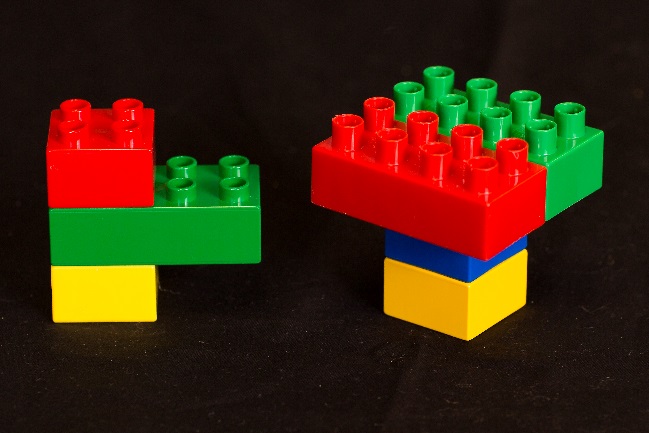 As you can see, each table has 2 large and 2 small blocks while each chair has 1 large and 2 small blocks. Each table contributes $16 in profit while each chair contributes $10 in profit.
|
Tables |
Chairs |
Availability |
|
| Large Blocks |
2 |
1 |
6 |
| Small Blocks |
2 |
2 |
8 |
| Profit |
$16 |
$10 |
I start a class discussion on the feasible solutions that were discovered along the way to the optimal solution, which is to produce 2 tables and 2 chairs earning a profit of $52.
|
Tables |
Chairs |
Profit |
|
0 |
4 |
$40 |
|
1 |
3 |
$46 |
|
2 |
2 |
$52 |
|
3 |
0 |
$48 |
I solve this problem graphically showing the 4 corner points and the optimal solution.
I introduce shadow prices by offering the students an additional large block and ask how much they are willing to pay for it (answer = $6). I show a second large block and ask how much the students are willing to pay for it (answer = $6). Finally, I show the students a third large block and ask how much they will pay for it (answer = $0). I lead a discussion on the concept of shadow prices and finally wrap up with solving the Legos problem on Excel.
I find that playing with Legos in class lightens the mood and makes LP more understandable.