Guest Post: The Missing Digit Puzzle

Prof. Andrew Stapleton at U. of Wisconsin-LaCrosse shares this teaching tip to enliven your class

This math puzzle looks a lot more intimidating than it really is. It is called the Missing Digit Puzzle. Pick a student to come to the front and write down a number on the white board or overhead projection. Hide or otherwise cover your eyes in some way so that you can’t see what your student is writing.

Ask your student to secretly write down ANY number (at least four digits long). e.g. 78341
Ask her to add up the digits… e.g. 7+8+3+4+1 = 23 … and then subtract the answer from the first number e.g. 78341 – 23 = 78318
Ask her to then cross out ONE digit from the answer. (It can be any digit except a zero) e.g. 7x318
She then reads out what digits are left e.g. 7-3-1-8. Even though you haven’t seen any numbers, you can say what the missing digit is! EIGHT

THE SECRET:
This great puzzle relies on the power of 9.
After your student has added up the digits and subtracted them, the answer will ALWAYS divide
by 9. If a number divides by 9, then when you add the digits up, they will also divide by 9. If
you check our example 7+8+3+1+8 = 27 which does divide by 9. When she crosses a digit
out, she then reads out the digits that are left. You add them up. In the example we had 7+3+1+8
= 19. All you do now is see what you have to add on to your answer to get the next number that
divides by 9! The next number to divide by 9 after 19 is 27. So, you need to add on EIGHT to
get to 27. This is the number that was crossed out!

Here’s another example:
Say the number written down is 873946284 (yikes!).
Your friend adds the digits 8+7+3+9+4+6+2+8+4 = 51
Your friend does the subtraction: 873946284 – 51 = 873946233
(So far you have NO IDEA what numbers are whizzing around!)
Your friend crosses a digit out 87394x233 and tells you what’s left.
You add 8+7+3+9+4+2+3+3 = 39.
The next number that divides by 9 after 39 is 45. As 45-39=6 this means that SIX is the missing
digit.
You can do this one quickly and even have other students come up and give it a try – and you
will always be able to tell what the missing digit is!

Guest Post: An Impressive Two-Minute Math Challenge to Use in Class

Prof. Andrew Stapleton at U. of Wisconsin-La Crosse shares with us a fun teaching tip.

Kick off your class with this captivating two-minute math trick!
Step 1: Grab a calculator. Ask everyone to take out their calculator or open the calculator app on their phone.

Step 2: Create a six-digit number. Instruct each student to think of any three-digit number and repeat it to form a six-digit number. For example: 729 becomes 729729.

Step 3: The magical prediction.  Invite students to shout out their six-digit numbers all at once. Pretend you’re calculating each one in real-time and confidently declare:
“I am going to calculate quickly and give you three directions and you will never have a remainder. That is, each iteration you will have a whole number. Follow my instructions, and your final result will always be your original three-digit number!”

Step 4: The steps.
Have everyone perform these operations on their six-digit number:
Divide the number by 13 (they’ll get a whole number).
Divide the result by 11 (still a whole number).
Divide that result by 7.
Surprise! Each student ends up with their original three-digit number.

How does it work?
The math is straightforward but seems like magic:

Multiplying a three-digit number by 1001 (i.e., 13×11×7) creates a six-digit number by repeating the original. Dividing in reverse (by 13, then 11, then 7) simply uncovers the original three-digit number.

The real fun? Your dramatic prediction adds flair and mystery, making the trick seem far more complex than it is. Enjoy the “wow” moment as your students are amazed!

Guest Post: “Exploring Fibonacci– A Math Trick with Applications in OM

Prof. Andrew Stapleton, at U. Wisconsin-La Crosse,  provides another interesting exercise to liven up your OM class.

The Fibonacci sequence, introduced by mathematician Leonardo Fibonacci from Pisa, Italy in the 12th century, is a number sequence where each term is the sum of the preceding ones. A typical Fibonacci sequences looks like: 1, 1, 2, 3, 5, 8, 13, 21, 34, and so on. While this is the most well-known version, Fibonacci numbers can begin with any two numbers on the number line as long as they follow the same pattern of addition.

The sequence is closely related to the Golden Ratio, a concept that appears frequently in nature (e.g., in the spiral pattern of shells or of sunflowers) and art (e.g., proportions in Renaissance paintings).

Interestingly, the Fibonacci sequence also has practical applications in Operations and Supply Chain Management. It can be applied in areas such as supply chain network design, forecasting inventory fluctuations, resource allocation, and even in facility layout optimization.

Fun Math Trick using Fibonacci Sequence
Here is an engaging way to explore Fibonacci numbers with your students:
1. Have a student pick any two numbers, say 5 and 4.
2. Add the numbers together (5+4=9).
3. Now, take the second and third numbers (4+9=13)
4. Continue the process for ten steps and calculate the sum.
For example, start with 5 and 4. These yields: 5, 4, 9, 13, 22, 35, 57, 92, 149, 241.
Now calculate the sum of the sequence. The sum is 627.

How to Predict the Sum:
Before calculating, you can impress your students with a neat trick! Here’s how:
 Instead of adding all of the numbers manually, look at the fourth number from the bottom of the list. In this case, it is 57.
 Multiply the number by 11.
57 x 11 = 627 – this gives you the total sum without having to add them up.
This works because the Fibonacci sequences follow a predictable pattern:
This is what the list of numbers will be:

a
b
a + b
a + 2b
2a + 3b
3a + 5b
5a + 8b
8a + 13b
13a + 21b
21a + 34b
The sum is 55a + 88b, which is 11 times the seventh number. Since multiplying by 11 is a relatively simple calculation, this creates a fun and useful math trick to amaze your students and connect math concepts to OM.

Guest Post: Random Number Prediction–A Class Exercise

Prof. Andrew Stapleton at the U. of Wisconsin-Lacrosse shares a teaching tip when discussing random numbers.

Predict a “random number” by alternating four-digit contributions. Start by determining a 5- digit number and writing it down in dark ink on a large piece of paper and sticking it in your briefcase. I act like I am picking random numbers, but I know exactly how to get to the number I have pre-determined.

Here is an example: I tell my class, “Let’s pick some numbers, I’ll start”: 4729 Mine I already know that the final number – the one written on the large piece of paper in my briefcase is 24727.

I then ask for two students to give me each a two-digit random number. The greater the number of participants the greater the impact. Student one chooses “58” and Student 2 chooses “32.” So 5832 yours

4167 Mine I act like I am thinking about another random four-digit number, but what I am doing is making their digits and mine add to 9999. (i.e., 5832 + 4167 = 9999)

I again ask two different students to each give me a two-digit random number. One gives me “69” and the other “02”. So 6902 yours

3097 Mine Again I make theirs and mine add to 9999, but I don’t do it right away. In fact, I act like I am really just pulling my digits out of thin air.

Sum = 24727. I then add all of these together. I tell them I had a dream about what number we would collectively come to in this exercise and wrote it down on a piece of paper and I get it out and unfold it. Once they see it matches, they are baffled and are eager to learn how I did it.

Solution: I simply take my original 5-digit number and subtract 2 from the last digit and put it in front of the first. This is because whatever you choose – I will choose digits that add to 9. So, the second set adds to 9999 and the third set adds to 9999 – just shy of 20000, in fact 19998. So, I subtract those two from the end and stick the “2” in the front.

Guest Post: Interdisciplinary Teaching in Operations Management


Today’s Guest Post comes from Dr. Albena Ivanova, who is Associate Professor of OM at Robert Morris University in Pennsylvania.

If you are tired of teaching the same OM topics every semester, here is a way to spice up your classes. You can pair with another professor from a different discipline to create an integrated interdisciplinary session. Here is what you need to do:

Pick a class that is offered at the same time as your class, so the students can work together. Look in the course schedule and find classes and professors that you can contact.

Talk with the other professor and identify common themes and overlaps between the two disciplines. Determine the topic of the interdisciplinary project.

Decide on the format of the presentation. You can choose a semester long project, one- or two-week project, or just one session. You can do a concert teaching, exchange classrooms, or invite a speaker.

Plan the project steps and class activities.

For example, last semester, we merged Operations Management and History of Art classes for one week to discuss the Dimensions of Quality of an Artwork. In the first session, I presented the dimensions of quality for products and services from an operations perspective and my art colleague presented how the perception of “good” art changed over time and presented to the students 25 pieces of artwork of different “quality”. Then we broke the students into interdisciplinary groups and asked each group to come up with three dimensions of quality with corresponding measures. After the first session completed, we analyzed the results and came up with seven dimensions that were derived from the student responses. In the second session, we presented the results and had an open discussion about the interdisciplinary nature of our classes. Here is the final definition of quality of art for our audience, arranged in the order of importance:

Quality art has meaning, provokes emotions, takes time to create, uses interesting colors and expensive materials, is unique and beautiful

Guest Post: Is Your Class Model Preparing Students for Career Success?

Beverly Amer is President’s Distinguished Fellow in the W.A. Franke College of Business at Northern Arizona University. She is also author of a workbook for college students on practicing soft skills and director of the 45 videos we provide with our text

Chances are good you’ve followed recent trends and have blended or flipped your OM course. Great! You’re modeling the kind of “workplace” students will join when they start their careers. They’ll be expected to source and evaluate resources independently, and come to work with knowledge, ready to contribute. But I suspect you’ve encountered a few bumps along the way, not the least is student confusion about what’s expected of them when so much of the “work” – that which you used to lecture over in class – is squarely on their shoulders.

My flipped undergraduate courses have benefited greatly from what I call a “student responsibility agreement.” It’s a simple syllabus appendix that explains our class model’s role in preparing them for career success, and my expectations of them. We all have classroom expectations, but reframing them along the lines of “career preparedness” can change the lens students use to view how their class behavior now can impact their future. I give this piece of advice: “If you can be the person in the room who not only identifies the problem, but generates 1 or 2 workable solutions, you’ll be viewed as an asset everyone will want on their team.”

So here goes – my list that moves the student from passive recipient of information to active participant in knowledge acquisition: (1) Read syllabus policies and schedules and use a calendar to avoid missed deadlines; (2) Start work on assignments well before the deadline so there’s time to seek help, if needed; (3) Build relationships with classmates for out-of-class work so in-class contributions are more meaningful; (4) Maximize efficiency by figuring out technology needs – and backups – before needed; (5) Don’t waste the time of your instructor by asking questions already answered in FAQ files, the syllabus, or other assignment materials; (6) Technology failures are never an excuse for missed deadlines; and (7) Sending me an email excuse for failure to finish right before a deadline does not guarantee any acceptance of such excuse.

Earth-shattering? Probably not. But laying a foundation of expectations early and explaining why learning to be a self-starter and problem-solver now can only benefit your students later.

Guest Post: A Case for Supply Chain Simulation in Your OM Class

Our Guest Post today comes from Chuck Nemer, who has taught operations management for 16 years at Metropolitan State University in Minneapolis. He is also a SCM trainer and can be reached at http://www.theguruofbiz.com

Here is what I often hear about supply chain management simulations from colleagues teaching OM:

• I want to provide a hands-on approach rather than get lost in theory
• I need to get more engagement from my students
• I need to present real-world challenges and the associated complexities

Using simulations, such as the ones that come free with the Heizer/Render/Munson text, in your classroom gives you all the above, as well as the opportunity to see for yourself that students “get it.” Students get to see not only how vital supply chain is to organizations today, but they can build a career where they touch all aspects of the organization and develop the ability to lead organizations successfully.

My experience has been simulation in the classroom aligns with and supports both the textbook and the body of knowledge for supply chain quite easily and successfully. Exciting to me, is that students walk away from the experience with confidence, and the ability to demonstrate to prospective employers they understand not just what supply chain is. But they also see what needs to be done to make a supply chain improve, grow, and compete successfully at a level greater than just from a textbook and lecture alone. Together, your knowledge, your class content, and the use of a simulation make a very powerful combination that you just have to consider these days where learners live and exist in a technology rich world and thirst for “an experience.” I really hope you will investigate the use of supply chain simulations and consider making them part of your classroom.

Teaching Tip: The Benefits of OM Student Study Groups

Maybe we should be making a stronger pitch for student-led OM study groups. There’s all sorts of research documenting how students can learn from each other, reports Faculty Focus (May 16, 2018). In one recent study (of 463 students at 38 colleges), students said they opted to study with others because the professor encouraged it and their peers invited them. Their groups handled all the meeting logistics and members decided collectively what they would do during the session.

Here’s what’s impressive: the top 3 study strategies students reported using in these groups were asking each other questions, discussing course materials, and quizzing each other. Those are evidence-based strategies. Asking questions and discussing the content are activities that deepen learning, and testing with questions enhances memory by providing retrieval practice. Each of these has substantial empirical support with regard to benefits for long-term retention, falling into the category of “desirable difficulties.”

And there’s more good news. The data showed that a student’s GPA correlated positively with how frequently study strategies such as making outlines, flashcards, study guides, and short, but frequent, group meetings took place. Students said they chose to study with others in hopes it would improve their understanding of the material. And most of them reported that it did. More than 60% said their level of learning in study groups was somewhat more or a lot more than they learned when studying individually. Almost 70% said that being in a study group increased their motivation to study.

Some tips for your students: (1) use small groups (3-5 max); (2) studying with friends is good, but bringing in outsiders deepens understanding; (3) meet often, but for short periods; (4) expect group members to come prepared; (5) explain things to each other and practice doing problems; (6) don’t just “go over” or reread class notes or text material, and don’t recopy notes.

Guest Post: MyOMLab and Partial Credit

howardweiss2Our Guest Post today comes from Howard Weiss, who is Professor of Operations Management at Temple University. Howard has developed both POM for Windows and Excel OM for our text.

I have used MyOMLab with the Heizer/Render/Munson text for over 6 years now. One option on assignments in MyOMLab is to “Allow partial credit on questions with multiple parts.”  In other words, a student does not need to get every part correct on a question to receive credit. This is only one aspect of partial credit and because I use MyOMLab for exams I need to allow for other types of partial credit.

For example, I commonly see students making these mistakes:  Forgetting the initial inventory in aggregate planning;  Maximizing instead of minimizing in LP;  Entering the service time instead of the service rate in waiting lines;  Not converting one time unit to another in line balancing;  Not converting months to years in inventory; Not multiplying by the cost per unit in layout.

For some of these mistakes, all answers would be incorrect and MyOMLab would give the students a zero for each problem. When I used to grade exams by hand, I would typically identify the mistake and give the student partial credit on the problem.

I now tell the students that they must save all of their work on the problem, which in my case is an Excel file. I encourage the students to review their exam results and to send me an email if they think they deserve partial credit on the problem. They must include their original Excel file with the incorrect work so that I can see that it matches the answer they entered into MyOMLab, an explanation of the mistake that they made, and the correct way to solve the problem. I typically give half credit on the part of the question for students who successfully do this. Many of my students take advantage of this option. They, of course, want the exam points and, I, of course, want them to learn from reviewing the exam.

Teaching Tip: Five Ideas for Ending Your OM Semester

classIts often been said that first and last class sessions are the bookends that hold a course together. Here are a few ideas from Faculty Focus (April 13, 2016) that might help us finish the semester with the same energy and focus we mustered for the first class.

Integrate the Content—Let the students bring it all together by integrating the major concepts, important ideas, and a few significant supporting details of the OM course. Perhaps they will follow the 10 operations decisions around which we build the text.

Review for the Final—Make the students do the work. Students are often at a loss when it comes to knowing how to study for comprehensive finals. Devote some time to working with them to develop a study game plan. What’s the best way to review notes?

Get and Give Useful Feedback—Although colleges have moved toward online course evaluations, use this last class to get and give a different sort of feedback. For example, create a list of every assignment students completed during the semester. Ask what you should stop, start, or continue doing. Or give students feedback on how you experienced the course. Share 5 things you’ll remember about this class and one thing about teaching you’ve learned from these students.

Bookend Activities—Tie the end to the beginning. Ask students what reasons justify making this a required class. (You don’t have to think they’re good reasons.)

Celebrate—It’s been a long semester. Get everybody walking around, talking, telling stories. Be part of the crowd. Shake hands; pose for selfies. Bring snacks or invite students to contribute snacks. This is a unique collection of individuals who will never again be together with you and the course content. End with applause and say “Thank you” if it’s a class that’s made you thankful.

Guest Post: Class Discussion–From Blank Stares to True Engagement in Your OM Class

jay howardOur Guest Post comes from Dr. Jay R. Howard, who is the dean at Butler University. His most recent book is Discussion in the College: Getting Your Students Engaged and Participating in Person and Online (Josey-Bass, 2015). 


Thirty years of research have demonstrated that when students are engaged in the classroom, they learn more. Classroom discussion is likely the most commonly used strategy for actively engaging students. Yet there’s always the possibility that our invitation for students to engage will be met with silence.

Sociologists have long contended that our behavior is guided by norms. Professors believe that one classroom norm is that students are expected to pay attention. But in most college classrooms students are not required to pay attention. The real norm is paying civil attention—or creating the appearance of paying attention. Students do this in a variety of ways. They write in their notebooks, nod their heads, make fleeting eye contact, and chuckle when the professor attempts to be funny. Why can students get away with only paying civil attention? The answer is that we as faculty let them.

We believe they should be self-motivated to complete assignments and prepare for class. Therefore, we don’t embarrass students into preparing for and participating in discussion. The result is that students can safely slide by, paying only civil attention in most college classrooms.

How do we get students to move beyond civil attention to true engagement in our OM classes? Perhaps the most effective strategy is allowing students to formulate their thoughts prior to being called on to verbally participate. The think-pair-share classroom assessment technique is one example: Ask students to take one minute and write a response to a question. Then ask students to share their thoughts. Another strategy is to structure your course so it requires students to come to class having read an assignment and prepared a short response paper or answer an on-line JIT quiz. In these ways, faculty can create new classroom norms, replacing the norm of civil attention with the expectation that all students come prepared to participate in classroom discussion.

Video Tip: Starting Your Fall Semester With Videos

magicStarting about 20 years ago, with our 6th edition, Jay and I began developing a series of company video and cases. They have ranged  from manufacturers of potato chips, boats, and ambulances, to service firms like a hospital, an NBA team, Red Lobster, and Hard Rock.  The videos are brief (5 – 12 minutes) and tie directly to the content of a specific text chapter.  There may be as many as seven videos on one company (such as Arnold Palmer Hospital or Hard Rock Café) and students seem to like following one or two organizations throughout the text/semester.  We are very pleased, that over the years, our 35 videos have won many awards, including 2 Silver Addy’s for the best short video, selected from 10,000’s of entries each year. We are even up for an Emmy award for one of our Orlando Magic videos!

hard rockI have always started the first week of the semester with one or both of the following:  Hard Rock Café: OM in Services (8 minutes) and Frito-Lay:  OM in Manufacturing (7 minutes).  The first shows how a service firm that is known throughout the world approaches some of the 10 OM decisions around which we structure the text.  This firm is especially interesting because it is a lot more than a restaurant. We show that Hard Rock makes almost the same revenue from its small retail shops as it does from the food side of the house.

The second video provides a perfect contrast to Hard Rock and makes for a great class discussion on how manufacturers differ from service firms.  Frito-Lay is also a product everyone knows.  But this company does not let outsiders in to tour, and has proprietary processes that even we were not allowed to film.  This video reviews how Frito-Lay deals with all 10 of the decisions that OM managers have to make.

I hope our video series helps get your Fall, 2015 semester off to a successful start. And there is more to come, as we introduce five new videos featuring OM at Alaska Airlines in January, 2016!

Guest Post: Building Furniture in a Linear Programming Class

Bob DonnellyToday’s Guest Post is by Dr. Robert Donnelly, Professor of Management at Goldey-Beacom College, in Delaware, who describes one exercise he uses to teach LP (Module B).

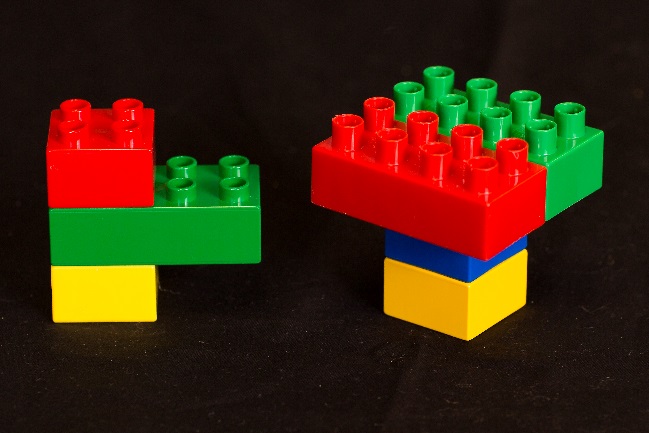
One of the challenges of teaching linear programming is the intangible nature of the topic which causes many students to have anxiety. One method that I use in my LP class is to pass out 6 large and 8 small Duplo-sized Legos to small groups of students and ask them to build tables and chairs. This is an example of a product mix problem with the objective of maximizing profit.

LP exampleAs you can see, each table has 2 large and 2 small blocks while each chair has 1 large and 2 small blocks. Each table contributes $16 in profit while each chair contributes $10 in profit.

Tables

Chairs

Availability

Large Blocks

2

1

6

Small Blocks

2

2

8

Profit

$16

$10

I start a class discussion on the feasible solutions that were discovered along the way to the optimal solution, which is to produce 2 tables and 2 chairs earning a profit of $52.

Tables

Chairs

Profit

0

4

$40

1

3

$46

2

2

$52

3

0

$48

I solve this problem graphically showing the 4 corner points and the optimal solution.

I introduce shadow prices by offering the students an additional large block and ask how much they are willing to pay for it (answer = $6). I show a second large block and ask how much the students are willing to pay for it (answer = $6). Finally, I show the students a third large block and ask how much they will pay for it (answer = $0).  I lead a discussion on the concept of shadow prices and finally wrap up with solving the Legos problem on Excel.

I find that playing with Legos in class lightens the mood and makes LP more understandable.

Teaching Tip: First Day of Class

The first day of class is critical,” writes Faculty Focus (Aug. 12, 2013). What happens sets the tone for the entire course. The impression you make will last the entire semester, and today’s students are not shy about sharing their opinions. That is why you must use the 1st day to inspire confidence in your abilities and create a classroom atmosphere where the rules are clear: expectations are high, and yet students feel welcome, comfortable, and engaged.

By starting the very first day of the term with clear routines and expectations, with easy procedures such as the “Today We Will” list, students learn that the class is well-organized and that they can achieve success through class attendance, preparation, and participation. You can maximize instructional time and minimize classroom management efforts.

The “Today We Will” list goes up on the board at the start of class and it stays there the entire time. The list lets students know what will be covered that day. They can glance at it to check progress or to see if they missed any big concepts. The list also keeps you on task. As you move around your classroom lecturing, the list is a visual reminder of what you need to accomplish in that period. It also reminds students that they are accountable for the day’s material whether they are present in class or not. For example, if  #1 on the list is “We will go over 3 questions that are on the midterm,” and a student missed the first 15 minutes of class, she will want to get that material from you or another student. So a thoughtful list will motivate students to attend class, arrive on time, and compensate for class time that they miss. If students have really grasped a concept more quickly than you expected, you can add items to the list.

However, the list is fairly standard on the first day of class. It contains the following 5 things: (1) Do what’s on the screen, (2) Introduce yourself, (3) Review syllabus completely, (4) Have lesson, (5) Conclude with preparation expectations for next class.

Guest Post: A First Day of Class OM Exercise

steve harrodDr. Steven Harrod is Assistant Professor of Operations Management at the University of Dayton. Today, he shares a tip on teaching critical thinking.

For many students, OM is an intimidating field of study–the first course that blends mathematical methods with qualitative decisions. For example, queuing theory is clearly mathematical, but choosing which queue structure is often a subjective decision. Today’s hot topics of “big data” and analytics require problem formulation skills, so I begin the OM course with an exercise to promote critical thinking. In particular, I seek to train my students to formulate decision questions in quantitative terms. I pose the question repeatedly, “What are the measurements?”

I motivate this discussion with a news story on health care, specifically, whether a surgically inserted stent or drug therapy is a better choice for patient care. First, I introduce the topic and instruct the students to think carefully about the news story. I ask them: Who are the stakeholders? Who are the decision makers? What are the objectives? What are the measurements?  And finally: What defines success? I then play the news story audio (which is found here).

Almost invariably, initial student answers will be vague, such as “improve the quality of health care” or “provide high quality care.” But drill the students to focus on tangible measures. Ask: “How do I measure that?” After some dialogue, you should reach agreement on more precise measures such as life expectancy, death in surgery, cost of treatment, cost of drug, duration of treatment, etc.

The news story presents this question as an argument between a Dr. Teirstein and a Dr. Topol, but after working through these discussion questions, you will find the real conflict between these doctors is over the choice of objectives and measures. Dr. Topol’s primary objective is lower cost, but Dr. Teirstein’s is fast treatment. This discussion is in fact a prelude to future topics in the course. In so many areas of OM, cost and speed are fundamental tradeoffs. No where is this more evident than in the study of queuing theory (Module D). Thus the debate over healthcare is at its root a debate over the balance between fundamentally opposed performance measures.

A detailed teaching note for this lesson is available here.