OM in the News: McDonald’s Tries AI a Second Time

McDonald’s plans to change its drive-thrus in a major way, reports MSN.com (June 5, 2026). Nearly two years after it discontinued its AI ordering system, it says it plans to roll out a new AI-based operating system at all restaurants.  A few years ago, McDonald’s joined the likes of Wendy’s and Taco Bell in testing AI-powered ordering systems at its drive-thrus. The ordering chatbots were made in partnership with IBM and released at more than 100 McDonald’s restaurants.
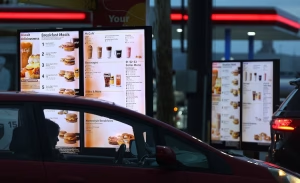
Unfortunately, the system, which was meant to make ordering easier, did anything but, with customers reporting that the automated ordering system added extra items to their tab. McDonald’s ended its partnership with IBM in 2024, but announced that it was exploring “voice ordering solutions more broadly.” Now, the fast food chain has found a new partner in Google to bring its Arch IQ and drive-thru assistant, Archy, back to life.

The brand announced its latest business strategy, called McDonald’s Next. The growth strategy plans to reimagine McDonald’s “menu, consumer, restaurant, and people,” while “imagining” new business and AI.

Stores are currently testing its Arch IQ drive-thru AI system, which can take orders in both English and Spanish with ease. “Archy will not only assist drive-thru orders but act as a master brain to help managers run a better restaurant. It’s like a personal assistant that alerts you to potential bottlenecks or issues,” the firm writes.

“We are currently in five test stores, having processed over 1 million transactions with about 90% of orders completed without human escalations. Impressive for a new test,” said one McDonald’s owner.

Classroom discussion questions:

  1. Why did AI fail the first time and will it work this time for ordering?
  2. How can AI help managers “run a better restaurant?”

OM in the News: How Chick-fil-A Uses OM to Make Fast Food Faster

Atlanta-based Chick-fil-A is on the vanguard of fast-food drive-through operations management, regularly dispatching specialist teams to its more than 3,000 restaurants to study the minutiae of parking-lot traffic patterns and how employees hand off orders. Chick-fil-A recently notched $21.6 billion in U.S. sales, the highest per-restaurant total in the industry (even though the chain stays closed on Sundays). About 60% of its sales happen at drive-up windows.

Burgeoning demand has threatened the “fast” in Chick-fil-A’s fast-food model, writes The Wall Street Journal (Feb. 2, 2025). The “cockpit”—the hectic corner of the kitchen where orders are bagged and handed off to drivers—was growing crowded. Drive-through lanes would run out of room for cars, which sometimes spilled beyond the parking lots. Customer studies regularly gave the chain top marks for quality, accuracy and service, but its drive-throughs ranked highest in time elapsed from entry to exit.

At the new store near Atlanta, Chick-fil-A has 4 drive-through lanes and an elevated kitchen.

For years, Chick-fil-A’s popularity has resulted in long lines of cars. For example, one Chick-fil-A in Rockford, Illinois was straining under a crush of customers lured by a chicken sandwich deal one recent Friday afternoon. Cars inched along 2 drive-through lanes while workers tapped in orders and others handed off bags of sandwiches and fries. Later, the store operator and OM process analysts from the chain’s headquarters hunched over a laptop studying the earlier mayhem. Security cameras in the kitchen and a drone hovering over the parking lot had captured footage of the rush, which set a new sales record for the store. At its peak, the drive-through served one car every 13 seconds, an enviable achievement for any fast-food operation. But not good enough for the company.

OM  insights are reshaping Chick-fil-A’s restaurants. One recently opened near Atlanta with no dining room but 4 drive-throughs that can serve some 700 cars an hour. A second-floor kitchen prepares food that is delivered to the cars below via a system akin to a dumbwaiter.

Restaurant operators have also explored different ways to take drive-through orders. Instead of relying on speaker boxes, they stationed workers outside to take orders directly from idling cars, then call them into the kitchen through cellphones or headsets. That practice helped speed up service, and that customers appreciated more direct interaction.

Classroom discussion questions:

  1. What process analysis tools in Chapter 7 of your Heizer/Render/Munson text could be used to improve quality and service times?
  2. Why are some fast-food restaurants moving toward no indoor dining areas?

OM in the News: The Fast Food Revolution

McDonald’s has a new Texas restaurant with no tables or seats or bathrooms for customers and a conveyor belt that routes food to drivers who order ahead. Chipotle also offers no place for customers to sit inside an Ohio restaurant that only takes digital orders. Taco Bell is evaluating a new design that features 4 drive-through lanes, double the typical two. Starbucks,  which long described itself as a “third place” for customers to gather after home and work, plans to add 400 U.S. stores with only delivery or pickup service in the next 3 years.

Taco Bell is testing a 4-lane drive through in Minnesota

America’s biggest restaurant companies made a bet during the pandemic that you would rather eat the food cooked on their premises someplace else. Now they are gambling you will want to do so for years to come. The strategy from these giant chains is to orient their operations around drive-throughs and online ordering while testing new restaurant concepts that only serve food to go, reports The Wall Street Journal (Jan.28-29, 2023). They say these designs will make them more profitable and efficient since restaurants that bring fewer customers inside cost less to build, maintain and staff.

Of all orders placed at U.S. fast-food restaurants in 2022, 85% were taken to go. That is down from a high of 90% during 2020 but up from 76% prepandemic. Among full-service restaurants, 33% of orders were to go in 2022— double prepandemic rates.

The concept of taking food and beverages to go took root in the years after World War II, as Americans embraced an automobile culture. In the 1970s the industry fully bought into the to-go idea. Wendy’s introduced its “pick-up” window in 1970, with the first McDonald’s drive-through in 1975. (90% of McDonald’s business is now drive-through).

The most distinctive feature of the new McDonald’s in Texas is an automated delivery system for customers who order ahead on an app. When you pull up to the window in the “order ahead” lane, a conveyor delivers your food with help from a robotic arm that pushes the bag out to the waiting car. Starbucks’ CEO has acknowledged its cafes now are often clogged with pick-up, drive-through, delivery and cafe orders all at once. The result: long lines and frustrated customers.  His plan is 700 more U.S. stores in the next 3 years with drive-throughs as the primary means of sales.

Classroom discussion questions:

  1. What operations issues will management face with this revised concept?
  2. What dangers are there in making such changes? Consider a SWOT analysis as in Chapter 2.

OM in the News: The Pandemic and the Drive-Through

The pandemic is sparking a boom in an often-overlooked type of property, the drive-through, reports The Wall Street Journal (March 3, 2021). Food halls and restaurants have taken a big hit from frequent limits on seating capacity during the Covid-19 crisis. But chains such as Chick-fil-A, McDonald’s, and Checkers & Rally’s said they are enjoying a sales uptick at stores with drive-through lanes, which have become more popular during the pandemic. As we discuss in the Chapter 9’s Global Company Profile on layout at McDonald’s (pages 368-9), drive-throughs have been ubiquitous since the 1970s. Now they are critical. “You can pull up in your car and stay socially distant,” said one industry CEO.

Burger King’s triple drive-through

Even restaurant chains that have never offered drive-through options are rolling out lanes. Shake Shack is building its first drive-through this year in Orlando. Some restaurant chains that already rely on drive-throughs are bulking up with even grander versions, in part to help meet a rise in digital orders. Burger King unveiled plans for future restaurants designed with triple drive-through lanes. One of the lanes would be reserved for customers who order online.

Many Checkers & Rally’s restaurants feature double drive-through lanes.

Chipotle Mexican Grill Inc. is expanding a similar strategy. The company plans to add 200 locations this year, with many offering customers the option to pick up digital orders via drive-throughs the company calls Chipotlanes. Starbucks just said that it expects to open about 800 stores annually, particularly in suburban locations with drive-through lanes. The company added that stores with these lanes drove half of net sales last year, up more than 10% from pre-pandemic levels.

Classroom discussion questions:

  1. Is building a 3 lane drive-through the right long-term decision?
  2. What location issues (Ch. 8) must be considered in adding this layout to a restaurant?

OM in the News: McDonald’s to Add Automated Drive-Thru Ordering

McDonald’s is making a bet it can automate the task of taking drive-thru orders, reports New Equipment Digest (Sept. 10, 2019). The world’s biggest restaurant company is buying startup Apprente, a developer of voice-recognition technology for use in the restaurant industry, to help speed up lines. The idea is to eventually have a machine, instead of a person, on the other side of the intercom to relay orders to kitchen staff. Chicago-area restaurants are testing the system.

McDonald’s sees Apprente helping it move cars through the drive-thru lane more quickly and take orders more accurately than employees. The company is also investing to add ordering apps and kiosks in its restaurants and digital menu displays. Fast-food companies are looking for an edge amid intense competition.

Apprente says its technology can accurately interpret conversational language — such as a customer ordering a hamburger with no onions and extra sauce. McDonald’s already is testing the technology in its drive-thru lanes, which makes up about 70% of the company’s business. It plans to roll Apprente’s technology out nationwide, and predicts it will have a “positive impact on more than half of our customers.”

McDonald’s also spent $300 million on Dynamic Yield Ltd.  this year, a company which helps retailers improve performance by collecting personal data from customers to fine-tune sales pitches and promotions. McDonald’s uses Dynamic Yield’s tools to suggest food and drinks to diners based on factors such as time of day, weather and traffic.

Classroom discussion questions:

  1. Why is this an important OM tool for McDonald’s?
  2.  Compare this to the 7 other major changes described in the Global Company Profile on McDonald’s that opens Chapter 9.

OM in the News: Speeding Up the McDonald’s Drive-Thru

mcdonaldsMcDonald’s Corp., losing the speed race to rivals and racking up customer complaints about slow service, is adding a third drive-thru window, reports The Chicago Tribune (Nov.15, 2013).

Called Fast Forward Drive-Thru, the reboot will start appearing in new and rebuilt McDonald’s stores next year. Patrons now pay at the first window and pick up food at the second. Soon there will be a second pick-up window. The drive-thru is even more important to McDonald’s than the Big Mac. The fast-food chain generates 70% of its sales from hungry drivers. Ever since McDonald’s created its first drive-thru in 1975 in Sierra Vista, Ariz., fast-food chains have competed fiercely to shave seconds off order times, equipping workers with headsets, video cameras and clocks showing how long cars have been waiting. In the early days, fast-food restaurants derived about 40% of their sales from drive-thrus.

Disgruntled diners have taken to Twitter to complain about slow drive-thru service at McDonald’s. “I HATE when McDonald’s makes me pull out of the drive thru line and wait in a parking spot like a chump,” @EmLynnClements posted last week. @HumblePie34 added: “McDonald’s needs an express drive thru lane so I don’t have to wait an hour for a mcflurry.”

A more complicated menu has bogged down McDonald’s service. Customers, for example, can choose from 9 different sauces to go with Mighty Wings. Fueling up at McDonald’s drive-thrus takes longer than at Taco Bell and Wendy’s. It takes 189 seconds at a McDonald’s, compared with 158 seconds at Taco Bell and 134 seconds at Wendy’s. McDonald’s drive-thru service is slower than last year and its slowest ever.

Classroom discussion questions:

1. Name 5 ways to increase service efficiency (see Chapter 5, page 175).

2. What are the advantages and disadvantages of adding the 3rd window? Why doesn’t every drive-thru use this approach?

OM in the News: Queuing Up at the Drive Thru

Chick-fil-A averages a whopping 6.09 cars in its drive-thru queue

Since the advent of the modern quick-service drive thru, restaurant operations managers have tinkered with the nuts and bolts to create a drive thru that is as fast, efficient, and pleasant as possible. Innovations throughout the years, from wireless headsets and order-confirmation boards to dual lanes and pre-sell signage, have created a better drive thru capable of handling the 60–70% of business that loops the exterior of most fast food restaurants.  Accuracy has topped out around 90% for most chains. Cleanliness and favorable exteriors are clearly a major investment in the industry. And order-confirmation boards have become a common tool.

Speed of service, though, has slowed at drive thrus, reports QSR Magazine (Oct. 2013). McDonald’s experienced its slowest average speed of service in the past 15 years, at 189.49 seconds; Chick-fil-A’s speed (203.88 seconds) was its slowest showing since 1998, Krystal’s (217.89) since 1999. The decline in speed is a bad thing, but times are changing. Food isn’t so simple anymore. Burgers and fries have become burrito bowls and customizable salad kits.

That could help explain Chick-fil-A’s speed-of-service. The chicken chain had, on average, more than 6 cars in the drive-thru queue, far and away more than competitors and nearly a full vehicle more than last year. The company is investing more in dual-lane drive thrus to better handle capacity issues. But the move toward more specialty sandwiches is also adding seconds to service time.

Speed is still a top priority at fast food restaurants, and they continue to design systems and procedures accordingly. For example, Wendy’s uses a separate grill and sandwich station in the drive thru to maintain its industry-best speeds, and it trains and cross-trains employees repeatedly to ensure the fastest speeds. Taco John’s is revisiting its drive-thru layout to improve little things that might impede the ability to service the drive thru quickly.

Classroom discussion questions:

1. What tools does OM provide to speed drive thru service?

2. How do the various chains differ in handling drive thru customers?