
When we were writing the current edition of our OM text, Jay spent weeks just looking for any decent photo of 3-D printers and 3-D object modeling (which we cover in Ch.5). Now The Economist (Feb.10,2011) has just published a lead article on how 3-D printing will transform manufacturing. This is a topic we think your students will find interesting.
Engineers and designers have been using 3-D printers for a decade, but mostly to make quick and cheap prototypes before tooling up in a factory to manufacture the real thing. Now 3-D printers are being used more than 20% of the time to actually manufacture the products. Its called 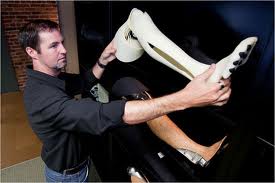 “additive manufacturing” and is already being used to make medical implants, jewelry, dental crowns, custom boots, racing-car parts, solid-state batteries, and much more.
At AEDS (the Airbus people), machines “print” a complex titanium landing gear bracket, the size of a shoe, which would normally be laboriously hewn from a solid block of metal. Their plan is much bigger though: as the 3-D printers grow, AEDS wants to print the whole wing of a jet.
Printing in 3-D may seem bizarre, but it is similar to clicking the print button on your inkjet printer to produce a letter. The difference is the “ink” in a 3-D printer is a material deposited in successive, thin layers until a solid object emerges. EADS, for example, starts with titanium powder. The printers spread a layer about .02 mm thick onto a tray where it is fused by lasers. Compared to a machined part, the printed one is 60% lighter, but just as strong! And a reduction of 1 kg in an airplane saves $3,000 in fuel per year.
The most exciting part of additive manufacturing is that it lowers the cost of entry into the business of making things. Some think the impact will be to manufacturing what the inkjet printer was to document printing.
Discussion questions:
1. Have each student find a different application of 3-D printing.
2. Why is this a potentially revolutionary technology?