
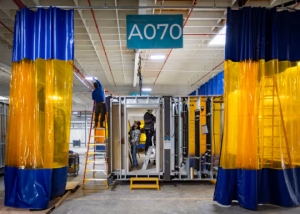
After Jerry Camarillo’s home in Altadena, Calif., burned down, he was determined to rebuild the ranch house exactly as it was before the L.A. wildfires. But the home’s insurance policy would cover only a fraction of the $700,000 estimated cost to rebuild. Then he found Hapi Homes, a company that builds prefabricated homes as pieces in factories and then assembles them on-site. The company could build his home for $200,000 less than the cost of traditional construction, and do it in less than half the time.
Companies that use modular construction, 3-D printing or other nontraditional methods have existed for decades on the fringe of home building, often tainted by previous missteps. (Off-site factory home construction has historically been used for lower-budget homes, leaving many people with the preconception that it tends to be of lesser quality). Now, these firms are breaking into the mainstream by offering a faster and less costly alternative for rebuilding in cities ravaged by natural disasters, reports The Wall Street Journal (June 3, 2025).

Many of the thousands of displaced homeowners in L.A., Hawaii and the Southeast are giving these businesses a look. Victims of hurricanes, wildfires or other disasters can be desperate to rebuild, but their insurance payouts are often well short of what is needed to cover traditional construction costs. Will disasters be the turning point for the wider adoption of factory-built housing?
ICON, a company that makes 3D-printed homes, uses giant 3-D printers to squeeze layers of concrete into the framing for a house. Reframe Systems builds homes in robotic, artificial-intelligence-powered microfactories. Offsite-factory construction can accelerate the building process because fewer workers are required and materials are often purchased in bulk. The shorter timeline can sharply reduce carrying costs for a project. And in disaster areas, where many builders are competing for construction labor and materials, factory-home manufacturers have an edge because they can access less crowded supply chains in other cities and states.
Classroom discussion questions:
- How do 3-D printing and factory home-building differ?
- What did an industry CEO meant when he said: “Never let a crisis go to waste?”


