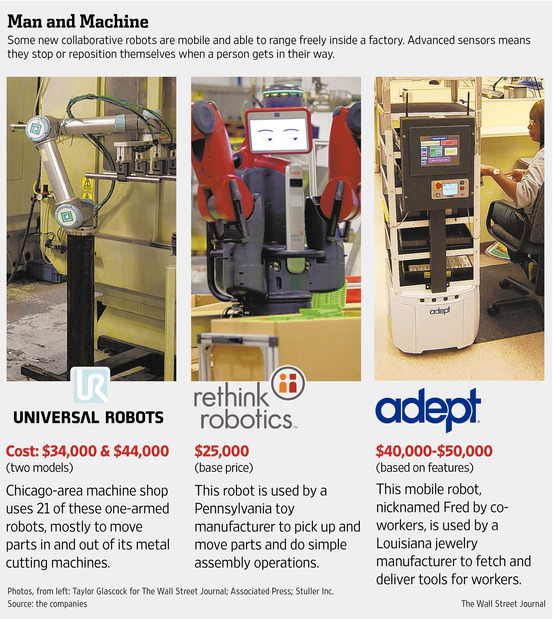
New manufacturing jobs that require more advanced skills are driving up the education level of factory workers who in past generations could get by without higher education, writes The Wall Street Journal (Dec. 10, 2019). American manufacturers are, for the first time, on track to employ more college graduates than workers with a high-school education or less, part of a shift toward automation that has increased factory output, opened the door to more women and reduced prospects for lower-skilled workers. “You used to do stuff by hand,” said a U. of Chicago prof. “Now, we need workers who can manage the machines.”
U.S. manufacturers have added more than a million jobs since the recession. Over the same time, they employed fewer people with at most a high-school diploma. Employment in manufacturing jobs that require the most complex problem-solving skills, such as industrial engineers, grew 10% between 2012 and 2018; jobs requiring the least declined 3%. (More than 40% of manufacturing workers have a college degree, up from 22% in 1991).
Improvements in manufacturing have made American factories more productive than ever and, despite recent job growth, require 1/3 fewer workers than the nearly 20 million employed in 1979, the industry’s labor peak. The workers that remain do much more cognitively demanding jobs. At Caterpillar, over 80% of job openings require or prefer a college degree. A majority of the company’s production jobs called for a degree or specialized skill.
At Harley-Davidson’s engine plant in Milwaukee, robotic arms now ferry motorcycle pieces, taking over the tough, repetitive work formerly done by employees. The machines have made the workplace safer, mirroring a national trend. In 2018, factory workers were hurt at half the rate as in 2003.
Classroom discussion questions:
- How do these changes impact productivity, as discussed in Chapter 1 of your Heizer/Render/Munson text?
- How many students in your class are looking for jobs in manufacturing?