OM in the News: The Rise of the Collaborative Warehouse Robot


Two Locus Robotics mobile robots at work with a staffer picking products at a warehouse

Locus Robotic Corp. robots resemble motorized stools with shelving and touchscreens. They operate in groups and use sensors to navigate through warehouses as workers pick items and move on. They are part of a new generation of automated tools known as collaborative robots because they work with human staffers. They come equipped with software that ties together inventory management data and warehouse management systems to help the robots quickly locate products in vast warehouses and figure out the fastest, most efficient path to the goods.

The robots can double the efficiency of human workers by cutting the time workers spend walking between shelves, reports The Wall Street Journal (April 23, 2019). “We do that by surrounding a human with the robots, and we have algorithms that dramatically decrease the walking time in a building,”  said Locus’ CEO. “Instead of walking up and down aisles, the human will work a zone and the robots will come to you.”

Most warehouses still rely largely on people who pull carts through the aisles, and even automated facilities like some of Amazon’s vast fulfillment centers require hundreds of workers to pick and pack goods for shipping. But the market for logistics robots is growing as online sales surge, pushing companies to fulfill orders faster for rapid delivery, and a tight labor supply makes it harder and more expensive to hire warehouse workers.

A report last month said that heavily automated warehouses worldwide would grow from 4,000 last year to 50,000 by 2023 and would put some 4 million commercial robots to work.

Classroom discussion questions:

  1. What are the strengths and weaknesses of collaborative robots?
  2. Why are warehouses pushing to automate?

OM in the News: The Rise of the Cobot (Collaborative Robot)


The robotic arm at Mofongo’s Distillery in Holland helps bartenders and draws in curious customers

Robots are moving off the assembly line, writes The Wall Street Journal (June 11,2018). Collaborative robots that work alongside humans—“cobots”—are getting cheaper and easier to program. That is encouraging businesses to put them to work at new tasks in bars, restaurants and clinics. In the Netherlands, a cobot scales a 26-foot-high bar to tap bottles of liquor so that bartenders don’t need to climb ladders. In Japan, a cobot boxes takeout dumplings. In Singapore, robots give soft-tissue massages.

Cobots make up just 5% of the $14 billion industrial-robot market, but sales will jump to 27% of a $33 billion market by 2025 as demand for the robotic arms rises. About 20 manufacturers have started selling such robots in the past decade. Smaller businesses are using more cobots as labor costs rise. Artificial intelligence software is making it easier to teach them repetitive tasks. The latest models are sleeker and safer than their predecessors, which were often confined in cages to protect them from injuring nearby humans. Cobot arms brake when they touch humans, and don’t have “pinch points” that could snag fingers and skin.

“Robots are now crossing the chasm from a niche to a mass market,” said a Credit Suisse expert. He likened the current adoption of robotics to the introduction in the late 1990s of smaller handsets that launched mobile phones into wider use. The slew of newer cobot makers has driven down prices, providing buyers with alternatives that sell for $18,000-$26,000.

Still, cobots can’t do everything a person can. Robots are getting good at repetitive work, freeing up humans for other activities, but have a hard time with more complicated actions.

Classroom discussion questions:

  1. What is the difference between a robot and a cobot?
  2. How are cobots an improvement over traditional industrial robots?

OM in the News: The Rise of the Collaborative Robot

Locus Robotics makes a type of collaborative robot that is designed to work with humans.

“In the battle of humans versus machine on the warehouse floor, some companies have found common ground,” writes The Wall Street Journal (Aug. 4, 2017). Instead of developing technology to completely replace manpower, the firms are designing robots meant to work alongside people. These robots, for example, can guide workers to items to be picked or can transport goods across a warehouse to be packed and shipped. Known as “collaborative” robots, they are small and relatively cheap—costing tens of thousands of dollars—compared with miles of conveyor belts and automation systems that run into the tens of millions. Many collaborative robots resemble motorized platforms fitted with shelves and touch screens. They use sensors to navigate past people and forklifts.

The new robots are designed with the majority of warehouses world-wide in mind, where orders continue to be fulfilled manually by people pushing carts up and down aisles. Robotics firms pitch them as a way to help people work faster and boost productivity during busy times, such as the holidays, when extra labor is harder to find. (Surging online sales and a tight labor market have made it more difficult and expensive to fill warehouse jobs.) For example, the robots can slash the number of steps workers take to fulfill an order. But they don’t grab objects off shelves, a task that is simple for humans but tricky to automate, though developers are getting close.

Such robots aren’t yet widespread compared to more-established technologies, like the shelf-moving robots developed in the mid-2000s by Kiva Systems, which Amazon bought in 2012. But collaborative robot’s lower price point could speed adoption.

Classroom discussion questions:

  1. Can robots completely take over warehouse fulfillment in the next few years?
  2. What is the difference between a collaborative robot and a Kiva robot?

OM in the News: Reshaping Factory Floors with Collaborative Robots

Collaborative robots work on parts as employees assemble dishwater racks along an assembly line at a Whirlpool Corp. factory in Findlay, Ohio
Collaborative robots work on parts as employees assemble dishwater racks along an assembly line at a Whirlpool factory in Ohio

Companies around the U.S. are reshaping their factory floors around “collaborative robots” that can stop if a person bumps into them. That precaution allows them to operate in tight spaces with little or no protective boundary. Collaborative robots stack spare tires and apply hot glue inside Chevys and Buicks at the GM plant in Lake Orion, Mich. They help install doors and windshields at BMW ’s plant in Spartanburg, S.C. They smooth riveted parts on 787 jets at a Boeing factory in Australia.

A long-term decline in U.S. factory jobs is due in part to automation. But manufacturers claim the automation trend isn’t intended to cut head count–instead it is aimed at improving safety and increasing productivity. “And as robots help manufacturers increase efficiency, they make U.S. factories more competitive versus countries with cheaper wages,” writes The Wall Street Journal (Nov. 9, 2016). If lower costs leads to more sales, factories could expand and add more of the higher skill jobs that remain.

North American manufacturers installed more than 28,000 robots last year. The market for collaborative robots is expected to grow to more than $1 billion by 2020, up from about $95 million in world-wide sales in 2015.

Universal Robots of Denmark sells one-arm robots for $45,000. The robot can work around the clock, taking the place of workers on 3 shifts. The average production worker makes $36,220 year. Manufacturing executives also say the robots save on materials costs because they apply materials like glue more efficiently. The robots also spare their workers from monotonous, laborious tasks that can cause injuries. Factory workers are the most likely to be injured at work by repetitive motion, and manufacturing ranks high among workplaces for injuries stemming from lifting and lowering.

Classroom discussion questions:

  1. What are the advantages of collaborative robots?
  2. What are their limitations?

OM in the News: Worker at Volkswagen Plant Killed By Robot

robot A technician was killed by a robot at a VW plant in Germany yesterday, reports The Financial Times (July 2, 2015), in a rare accident that touches on concerns about the spread of automation and its impact on jobs. The 21-year-old was installing the machine when he was struck in the chest by the equipment and pressed against a metal plate. The fatality comes as concerns spread about the effects of automation, including fears about whether robots can be controlled when they become more intelligent than humans.

Deaths in factories caused by automated equipment date back decades, but robot-related fatalities are rare as heavy robots are kept behind safety cages to prevent accidental contact with humans. In this incident, the worker was standing inside the safety cage when the accident occurred. VW said the robot did not suffer a technical defect. The machine was not one of the new generation of lightweight collaborative robots that car manufacturers are installing to work alongside workers. Collaborative robots do not have a safety cage but their force and speed can be limited by the way they are built. They also have sensors to detect human movement. Some are also designed to stop if a human gets too close.

VW said last year it planned to use more robots to cope with a shortage of new workers as baby boomers retire in coming years. These robots would take over monotonous tasks, while humans would focus on more highly skilled jobs. The car industry has by far the highest density of robots, but such automation is increasing rapidly in other industries as their cost falls and capabilities increase.

Fatality rates in manufacturing are below the average for the economy as a whole, and have been falling as automation has increased. There were 2.1 fatal injuries for every 100,000 full-time equivalent employees in manufacturing in the US in 2013, down from 2.7 in 2006. (It is about 8 times more dangerous to work in a bar  where the fatality rate there is 16.4 deaths per 100,000 employees.)

Classroom discussion questions:

1. Why are robots an important part of production at VW?

2. What is a collaborative robot?

OM in the News: The Latest Robots Take Hold–Deftly

German Chancellor Merkel and Indian Prime Minister Modi with the new YuMi robot

A new generation of robots designed to work safely alongside people and take on tasks such as assembly of small parts that require more dexterity than older robots can muster, is here, reports The Wall Street Journal (April 14, 2015). The Swiss firm ABB just introduced YuMi, which with a starting price of about $40,000, can help assemble such products as smartphones, laptops and tablet computers that have been assembled largely by hand by workers in lower-cost countries like China.

The small robots, called collaborative robots, are more flexible, much easier to program and safer for humans. Older types of robots, designed to do such tasks as weld or hoist heavy objects, are so fast and powerful that they need to be surrounded by fences to avoid injuring workers. The newer robots have sensors and cameras, telling them to slow down or halt when people get too near. They can be used for quality inspections and packaging.“We have taken the robot out of the cage,” said ABB’s CEO.  YuMi is dexterous enough to thread a needle, he added.

YuMi is designed to work with small parts weighing as much as 1.1 pounds. German robot maker, Fanuc, by contrast, has built the CR35iA, which can pick up items weighing as much as 77 pounds. That new robot is expected to be used for such things as stacking boxes on pallets, moving materials into place for assembly, and driving in screws. Many repetitive tasks in factories are still done by people because they require a delicate sense of touch and dexterity that eludes most machines. Robot makers say they are making progress toward matching human dexterity, though. The German Kuka LBR iiwa robot, for instance,  can install a tube inside a dishwasher.

Classroom discussion questions:

1. Why is this new generation of collaborative robots important to operations managers?

2. What is the restriction that older and larger robots face?


OM in the News: Robots Work Their Way Into Small Factories

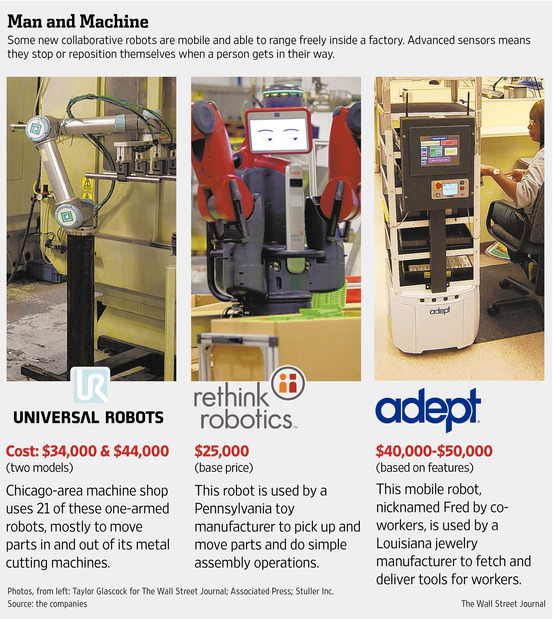
robotRobots aren’t just for the big guys anymore,” writes The Wall Street Journal (Sept. 18, 2014).  A new breed of so-called collaborative machines—designed to work alongside people in close settings—is changing the way some of America’s smaller manufacturers do their jobs. The machines, priced as low as $20,000, provide such companies—small jewelry makers and toy makers among them—with new incentives to automate to increase overall productivity and lower labor costs.

Robots have been on factory floors for decades. But they were mostly big machines that cost hundreds of thousands of dollars and had to be caged off to keep them from smashing into humans. Such machines could only do one thing over and over, albeit extremely fast and precisely. As a result, they were neither affordable nor practical for small businesses.

Collaborative robots can be set to do one task one day—such as picking pieces off an assembly line and putting them in a box—and a different task the next. Some are mobile and able to range freely inside a factory. The use of advanced sensors means they stop or reposition themselves when a person gets in their way, solving a safety issue that long kept robots out of smaller factories.

Classroom discussion questions:

1. Why will factories always need people?

2. What are the advantages and disadvantages of these smaller robots?