OM in the News: The New Hotel Layout

We open Chapter 9, Layout Strategies, with the Global Profile on how McDonald’s around the globe are starting to look more like coffee shops than burger joints. According to The Wall Street Journal (June 10, 2011), hotel lobbies are being redesigned en mass to look like Starbucks outlets as well.  Hilton’s Garden Inn chain remodeling plan, for example, includes what employees call a “Starbuckian area” with communal seating  for the laptop set.

Likewise, Intercontinental’s Holiday Inn  chain is opening a new lobby concept called the “social hub”, with built-in TVs, high tables for laptop plug-in, and an area for food and coffee. Marriott is refitting 100’s of lobbies with touch screens so customers can check weather and flight information. More than 300 Courtyard’s have lobby bistros, with a full breakfast and other food options. And Hyatt lobbies now have a central counter where guest can order drinks, coffee, or food. The same employees who check guests in can even serve the lattes or burgers.
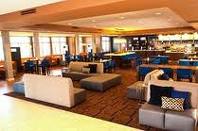
Research shows that younger guests would rather spend time in lobbies than in their rooms. “They want to be alone, but not lonely”, according to a Hilton VP. The new layouts represent a way for hotels, hard hit during the recession, to boost  revenues without taking the risk of raising room rates.

Discussion questions:

1. Why are hotels renovating lobbies instead of rooms?

2. What are the strategic issues of hotel layout?

Video Tip: Layout of the New Arnold Palmer Hospital

Jay and I  have created two videos to accompany Ch.9 (Layout Strategies) : the first an assembly line analysis at Wheeled Coach (the ambulance manufacturer) and the second the design of a radical new building  for the Arnold Palmer Hospital.  The hospital layout was really exciting because we became involved in the project and filmed it from start to finish.

Instead of the traditional “racetrack” design (long hallways with a central nursing station on each floor), when the hospital  added the  new building  a circular “pod” system was designed. The whole idea was to cut down the walking time of the hospital’s most precious scarce resource: nurses. The average nurse (about 45 years old) was hiking 2.7 miles a day up and down the hallways to the central station.

The layout design process lasted over a year. Over  1,000 meetings of doctors, nurses, and patients turned into drawings and then into “test” layouts. The hospital rented a warehouse a mile away and created full-sized mockups of every type of room. When we toured, we were encouraged to comment on every aspect of the layout, from placement of electrical outlets, to pictures on the walls, to Murphy beds for guests, to bathrooms.

The result was  a roundish building with  central nursing pods for each cluster of 34 rooms (this is shown in Figure 9.22 in the book). What a change in walking time for nurses: a 20% drop with the new layout!

Nothing is perfect, though. Despite all the thoughtful planning, analysis, and mockups, the last time I visited the new building I found nurses still unhappy about the “local station” pods. They  had to go back and forth to the “central station” too frequently because everything needed was not at the local pods near the patient rooms. Layout is indeed part art, part science.

OM in the News: Product and Layout Changes Drive McDonald’s

We open Chapter 9 (Layout Strategies) with the story of  the 7 strategic changes at McDonald’s since 1950. All  but one have been major layout redesigns (eg., indoor seating, drive thru, play areas, self-service kiosks, etc.). Adding breakfast foods to the menu (in the 80’s) was the one product change–until now. The front page article in The Wall Street Journal (Dec.27,2010) details two brand new strategies–the 1st a product decision and the 2nd yet another layout change.

Under pressure from market-share competitors of all types–from 7-Eleven and Starbucks to smoothie outlets and gas stations– the 14,000 US McDonald’s have broadened their fare. As of now, there are  fruit smoothies, oatmeal, carmel-mocha drinks, flatbread sandwiches, and “garden” snack wraps. This new product development strategy (Ch.5) has created so many choices that the company has been running ads reminding us it still sells Big Macs.

Using manufacturing technology, McDonald’s has made many new items from existing items’ ingredients. Chicken wraps use Chicken Selects’ meat and breakfast burrito tortillas. This simplifies preparation and lowers costs.

But new layout costs have  blunted franchisee enthusiasm. The food assembly line (see Figure 9.12 in the text) had to be changed to make wraps. And an even bigger modification was the addition of the $100,000 McCafe drink stations– one of the most expensive changes in years. (The corporation picks up $30,000 of that cost). Stores had to be redesigned to make room for space next to the pick-up window to accommodate the 4 pieces of drink equipment. Some franchisees balked at the price tag and low drink sales volumes, claiming “we are not even paying for the electricity to run the machines”.

Discussion questions:

1. Why did McDonald’s make these two strategic changes?

2. Ask your students to rank the importance of the  9 changes, referring to the Global Profile in Ch.9.

3. How has the average McDonald’s  changed in the past decades? Are all of the layout strategies still in place?