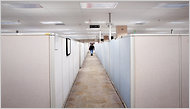
Customers who walk into Wells Fargo’s newest branches won’t see teller windows, safe-deposit boxes or bankers sitting in offices, writes The Wall Street Journal (April 12, 2013). Instead, bank employees will walk around with computer tablets, and the branch’s walls will fold in at night so that only the ATMs are exposed to customers. Welcome to the incredibly shrinking bank branch.
The “minibranch” is the bank’s first effort to create a floor plan that can serve most of a customer’s basic needs in less than half the space of a traditional setup. Typical branches are larger than 4,000 square feet and cost roughly $3 million to build. Older branches can be as large as 10,000 square feet. Minibranches take up 2,000 square feet or less– and their operating costs are 40% to 50% below traditional branches.
Under the new layout, bank employees approach customers when they walk into the lobby and guide them to one of three 19-inch flat ATM screens. There, they can conduct a transaction on their own or receive assistance from the employee who carries the computer tablet and wears a messenger bag that holds a keyboard and cellphone. The branch doesn’t have a vault; all cash is kept in the ATMs. One of the most unusual features is a series of movable walls, which open to reveal a desk area and banquette behind each ATM. When the branch is closed, the walls are locked into position to hide that area, giving customers access only to the ATMs.
Bank executives acknowledge that the new formats might turn off some customers who walk into a branch because they prefer old-style banking. “Customers are going to a branch for a reason; it is to deal with people, not an iPad,” says one analyst.
Discussion questions:
1. How does this layout decision (see Chapter 9) impact efficiency at Wells Fargo? Customer service?
2. Have minibranches been attempted earlier? With what results?