OM in the News: AI Data Centers, Water, and Sustainability

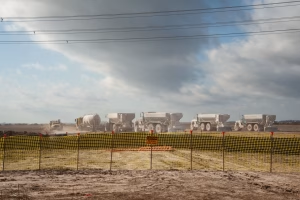
Large water tanks at the Meta data-center campus in Arizona

Amazon, Google, and Microsoft are among the tech companies spending an estimated $1 trillion on AI infrastructure this year and last. In some regions, they are using far more water than they report, depending on how data centers are powered. And their water consumption is projected to grow rapidly in coming years. Water demands of the biggest infrastructure buildout in U.S. history could lead to regional fights over who gets an increasingly scarce resource, writes The Wall Street Journal (July 3, 2026).

Google’s just-released 2025 sustainability report is an instructive example. The company said it consumed 10.9 billion gallons of water—a 34% increase from 2024—almost all for data-center cooling. Meta’s  water use was 19 billion gallons in 2024. Meta has a plan to “become water positive in 2030,” in part through water-restoration projects. Microsoft has announced data centers that will have zero water use, as well as a commitment to “community-first AI infrastructure.” This includes a pledge to “replenish more water than we use.”

Cheap land and cheap power have put data centers in the high water-stress areas such as Arizona. About 2/3 of new data-center construction in the U.S. is in water-stressed areas. Phoenix is an example: the total water demands of data centers there amount to 3% of the city’s annual water use. By 2031, they could be in excess of 20%, a number approaching total water used by residents to maintain all of Phoenix’s lawns and landscaping.

Recently, Nvidia said it had solved the data-center water issue, showing off a closed-loop cooling system that doesn’t require additional water once filled. Unfortunately, most existing data centers use evaporative cooling systems that are energy-efficient but water-hungry, and retrofitting those could be prohibitively expensive.

In these boom times, it’s clear why AI data centers are in the spotlight. And the lack of transparency and widespread use of non-disclosure agreements by many data-center builders has only drawn more suspicion and distrust. These are among the reasons that $170 billion of AI data-center capacity has been blocked, stalled or canceled since 2024.

Classroom discussion questions:

  1. What solutions are being considered to deal with electricity and water demands?
  2. Are data centers overbuilding?

OM in the News: The AI Splurge and Big Tech’s Workforce

Tech companies are rushing to trade their people for more chips. “Some of those companies might come to regret the exchange,” writes The Wall Street Journal (April 27, 2026).

Microsoft (by 7%), Block (parent of Square and Cash App by 40%) and Meta (by 8,000) are just the latest major tech companies trying to scale back their workforces in the name of AI. Layoffs affecting 45,800 tech employees were just announced, making March 2026 the worst month for reported tech-job reductions in at least 2 years.

Companies are straining to portray the cuts as evidence that they are confident in an AI future in which more workers will be replaced by machines.  Tech companies are shelling out as much as they can—more than their rivals, they hope—on AI chips and data centers that could put them in the lead in a race they feel they can’t afford to lose. That in turn is heightening competition over who can use AI to help do more with a lot less, freeing up money to spend on expensive chips.

Dressing up layoffs as visionary moves for the age of AI carries certain risks. Rampant layoffs hurt morale and create an exit incentive for other employees, especially talented ones with alternatives. For all of AI’s capabilities, people will be needed to figure out business models, deal with customers and, importantly, make sure AI tools are being deployed and used safely.

The layoffs also lend credence to a growing public perception that AI isn’t a panacea but a job killer. That will feed a backlash that is already constraining AI, as more communities are fighting against the construction of massive data centers.

The reduction in workforces sends two messages. First, it indicates tech companies will stop at nothing to spend on AI, something markets have often cheered. Second, it says tech companies believe they can operate fine with fewer employees, even after a couple of years of cuts that followed a Covid-era hiring spree.

Classroom discussion questions:

  1. What are the tradeoffs in reducing tech headcounts?
  2. What are the implications for our students and recent grads?


OM in the News: AI Push Is Costing a Lot More Than the Moon Landing

It’s bigger than the railroad expansion of the 1850s, the Apollo space program that put astronauts on the moon in the 1960s and the decadeslong build-out of the U.S. interstate highway system that ended in the 1970s.

We’re talking about the data centers now being built and financed by some of the world’s biggest companies in the artificial-intelligence boom. Four U.S. tech giants—Microsoft, Meta, Amazon, and  Google—are planning to spend $670 billion to build out AI infrastructure this year alone as they scramble to increase the computing power needed to operate and scale their AI-related endeavors.
And if you compare this spending to some of the biggest capital efforts in U.S. history by percentage of gross domestic product, you can see exactly how staggering the figures are, reports The Wall Street Journal (Feb. 9, 2026). In fact, it’s dwarfed only by the Louisiana Purchase, completed in 1803, which doubled the size of the U.S. and consumed 3% of the GDP.  (The AI buildout is projected at 2.1% of GDP, while railroads in the 1850s were 2%, the US highway system was 0.4%, and the Apollo space program was 0.2%).

The four companies’ capital spending has been increasing as a percentage of their annual revenue the past few years. In 2026, Meta’s spending could amount to more than 50% of its sales for the first time ever.

How is this build-out an OM issue? First, as we discuss in Chapter 2, these four companies are betting that they will attain competitive advantage by competing on low-cost and response. Second, our chapter on sustainability (Supp. 5) points out the costs of carbon footprints, which data centers generate heavily. Third, as we note in the chapter on location strategies (Ch. 8), the centers locate where power is cheap and plentiful.

As of late 2025, Northern Virginia has 64 data centers under construction, solidifying its position as the world’s largest data center market. The region hosts over 550 existing facilities.  They consume massive amounts of power, comparable to the total usage of large states like Minnesota.

Classroom discussion issues:

  1. Discuss the plusses and minuses of this massive construction trend.
  2. What do the builders hope to obtain?

OM in the News: Locating an AI Data Center Means Huge Power Needs

Meta Platforms just scooped up 2,700 acres of Louisiana farmland for what would be its largest-ever data center, built over flat rice fields in one of the poorest corners of the state.  At 4 million square feet, or 70 football fields, Meta’s data center will cost $10 billion and sit on more acreage than L.S.U. in Baton Rouge, which has more than 34,000 students. CEO Zuckerberg says the site will be used to train future versions of Meta’s open source AI models and be “so large it would cover a significant part of Manhattan.”

Building advanced artificial-intelligence systems will take city-sized amounts of power, which has turbocharged electricity demand projections for the first time this century, reports The Wall Street Journal (March 31, 2025). 

operations management and artificial intelligence and AI and location
Construction at the site of Meta’s new data center in Holly Ridge, La

Tech companies are pressing into unexpected parts of the country, far from traditional data-center markets such as Northern Virginia. They are hunting for huge swaths of flat land with access to natural gas and transmission lines, landing them on the doorstep of oil-and-gas country. To meet the voracious power needs of the project and other growth, Entergy Power intends to spend $3.2 billion to build three natural gas-fired power plants, tapping the state’s vast gas reserves.

In tiny Holly Ridge, La., hundreds of pieces of construction equipment are rolling past, with 5,000 construction workers on the way. Meta will bring money, jobs and local tax revenue. But the project also threatens to burden electricity customers across much of Louisiana with higher costs if demand from the tech giant eventually dries up.

L.S.U. estimates Meta could use 15% of Louisiana’s current electricity generation. That is worrisome to other utility customers largely because of the mismatch between the 40- 50 year lifespan of gas-fired power plants and Entergy’s 15-year deal with Meta.

Meta’s permanent jobs—around 500—are fewer than the thousands that might have accompanied an auto factory. For a region with a median household income of $53,000, the impact will be meaningful, though. Average salaries at Meta are projected at $82,000.

As we discuss in Chapter 8, Location Strategies, states often must offer financial incentives to draw major new employers. To woo Meta, Louisiana approved a sales-tax exemption for data-center equipment and helped procure more land from local farmers.

Classroom discussion questions:

  1. Are the incentives offered Meta unusual or risky?
  2. Why are data centers and their current technologies controversial?