OM in the News: Locating an AI Data Center Means Huge Power Needs

Meta Platforms just scooped up 2,700 acres of Louisiana farmland for what would be its largest-ever data center, built over flat rice fields in one of the poorest corners of the state.  At 4 million square feet, or 70 football fields, Meta’s data center will cost $10 billion and sit on more acreage than L.S.U. in Baton Rouge, which has more than 34,000 students. CEO Zuckerberg says the site will be used to train future versions of Meta’s open source AI models and be “so large it would cover a significant part of Manhattan.”
Building advanced artificial-intelligence systems will take city-sized amounts of power, which has turbocharged electricity demand projections for the first time this century, reports The Wall Street Journal (March 31, 2025). 

operations management and artificial intelligence and AI and location
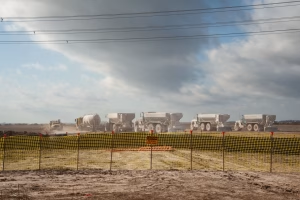
Construction at the site of Meta’s new data center in Holly Ridge, La

Tech companies are pressing into unexpected parts of the country, far from traditional data-center markets such as Northern Virginia. They are hunting for huge swaths of flat land with access to natural gas and transmission lines, landing them on the doorstep of oil-and-gas country. To meet the voracious power needs of the project and other growth, Entergy Power intends to spend $3.2 billion to build three natural gas-fired power plants, tapping the state’s vast gas reserves.

In tiny Holly Ridge, La., hundreds of pieces of construction equipment are rolling past, with 5,000 construction workers on the way. Meta will bring money, jobs and local tax revenue. But the project also threatens to burden electricity customers across much of Louisiana with higher costs if demand from the tech giant eventually dries up.

L.S.U. estimates Meta could use 15% of Louisiana’s current electricity generation. That is worrisome to other utility customers largely because of the mismatch between the 40- 50 year lifespan of gas-fired power plants and Entergy’s 15-year deal with Meta.

Meta’s permanent jobs—around 500—are fewer than the thousands that might have accompanied an auto factory. For a region with a median household income of $53,000, the impact will be meaningful, though. Average salaries at Meta are projected at $82,000.

As we discuss in Chapter 8, Location Strategies, states often must offer financial incentives to draw major new employers. To woo Meta, Louisiana approved a sales-tax exemption for data-center equipment and helped procure more land from local farmers.

Classroom discussion questions:

  1. Are the incentives offered Meta unusual or risky?
  2. Why are data centers and their current technologies controversial?

Guest Post: Vertical Farming

Prof. Howard Weiss, who developed the Excel OM and POM software that accompanies our text for free, shares an interesting thought.

One of the location factors displayed in Figure 8.1 of your Heizer/Render/Munson textbook is the size of the potential location. One way to increase the size available for operations is to build vertically. This is why there are skyscrapers in so many cities. As the populations in cities grew there was a need for more room for both housing and business and skyscrapers create more room on the same building footprint.

The concept of expanding operations vertically has now reached the farming industry. Vertical farming is a technique where crops are grown on top of each other, typically indoors inside a facility that may be a skyscraper, warehouse or shipping container.

There are several advantages to vertical farming. First, of course, is that more crops can be raised on a smaller facility footprint. These farms operate in a highly controlled environment. Weather has minimal or no effect on these farms because the temperature, humidity, light and water are completely controlled. Also, different crops can be developed simultaneously whereas on a traditional farm different crops are planted and harvested in succession. Because the farms are indoors there is year- round crop production. Water can be recycled and reused. The farms can be located closer to urban centers reducing transportation costs. Less labor is required.

However, there are several downsides to vertical farming. While fewer employees are required than on a typical farm, these employees need to learn new skills. The startup costs for a vertical farm are higher than the startup costs for a traditional farm. While the environment is controlled, the energy costs to do so are higher than energy costs on a typical farm. In addition, energy costs have been rising both in the U.S. (8.4% higher) and Great Britain (58% higher) over the past few years and the carbon footprint of a vertical farm is larger than that of a typical farm. The cost to the consumer of the food that is grown is higher than food from typical farms. The types of crops that can be grown is not as large as that of a typical farm.

Classroom Discussion Questions
1. How could an individual take advantage of vertical farming when growing vegetables?
2. Are there any vertical farms located near your university location?


OM in the News: Coal Gets Hot

Coal makes a comeback.

Contrary to observations in Supplement 5 (Sustainability in the Supply Chain) of your text, an energy-starved world is turning to coal as natural-gas and oil shortages exacerbated by Russia’s war against Ukraine lead countries back to the dirtiest fossil fuel. From the U.S. to Europe to China, the world’s largest economies are increasing coal purchases to ensure sufficient supplies of electricity, despite prior pledges by many countries to reduce their coal consumption to combat climate change.

“The global competition for coal—also now in short supply after years of declining investment in new mines and resources—has driven benchmark prices to new records this year,” reports The Wall Street Journal (July 5, 2022). The push is being led by Europe, which is boosting coal purchases to ensure it can keep power flowing to homes and factories after Russia cut gas supplies. Germany, which has promised to eliminate coal as a power source by 2030, is among the nations now importing more.

Trucks carrying coal in India, where coal powered generation hit a high this year.

Parts of the U.S. are boosting use of coal power, as high demand for electricity amid unusually hot temperatures pushes regional power grids to the brink of blackouts this summer. China, the world’s biggest coal consumer, is expanding production of the fuel and its use in power generation, spooked by shortages last year that caused country-wide electricity cuts and outages. India is also leaning hard on coal as energy demand increases.

Coal use fell in many major Western countries over the past decade, displaced by cleaner forms of energy that became more cost-competitive. Natural gas became more plentiful thanks to the American fracking boom and Russian exports to Europe. Wind and solar power also gained, buoyed by falling prices and government subsidies and mandates. In addition to Germany, Italy, France, the U.K., the Netherlands and Austria have now said they are preparing to restart coal-fired power plants, boost their production or keep them running longer than planned.

The resurgence of coal, which emits around double the carbon dioxide as natural gas, further threatens to set back international efforts to keep global temperatures under 2 degrees Celsius.

Classroom discussion questions:

  1. Why is increasing coal consumption an issue impacting operations managers?
  2. What are ISO 14001 and 50001 and how do they relate to this article?

OM in the News: The Energy-Minded Hotel

A guest room key card at a Sofitel
A guest room key card at a Sofitel Hotel

American hotels have long resisted key cards (where guests must place a room key into a slot on the wall to activate the lights and temperature control system) or other energy-saving systems. Energy was cheap, and hoteliers feared that guests, who routinely left their rooms with the lights and air-conditioner on, would see any check on their energy use as an inconvenience. “But the aversion of hoteliers in the U.S.,” writes The New York Times (May 10, 2016), ” is slowly shifting as Americans have become more energy conscious and more states and municipalities have adopted rigorous building codes for energy use.”

In 2014, 29% of hotels had a sensor system in guest rooms to control the temperature, compared with less than 20% in 2004; and more than 75% had switched to LED lighting, up from less than 20%. Other energy-saving measures had also been more widely adopted. Energy costs typically represent 4-6% of a hotel’s overall operating expenses, with the largest share for heating and air-conditioning.

Many major hotels in the U.S. have digitally controlled thermostats to monitor the temperature in guest rooms. And a growing number have installed sophisticated systems that sense when a room is occupied. When a hotel guest enters a room, the device allows the temperature to be manually controlled within a certain range — from 60 to 80 degrees, for example — and then sets it back into an energy-saving mode when the room is vacant again. Such a system can save a hotel 20% or more in energy costs. And many utility companies now offer rebates to hotels that have installed digital thermostats and other energy management devices.

Classroom discussion questions:

  1. What are the downsides of key card technology?
  2. Why is sustainability of growing concern in the hotel industry?

OM in the News: Walgreen’s “Net Zero Energy” Stores

Roof of new Walgreen store in Evanston, IL contains 800 solar panels

As the Walgreen Company expands its sales items to fresh salads, Redbox DVD rentals and digital photo scanners, among other products, its consumption of power keeps inching up. While the drugstore chain cannot significantly reduce its electricity use in all stores immediately, it is building its first “net zero energy” store in Evanston, IL, that it hopes will produce more energy than it consumes. Alternative energy equipment at the store includes more than 800 solar panels on the roof, two 35-foot wind turbines and a geothermal energy system dug hundreds of feet beneath the store’s foundation.

The net zero concept is part of the retail giant’s overall sustainability plan to reduce energy use by 20% by 2020 across all of its more than 8,000 stores, reports The New York Times (June 5, 2013). The cost of building the new store will be about twice that of a typical new store. Over time, however, executives expect to recoup the extra costs from reductions in the store’s energy use, tax credits and rebates from utility companies.

Walgreen is also incorporating several conservation and energy producing strategies in existing stores, including LED lighting, energy-efficient building materials and carbon dioxide refrigerant for heating, cooling and refrigeration.

The new store, on the site of an old store that had been razed, is being built by recycling more than 85% of the demolished store’s material like bricks, concrete and metal. In addition, Walgreen has drilled eight 550-foot holes for pipes — about as deep as the landmark Chicago Board of Trade building is tall — to create a geothermal energy system that will use the constant temperature of earth to heat and cool the building.

Discussion questions:

1. Why is Walgreen developing the “net zero energy” store?

2. What is the chain’s sustainability strategy?

OM in the News: How Oslo Turns Garbage into Energy

Half of Oslo is heated by burning garbage

Oslo, writes The New York Times (April 30, 2013), is a city that imports garbage. Some comes from England, some from Ireland. Some is from neighboring Sweden.  A British tax on landfill makes it cheaper to send it to places like Oslo. “It helps us in reducing the escalating costs of the landfill tax,” says a spokeswoman for Leeds, England. Oslo even has designs on the American market. “I’d like to take some from the United States,” says the director of one plant that turns garbage into heat and electricity. “Sea transport is cheap.”

A recycling-friendly place where roughly half the city and most of its schools are heated by burning garbage — household trash, industrial waste, even toxic and dangerous waste from hospitals and drug arrests — Oslo has a problem: it has literally run out of garbage to burn. The fastidious population of Northern Europe produces only about 150 million tons of waste a year, far too little to supply incinerating plants that have capacity of more than 700 million tons. The problem is not unique to Oslo, a city of 1.4 million people. Across Northern Europe, where the practice of burning garbage to generate heat and electricity has exploded, demand for trash far outstrips supply.

Garbage may be garbage in some parts of the world, but in Oslo it is very high-tech. Households separate their garbage, putting food waste in green plastic bags, plastics in blue bags and glass elsewhere. The bags are handed out free at groceries and other stores.

Still, not everybody is comfortable with this garbage addiction. “From an environmental point of view, it’s a huge problem. There is pressure to produce more and more waste, as long as there is this overcapacity,” says one Norwegian environmental expert. Retorts the head of Oslo’s waste recovery agency, “Recycling and energy recovery have to go hand in hand.”

Discussion questions:

1. How do some US cities deal with massive amounts of garbage?

2. Why are sustainability efforts such as this of interest to operations managers?