OM in the News: The AI Splurge and Big Tech’s Workforce

Tech companies are rushing to trade their people for more chips. “Some of those companies might come to regret the exchange,” writes The Wall Street Journal (April 27, 2026).
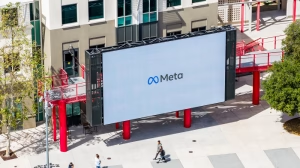
Microsoft (by 7%), Block (parent of Square and Cash App by 40%) and Meta (by 8,000) are just the latest major tech companies trying to scale back their workforces in the name of AI. Layoffs affecting 45,800 tech employees were just announced, making March 2026 the worst month for reported tech-job reductions in at least 2 years.

Companies are straining to portray the cuts as evidence that they are confident in an AI future in which more workers will be replaced by machines.  Tech companies are shelling out as much as they can—more than their rivals, they hope—on AI chips and data centers that could put them in the lead in a race they feel they can’t afford to lose. That in turn is heightening competition over who can use AI to help do more with a lot less, freeing up money to spend on expensive chips.

Dressing up layoffs as visionary moves for the age of AI carries certain risks. Rampant layoffs hurt morale and create an exit incentive for other employees, especially talented ones with alternatives. For all of AI’s capabilities, people will be needed to figure out business models, deal with customers and, importantly, make sure AI tools are being deployed and used safely.

The layoffs also lend credence to a growing public perception that AI isn’t a panacea but a job killer. That will feed a backlash that is already constraining AI, as more communities are fighting against the construction of massive data centers.

The reduction in workforces sends two messages. First, it indicates tech companies will stop at nothing to spend on AI, something markets have often cheered. Second, it says tech companies believe they can operate fine with fewer employees, even after a couple of years of cuts that followed a Covid-era hiring spree.

Classroom discussion questions:

  1. What are the tradeoffs in reducing tech headcounts?
  2. What are the implications for our students and recent grads?


OM in the News: Is Apple Really Reshoring?


With great fanfare, Apple just announced plans to spend $500 billion (yes–that’s a half a trillion dollars!) in the U.S. and add 20,000 jobs over the next 4 years. Apple, like many of the most valuable U.S. companies, isn’t a major manufacturer. It designs products, writes software and creates chip blueprints, but outsources much of its production and markets the results.

But early in the Trump administration, Apple and other companies are trying to quickly answer the president’s call to rouse American manufacturing, reports The Wall Street Journal (Feb, 25, 2025). To do that, they are turning to investments and job growth. Apple’s new jobs promises are slightly ahead of the company’s recent 4-year pace, and the spending pledge is roughly on track with its recent investments that include previously planned spending or developments already under way.

The company has yet to spell out how many people it will continuously employ beyond saying it will create thousands of jobs. If Apple adds 20,000 jobs, it would mark only a modest increase in hiring over the 19,000 U.S. workers every 4 years since 2013.

Unclear is how much of the planned spending is actually new. Apple has spent about $1.1 trillion over the past 4 years on total operating expenses and capital expenditures, of which about $500 billion was in the U.S.  In short, Apple’s announced figure is in line with what one might expect the company to be spending anyway.

While it is still largely dependent on East Asia, and China in particular, Apple has been using more suppliers that manufacture in the U.S. since the pandemic. Its expansion includes a multibillion-dollar commitment to produce advanced silicon in a fabrication facility in Arizona, and a new 250,000-square-foot factory in Houston is slated to open in 2026 and produce servers for AI systems.

Big investment plans don’t always pan out. In 2018, electronics-maker Foxconn—one of Apple’s big suppliers—said it would invest $10 billion and create 13,000 jobs at a liquid-crystal-display plant in Wisconsin.  Foxconn later cut investment to under $700 million and 1,450 jobs.

Classroom discussion questions:

  1. Why do such announcements often not result in the advertised plans?
  2. Why is Apple moving some its manufacturing to the U.S. from China?


OM in the News: The Growing Cluster of High-Tech Talent

Seattle is one of 5 metro areas that have attracted the lion’s share of the nation’s tech talent

The forces that are driving the nation’s top technology talent to just a handful of cities have intensified in recent years, leaving much of the nation behind as the U.S. becomes a more digital economy, reports The Wall Street Journal (Dec. 13, 2019). Just five metropolitan areas—Boston; San Diego; San Francisco; Seattle; and San Jose—accounted for 90% of all U.S. high-tech job growth between 2005 to 2017.

The nation’s 377 other metro areas accounted for 10% of the 256,063 jobs created during that period in 13 high-tech industries such as software publishing, pharmaceutical manufacturing and semiconductor production. Among the smaller cities that gained tech jobs were Madison, Wis.; Albany, N.Y.; Provo, Utah; and Pittsburgh. The result is increased concentration of high-tech resources in just a few places and a strengthening of economic forces that are dividing the nation.

Tech industries find they are most productive when they have resources clustered in few places, a topic discussed in Chapter 8 of your Heizer/Render/Munson OM text. Such clustering allows for the fast spread of new ideas and a concentrated talent pool from which businesses recruit. But the concept runs counter to the idea that technology might allow people to work from anywhere, even in remote places.

The trend is creating problems for the cities that have these concentrations of workers and for those places that don’t. San Francisco and Boston are becoming increasingly unaffordable as home prices soar, while cities outside of these high-tech hubs are missing out on the dynamism that technology creates. “The superstar places are becoming extremely expensive, choked with traffic and struggling with big social costs like inequality gone wild and homelessness,” said a researcher studying the issue.

Some big cities were left behind. Combined, the Washington, D.C. area; Dallas; Philadelphia; Chicago; and L.A. lost more than 45,000 high-tech jobs between 2005 and 2017.  Many small cities across the heartland also lost tech jobs.

Classroom discussion questions:

  1. What are some other clusters besides tech talent?
  2. What does it take to create a tech cluster?