OM in the News: 3-D Printed Homes and Disaster Areas

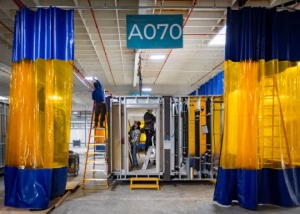
A SoLa Impact modular housing unit is assembled at a Los Angeles factory

After Jerry Camarillo’s home in Altadena, Calif., burned down, he was determined to rebuild the ranch house exactly as it was before the L.A. wildfires. But the home’s insurance policy would cover only a fraction of the $700,000 estimated cost to rebuild. Then he found Hapi Homes, a company that builds prefabricated homes as pieces in factories and then assembles them on-site. The company could build his home for $200,000 less than the cost of traditional construction, and do it in less than half the time.

Companies that use modular construction, 3-D printing or other nontraditional methods have existed for decades on the fringe of home building, often tainted by previous missteps. (Off-site factory home construction has historically been used for lower-budget homes, leaving many people with the preconception that it tends to be of lesser quality). Now, these firms are breaking into the mainstream by offering a faster and less costly alternative for rebuilding in cities ravaged by natural disasters, reports The Wall Street Journal (June 3, 2025).

An ICON system uses 3-D printing to add concrete to the framing of a home

Many of the thousands of displaced homeowners in L.A., Hawaii and the Southeast are giving these businesses a look. Victims of hurricanes, wildfires or other disasters can be desperate to rebuild, but their insurance payouts are often well short of what is needed to cover traditional construction costs. Will disasters be the turning point for the wider adoption of factory-built housing?

 ICON, a company that makes 3D-printed homes, uses giant 3-D printers to squeeze layers of concrete into the framing for a house. Reframe Systems  builds homes in robotic, artificial-intelligence-powered microfactories. Offsite-factory construction can accelerate the building process because fewer workers are required and materials are often purchased in bulk. The shorter timeline can sharply reduce carrying costs for a project. And in disaster areas, where many builders are competing for construction labor and materials, factory-home manufacturers have an edge because they can access less crowded supply chains in other cities and states.

Classroom discussion questions:

  1. How do 3-D printing and factory home-building differ?
  2. What did an industry CEO meant when he said: “Never let a crisis go to waste?”

OM in the News: Apple’s Supply Chain and Climate Change

Torrential rains flooded Guangzhou this year, where Apple has 71 facilities.

Few global multinationals have been more vocal and forthright in their ambitions to take on climate change than Apple. Yet Apple’s vast supply chain — comprising more than 400 facilities across 180 regions in nearly 30 countries– stands in the path of some of the most damaging effects of climate change itself, .

Based on global databases of power-generation, extreme weather, flood zones, economic impact and carbon emissions, the very regions most vulnerable to climate change are those with the highest concentration of manufacturers, writes Bloomberg,com (Sept.  26. 2023). This risk isn’t exclusive to Apple. Global companies including Samsung, Sony, and Dell procure from many of the same vendors.

Put simply, the belt of the planet where natural disasters will intensify most rapidly due to global warming — from floods and heatwaves to increasingly powerful cyclones — is precisely the one where Apple has built its manufacturing footprint. It’s most visible in a swath of Asia from India to Japan.

We’ve already seen the damage weather disasters can do to multinational manufacturing operations. Floods across Thailand in 2011 shuttered more than 14,000 businesses, throwing a wrench into global automotive and electronics supply chains that were dependent on low-cost manufacturing. It was the biggest flood disaster in insurance industry history, causing about $55 billion of losses and slowing deliveries of Apple computers as component suppliers were forced to suspend work.

Much of the world has since made efforts to prevent such a disaster. Toyota, a pioneer of JIT, raised the time it held onto its inventory from 30 days to 49 now. Apple’s inventory days increased from 5 to 11 since the 2011 floods. Overall, larger inventories make supply chains more resilient to disaster — but they also cost money because of capital tied up in warehouses. Despite this, the countries in Asia where Apple’s supply chain has been built are also some of those that will be most prone to floods. Power cuts pose similar risks to manufacturers. A heat wave last year left India’s grid on perilously thin margins as coal-fired generators ran short of fuel.

Apple’s plans for greening its manufacturing network illustrate the challenge. The company has called on its suppliers to follow its own path to zero-carbon power by 2030. Yet many of the countries on which it is most dependent have unusually high shares of fossil fuels in their grids, with coal accounting for more than 60% in China and Indonesia, and nearly 75% in India.

Classroom discussion questions:

  1. What can Apple do at this point?
  2. What technique in Supp. 11 in your Heizer/Render/Munson text can be applied to analyze potential natural disasters?

Good OM Reading: McKinsey’s Report on Global Value Chains–Part 1

In recent decades, value chains have grown in length and complexity as companies expanded around the world in pursuit of profits. Since 2000, the value of intermediate goods traded globally has tripled to more than $10 trillion annually. Businesses that successfully implemented a lean, global model of manufacturing achieved improvements in inventory levels, on-time-in-full deliveries, and shorter lead times.

However, these OM choices sometimes led to unintended consequences.. Intricate production networks were designed for efficiency, cost, and proximity to markets but not necessarily for risk. Now they are operating in a world where disruptions are regular occurrences. “Companies can now expect supply chain disruptions lasting a month or longer to occur every 3.7 years, and the most severe events take a major financial toll,” reports the McKinsey Global Institute. This new research study, which we summarize in a two-blog series, explores the profound shocks facing value chains from financial crises, terrorism, extreme weather, and, yes, pandemics.

Some manufacturers will use technology and devise other strategies to come out on the other side of the pandemic more agile and innovative. McKinsey reminds us that the COVID pandemic is only the latest in a series of disruptions. In 2011, a major earthquake and tsunami in Japan shut down factories that produce auto components, halting assembly lines worldwide. It also knocked out production of silicon wafers, on which semiconductor companies rely. 

 Forty weather disasters in 2019 caused damages exceeding $1 billion each. And the number of ransomware attacks doubled from 2018 to 2019. Interconnected supply chains and global flows of data, finance, and people offer more “surface area” for risk to penetrate, and ripple effects can travel across these network structures rapidly. Companies tend to focus much of their attention on managing the types of shocks (like trade disputes, product recalls, data breaches, or logistics disruptions) they encounter most often. COVID is a reminder that outliers may be rare—but they are real possibilities that companies need to consider in their decision making.

Classroom discussion questions:
1. Relate each of the major headings in Supp. 11 (Supply Chain Management Analytics) to the COVID pandemic.

2. What changes might an operations manager make in response to this report?

OM in the News: Hurricane Harvey and the Texas Supply Line

With rising waters threatening stretches of highways and railroad tracks in southeast Texas, freight companies are working to reroute cargo.

Trucking fleets, railroads and shipping lines are rerouting cargo and setting up alternate supply lines as Hurricane Harvey promises to disrupt freight traffic across southeast Texas for days. Seaports in Houston and Corpus Christi have been closed to most ships since before Harvey made landfall Friday, and rising waters from days of heavy rains and catastrophic flooding are threatening long stretches of highways and railroad tracks, bringing freight transportation in a major American hub to a virtual standstill.

Union Pacific has halted all freight rail traffic bound for Houston and surrounding areas, while UPS has suspended freight service in Houston and Beaumont and is offering limited service as far west as San Antonio. Two Maersk Line container ships remain anchored in the Gulf of Mexico, joining oil tankers and cruise ships waiting for Houston’s port to reopen.

“The gridlock will likely reverberate beyond Texas, threatening to snarl international trade routes,” writes The Wall Street Journal (Aug. 29, 2017). Houston is a key consolidation point for imports of vehicles and appliances made in Mexico, and stores as far away as Denver bring in foreign-made goods via the city’s port. The storm affected up to 10% of the U.S.’s trucking capacity. Retailers and other shippers around the country may struggle to line up enough trucks to ship goods. And many trucks that are available are being turned over to relief and rebuilding efforts. Wal-Mart has sent more than 1,000 big rigs to hard-hit areas and evacuation centers, with most carrying water.
Shipping costs could rise anywhere from 5% to 22%, and many freight companies say they have no idea when they will resume operations.

Classroom discussion questions:

  1. Why did the storm in Houston have such an impact on supply lines?
  2. Will there be a long-term repercussion?

OM in the News: “Thin Supply Chains” and Thai Flooding

Workers at Japanese hard-drive maker Nidec Corp.’s plant in Thailand have a remedy for the flooding that has shut 1,000’s of factories there. They use narrow wooden boats to ferry boxes of delicate motors across a flooded plain to a truck that will haul them to Bangkok. But The Wall Street Journal (Nov.3, 2011) asks: “Are the companies to blame for some of the economic costs of the disaster”? Some experts say, yes, that flooding in Thailand should serve as a warning to companies world-wide: thin supply chains for critical components are vulnerable to disasters.

“Companies  never see the big picture, and see where the potential problems in their supply chains might be; and this is especially true as these supply chains become more geographically dispersed”, says a McKinsey & Co. partner. Thailand’s flooding (as did Japan’s earthquake) has ricocheted around the world in ways few businesses expected. For example, about 1/4 of the world’s hard-drive output is under water. And Honda’s main Thai plant is semi-submerged, choking off the supply of key components to factories around the world. (The Honda factory in Brazil is cutting production by 1/3). In all, 7 of Thailand’s industrial parks are flooded.

Supply chain experts say much of the disaster “could have been averted if companies themselves hadn’t been so focused on saving money by using lean supply chains”. In a country prone to major flooding,  insurers may now be reluctant to offer coverage, forcing manufacturers to move out. Nidec has already announced plans to transfer some output to the Philippines and China, even as its workers in Thailand paddle out to salvage what they can from the plant.

Discussion questions:

1. Discuss the danger in “thin” (lean) supply chains.

2. What is the solution for the OM manager?