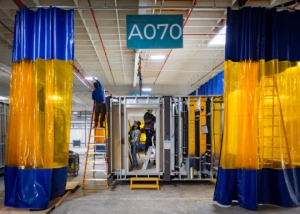
OM in the News: 3-D Printed Homes and Disaster Areas

A SoLa Impact modular housing unit is assembled at a Los Angeles factory

After Jerry Camarillo’s home in Altadena, Calif., burned down, he was determined to rebuild the ranch house exactly as it was before the L.A. wildfires. But the home’s insurance policy would cover only a fraction of the $700,000 estimated cost to rebuild. Then he found Hapi Homes, a company that builds prefabricated homes as pieces in factories and then assembles them on-site. The company could build his home for $200,000 less than the cost of traditional construction, and do it in less than half the time.

Companies that use modular construction, 3-D printing or other nontraditional methods have existed for decades on the fringe of home building, often tainted by previous missteps. (Off-site factory home construction has historically been used for lower-budget homes, leaving many people with the preconception that it tends to be of lesser quality). Now, these firms are breaking into the mainstream by offering a faster and less costly alternative for rebuilding in cities ravaged by natural disasters, reports The Wall Street Journal (June 3, 2025).

An ICON system uses 3-D printing to add concrete to the framing of a home

Many of the thousands of displaced homeowners in L.A., Hawaii and the Southeast are giving these businesses a look. Victims of hurricanes, wildfires or other disasters can be desperate to rebuild, but their insurance payouts are often well short of what is needed to cover traditional construction costs. Will disasters be the turning point for the wider adoption of factory-built housing?

 ICON, a company that makes 3D-printed homes, uses giant 3-D printers to squeeze layers of concrete into the framing for a house. Reframe Systems  builds homes in robotic, artificial-intelligence-powered microfactories. Offsite-factory construction can accelerate the building process because fewer workers are required and materials are often purchased in bulk. The shorter timeline can sharply reduce carrying costs for a project. And in disaster areas, where many builders are competing for construction labor and materials, factory-home manufacturers have an edge because they can access less crowded supply chains in other cities and states.

Classroom discussion questions:

  1. How do 3-D printing and factory home-building differ?
  2. What did an industry CEO meant when he said: “Never let a crisis go to waste?”

OM in the News: Robots May Build Your Next House

An electrician checks her blueprint at Baltimore’s Blueprints Robotics factory.

“The future of U.S. homebuilding may depend on robots,” writes Businessweek (April 24-30, 2017). With construction workers in short supply and demand rising, builders are turning to “fast factories” that can build houses like cars on an assembly line, using robots to fire 1,000s of nails into studs each day without missing. Other machines cut, sand, drill, and insulate. The plants enable developers to fill the labor gap by having houses and apartment buildings manufactured off-site, for less money and in a fraction of the time. Even Marriott Hotels is increasingly turning to modular construction.

Builders hire the factories to manufacture homes in sections, which are transported on trucks, then laid down on foundations by cranes, like giant Legos. Sometimes the modules are fully framed rooms, complete with tile showers and gourmet kitchens. The house is 60% complete when it arrives. The idea of transporting homes in prefabricated sections has roots in the early 1900s, when homesteaders could buy kits from a Sears Roebuck catalog for assembly on their newly acquired plots of land. In the 1980s and 1990s, it became increasingly popular to build lower-cost homes in factories.

Today’s plants are capable of producing bigger buildings with more elaborate designs. The Blueprint Robotics factory in Baltimore is one of the first in the U.S. to use robots. Taller multifamily buildings, dorms and hotels are increasingly being manufactured indoors. And so are mansions that sell for millions. Having an indoor facility means weather delays are rarely a factor. Each worker is given a narrow concentration, like tiling floors or sanding drywall, which increases production speed. People without any background in construction can become skilled laborers in 2 weeks.

Classroom discussion questions:

  1. Provide 2 other examples of fixed position layout (see Chapter 9).
  2. What are the disadvantages of this automated, modular approach?

OM in the News: Lego High-Rise Construction in NY

Apartments are preassembled at the factory, safely away from the elements

Inside a warehouse at the Brooklyn Navy Yard, steel beams and flat metal sheeting rest atop a workbench. A diagram–which looks an awful lot like furniture assembly instructions–spells out where each beam and metal screw belongs. On it someone has carefully checked off each component, one by one.

The metal may not look like much yet, but it’s on its way to becoming part of the world’s tallest modular residential high-rise. Workers will configure these beams into walls, which will become the scaffolding of rooms, which link together to form entire apartments. Then the “mods” are loaded onto a truck and driven 2.5 miles away, lifted by crane and snapped into position like Lincoln Logs. Time to load an apartment: 30 minutes. From the first cut of metal to placing a mod on its final site, the entire process takes about 20 days. “And we’ll get faster,” says the VP of Swedish construction giant, Skanska. “This is bringing the best of manufacturing and construction together.” The first 32-story tower is slated for completion in December.

Skanska is counting on the new factory approach to urban construction to save on costs and provide greater quality control, writes Forbes (May 5, 2014).  A 1,000-square-foot apartment in NY costs an estimated $330,000 to build; Skanska estimates it will knock 15% to 20% off that this go-round–and as much as 30% off with more experience.

“If they can show that here, I think it has potential to have a transformative effect,” says a Tulane architecture professor. “It’s of interest both to architecture and to developers who are interested in building affordably and fast.” The most important innovation is the construction method itself. The factory feels like the love child of Home Depot and a sterile surgical chamber. “We believe that in factory environments the productivity of the worker is greater,” says a project exec.

Classroom discussion questions:

1. Which of the seven layout types in Chapter 9 best describes this project?

2. Which of the 10 OM decisions impact this construction?


OM in the News: Modular Construction in New York City

Factory workers installing walls in Pennsylvania

A vacant lot in Manhattan is littered with rubble and concrete pilings. But this month, writes The New York Times (March 10, 2013), this 50-foot-wide sand pit will be transformed into a 7-story apartment building, with finished bathrooms, maple cabinetry and 10 terraces. This example of fixed position layout (see Chapter 9) is the result of modular, or prefabricated, construction. The technique means a building is manufactured piecemeal on a factory assembly line, trucked to the construction site and erected much the way Legos are. The trend toward modular does pose issues, particularly for NYC’s powerful construction unions as it means exporting some construction jobs to factories outside NY.

The modules, which have steel and concrete frames, are being trucked four to five at a time to the building site from their Pennsylvania factory. On each of the following mornings for about four weeks, an enormous crane will stack the modules. Workers will then “zip” them up, connecting one to the next, and to the building’s plumbing and electrical systems.

Completed 7-story apartment house

The project is expected to take 9 months from start to finish, compared with 16 to 18 months if construction had been done on-site. “Because it takes half the time,” says the builder, “we can rent out the units and generate income much quicker, and the carrying costs are lower.” Because modular units are built on an assembly line — which is a quarter-mile in length at the factory — there are constraints, including having to choose the paint colors, finishes, appliances and every other detail upfront. But with indoor construction, there are no delays or damages to the material from inclement weather. Modular construction provides sustainability benefits, too. “We can recycle everything, all of the packaging materials, the gypsum, every piece of steel,”  says a modular builder, “because none of our products are affected by the elements.”

Discussion questions:

1. What are the advantages of fixed position layout in building construction?

2. What are the disadvantages?