OM in the News: The Office of the Future

“The office used to be a place people went because they had to,” writes The Economist (Dec. 4, 2021). Meetings happened in conference rooms and in person. Desks took up the bulk of the space. The pandemic, however, has exposed the office to competition from remote working, and brought up a host of questions about how it should be designed in the future. In Chapter 9 we discuss this evolution of office layouts, including the need for offices that accommodate Proximity, Privacy and Permission.

In the past the office was a place for employees to get their work done. Now some think of the office as the new offsite. Its purpose is to get people together in person so they can do the things that remote working makes harder: forging relationships or collaborating in real time on specific projects. Others talk of the office as a place that makes the idea of mingling with people attractive.

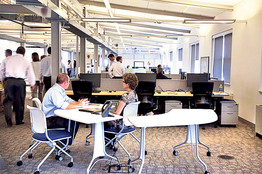
But a layout that is largely devoted to people working at desks alongside the same colleagues each day is very 2019. With fewer people coming in and more emphasis on collaboration, fewer desks will be assigned to individuals. Instead, there will be more shared areas, or “neighborhoods”, where people in a team can work together flexibly.

Designs for the post-Covid office must also allow for hybrid work. Meetings have to work for virtual participants as well as for in-person contributors: cameras, screens and microphones will proliferate.  All of which implies the need for flexibility. Laptop docking stations are simple additions, but other bits of office furniture are harder to overhaul. Desks themselves tend to be tethered to the floor through bundles of cables and plugs. Will the office of the future feature desks with wheels? With flexible meeting rooms whose walls that lift and slide?

Optimists think the office of the future will be a spacious, collaborative environment that makes the commute worth it. But in reality, pragmatic considerations—how much time is left on the lease, the physical constraints of a building’s layout, uncertainty about the path of the pandemic—will determine the physical look. Whatever happens, the office won’t be what it was.

Classroom discussion questions:

  1. Discuss the history of office layout. (Hint: see pages 371-3 in your Heizer/Render/Munson text).
  2. Why is this an important OM issue?

OM in the News: The New Office Layout

Cushman & Wakefield is bringing its ‘Six-Feet Office’ concept to offices in LA and NYC.

When employees file back into American workplaces—some wearing masks—many will find the office transformed, writes The Wall Street Journal (May 12. 2020). Desks, once tightly packed in open floor plans, will be spread apart, with some covered by plastic shields and chairs atop disposable pads to catch germs. The beer taps, snack containers, coffee bars and elaborate gyms and showers that once set high-dollar, white-collar environments apart will likely remain closed to prevent the spread of coronavirus.

The office adaptations reverse a decadeslong push in American corporations to cram workers into tighter spaces, with few separations between colleagues. Companies once spent millions of dollars retrofitting spaces to create rows of open desks, intimate conference rooms and elaborate communal gathering areas. Those designs, highlighted on page 373 in Chapter 9 (Layout Strategies), are now problematic. Modifying offices to safely allow some workers to return is even more challenging than sending people home. Some hallways and stairwells will become one-way, and many conference rooms will stay shut because they are too small to allow people to spread out.

Co-working giant WeWork once prized density, making corridors narrow on purpose so that people were more likely to bump into each other and chat. It rented out access to its “hot desks”—large, shared tables with no assigned seating. Cushman & Wakefield, a real-estate-services firm, plans to feature plexiglass dividers between desks and circles on the floor to indicate how far apart.

Classroom discussion questions:

  1. What changes would you recommend we make in our presentation of Office Layout in Chapter 9?
  2. Will these changes become a permanent part of office life?

OM in the News: Office Layout in Silicon Valley

Throughout Silicon Valley, cash-rich technology firms are building bold, futuristic headquarters that convey their brands to employees and customers. Uber, for example, is designing an entirely see-through HQ. It is expected to have some interior areas, as well as a park, that will be open to the public. The very newest buildings, such as Apple’s, are highly innovative in their internal layout. Some of that is because of fierce competition within the tech industry for the best talent: firms are particularly keen to come up with attractive, productive environments. “But these new office spaces will also signal how work is likely to evolve,” writes The Economist (April 29, 2017).

The big idea championed by the industry is the concept of working in various spaces around an office rather than at a fixed workstation. Employees may still have an assigned desk but they are not expected to be there, and they routinely go to different places to do various tasks. There are “libraries” where they can work quietly, as well as cafés and outdoor spaces for meetings and phone calls. The top floors of Salesforce Tower, for example, will be used not as executive corner offices but as an airy lounge for employees where they can work communally.

A fluid working environment is meant to allow for more chance encounters, which could spur new ideas and spark unexpected collaborations. Facebook has the world’s largest open-plan office, designed to encourage employees to bump into one another in its common spaces and garden. Amazon aims to make communal areas into “living-room-like spaces.” The lack of fixed workstations shrinks the amount of expensive real estate given to employees without leaving them feeling too squeezed. Tech firms devote around 15 square yards to each employee, 1/4 less than other industries.

Young workers are thought to be more productive in these varied environments, which are reminiscent of the way people study and live at university. One drawback, however, is that finding colleagues can be difficult.

Classroom discussion questions:

  1. Are these layouts likely to permeate other industries?
  2. Will everyone be pleased with the new designs?

OM in the News: Revolutionizing Office Layout–Part 1

Open plan designs dominate Sky’s new HQ

Today’s and tomorrow’s blogs tell the story of the new approach to office layout (Chapter 9) at several forward thinking companies: Today we note Britain’s Sky TV (outside London). Tomorrow, we look at some Silicon Valley high-tech office layouts.

“The Sky TV building’s steel staircases appear to be randomly scattered,” writes The Financial Times (May 2, 2017). But there is architectural intent in this — they encourage people to circulate and mix. It is a hot-desking environment but also offers a range of facilities for those wanting some sense of seclusion and privacy. Staff can work anywhere across the building. People type away in sofa-filled zones, in cafés and in booths.

While these ingredients are found in many modern offices, there are a couple of unusual features. One is a full-size cinema to one side of foyer, used for screenings and meetings. The other is a glass-walled studio in the middle of one of its atriums. There, a Sky News presenter is talking live. There are different clustered arrangements of desks — the idea is to break up space so attention is not solely focused on endless banks of desks receding into the distance.

Some of the innovations designed to ease the working week are less obvious. Sky’s CEO says much of the internal mail system deals with personal rather than business-related post. The reason for this is that most work communication is now done electronically and people do a lot of shopping online. “We have an Amazon collection point here. Why treat it as a problem when it can be a benefit?”

Classroom discussion questions:

  1. How does Sky TV’s layout differ from traditional office designs?
  2. What are the advantages and disadvantages of the layout described?

OM in the News: Citigroup’s New Office Plan–No Offices

Citigroup CEO Michael Corbat at the bank’s HQ, under renovation. Corbat says the open floor plan will encourage communication.

In renovating its Manhattan tower, Citigroup is planning to offer all the amenities of the modern skyscraper, including a rooftop deck, state-of-the-art gym, upgraded coffee and faster elevators. But when the bank’s executives move this month into their new digs at the 39-story office building, they will find one big thing missing: actual offices. The nation’s 3rd-largest bank is making the shift to an open-plan layout—a vibe more identified with tech startups than global banking conglomerates—where no one, not even its CEO will have a door. Most employees won’t even get their own desks.

Citigroup says the setup will connect people face-to-face, raise energy levels and save money, by fitting more people into one space. The new layout is minimalist and egalitarian. Because most desks aren’t assigned, employees must lock up their family photos and personal stuff each night. Everyone gets a window view—but no one gets complete privacy.

“Researchers disagree about whether open offices foster communication or encourage distraction,” writes The Wall Street Journal (Dec. 26, 2015). The wall-less workspace is meant to flatten hierarchies, something banks have traditionally been built on. The Citicorp CEO’s new 360 sq. ft. workspace won’t have walls or a door. Instead it features tall glass dividers to provide what the bank calls “seated privacy.” Lesser executives get semiprivate spaces of 180 sq. ft.

The bank says it carefully considered its employees’ concerns. The design—from white-noise generators to walls and ceilings that absorb sound—is meant to minimize the distraction of nearby conversations. Each floor will have multiple conference rooms and small phone rooms for private conversations. But other banks that have incorporated some open spaces have kept private offices for almost all of their senior executives.

Classroom discussion questions:

1.Why is office layout an important OM decision?

2. What are the 3 physical and social aspects that workspace layout must balance (see Chapter 9)?

OM in the News: The New Office Is Oh So Quiet


The dream of workspace serenity

“In the prototypical modern workplace,” writes BusinessWeek (July 10, 2014), “desks are spread around open floors or clustered in pods.” The theory is that this encourages collaboration and creates the chance interactions among colleagues from which breakthroughs emerge. And of course, these layouts also allow more workers to be economically squeezed into less space. As a result, the quiet and calm necessary for deep thinking, and the solitude that nourishes the introverted mind, are obliterated. In the past century (since Steelcase–the largest office furniture company–invented the “modern efficiency desk”), the American office has only grown more open. Today, with “flat management structure” and “radical transparency,” even CEOs have put their desks in the bullpen.

This is despite a growing body of research that underlines the open plan’s drawbacks. A 2013 study in the Journal of Environmental Psychology found that the idea of open plans improving morale and productivity has no basis in the research literature. An earlier paper looked at physiological and mental effects from being subjected to 3 hours of simulated office sounds. Among other things, participants gave up faster on a set of unsolvable brainteasers—their willpower presumably sapped by simply having to endure the noise. And while workers in open-plan offices do indeed talk to each other more, those conversations are superficial, because the conversants know neighbors can listen in.  Steelcase’s own surveys found that privacy has been the No.1 issue for years. It’s the biggest gap between what workers have and what they want.

Unveiled last month, Steelcase has introduced five new office layout rooms: Be Me, Flow, Studio, Green Room, and Mind Share. Studio has a low chaise, a plush rug, and a basket of rolled-up yoga mats in one corner. In Be Me, a daybed takes up one side of the space, encouraging reclining, even napping. Green Room, designed for introvert-friendly small meetings, has a sectional sofa– introverts prefer to converse obliquely, not face-to-face.

Classroom discussion questions:

1. How have office layouts changed over the years?

2. Why is layout an important OM issue?

OM in the News: Office Layout as an OM Strategy

The Wall Street Journal (Feb.29, 2012) writes that “companies looking for cost savings are increasingly packing more employees into less space.” This Chapter 9 topic of office layout reflects a trend causing high commercial vacancy rates in a slowly recovering economy. Panasonic, for example, is moving from a 575,000 square foot campus in New Jersey to a 280,000 sq. ft. one nearby. This comes without reducing headcount, but rather reconfiguring its offices. The General Services Administration (GSA) is building a new 800,000 sq.ft. DC headquarters that will hold 6,000 employees. Its current building houses just 2,400 employees in 700,000 sq. ft.

It turns out that with workstations shrinking and private offices disappearing (replaced by more cubicles with low walls), and with more employees working remotely, employers have been gradually taking up less space for decades. Firms today take about 200 sq.ft. on average per employee, down 20% from a decade ago. And “the amount of space is continuing to shrink,” according to an industry expert.

Landlords of top space are particularly concerned about law firms, which for decades devoted large swaths of their offices to filing cabinets and libraries, as well as desks for support staff. But lawyers need fewer assistants, and technology is shrinking, or making obsolete, the need for paper storage. San Diego law firm Robbins Geller Rudman & Dowd just contracted its space by 20%, to 114,000 sq.ft.,while adding more lawyers.

Discussion questions:

1. Is there a similar trend to reduce operations space in manufacturing?

2. What other benefits accrue from shrinking office space per employee?

OM in the News: Layout and the Shrinking Office

Office layout may not be the most exciting topic we teach in Chapter 9, but  an article in The  New York Times (Jan.19,2011) will definitely catch your students’ attention. Titled “Office Work Space is Shrinking”, students will discover that their future office may be a lot smaller than they anticipated, but that’s not all bad.  As employees become more mobile and less tied to their desks, the work space per employee nationwide (across all industries) has dropped from 400 sq. ft. in 1985 to 250 sq. ft. today. And it’s heading towards 150 sq. ft. within 10 years.

“A lot of thinking about the office has changed”, says the president of Steelcase, which is the leading office furniture maker. “The work setting was a reflection of your status.  A job focuses more on collaboration  than on the individual now”.

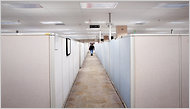
Intel, featured in the Times article, was known for decades for its endless rows of gray cubicles, low ceilings, and flourescent lighting. Intel was never one of those tech companies to offer beanbag chairs, designer desks, or pinball machines. But in the last 2 years, the company has completed a major relayout of over one million sq. ft. of office space. Gray walls are now yellow, purple, and white,  cubicle walls are low enough to see  other employees, and lounges have been equipped with flat-screen TVs, comfy chairs, and sleek kitchens. The whole idea was to get people to work more in groups, rather than be isolated at their desks.

This also saves money. With less space needed per person, one newly layed-out floor at Intel holds 1,000 employees, up from 600. In some departments where employees are on the road a lot, two people may be assigned to one desk. Even tradition-bound firms in accounting and banking are embracing the open-floor layouts. The thinking is that downsizing makes people interact more and become more productive.

Discussion questions:

1. What are the plusses and minuses of the new office layout concept.?

2. Which system do students prefer–private offices(or cubicles) vs. open floor plans?