OM in the News: A Soap Maker Cracks the Code to ‘Made in America’

A $7.95 bottle of Bath & Body Works (BBW) foaming hand soap used to take 3 months to put together. The pieces had to travel more than 13,000 miles from China, Canada and Virginia to the company’s Ohio distribution center.

Bath & Body Works decided it needed to get new products to market more quickly. The result was a production initiative with little parallel in corporate America, writes The Wall Street Journal (July 26, 2023). The new campus includes 10 manufacturers and millions of square feet of production and warehouse spaces, with 5,000 employees working there.

Now every step of production occurs at plants just feet from each other on the company’s dedicated “beauty park” near Columbus, Ohio. One factory makes the foaming pump and mechanism. Another makes the bottle itself, a third makes the label, a fourth makes the soap, fills the bottle, attaches the label and screws on the top. A fifth packages it. Getting a bottle to distribution is down to 21 days and a few miles. A majority of Bath & Body Works products, which are sold in its own stores, are made on site.
BBW persuaded companies throughout its supply chain to move to an Ohio city near its HQ

Bringing production closer to home, often called “reshoring,” has become a priority for many companies. Disruptions from Covid-19, severe weather, trade wars, geopolitical tensions and stuck ships left consumers without the couches and hot tubs they wanted. While competitors struggled with shortages, BBW’s suppliers on location shared raw materials and even employees. (Persistent supply-chain issues are leading to a factory building boom, with spending at its highest level in at least 20 years).

But moving production to Ohio wasn’t easy. Factories had to contend with planning officials, high labor and construction costs and even endangered bats. And BBW had to persuade its best suppliers to move. The plus for suppliers was continuing to do business with volume guarantees from BBW for a set number of years. The minus: spending millions to relocate production and buy new equipment. There was a lot of supplier resistance to overcome.
The BBW campus can be a model for other companies and communities. It has attracted an Amgen pharmaceutical plant. Intel just chose the area as the site of a $20 billion semiconductor facility. Intel said the plant would attract dozens of new local suppliers, including semiconductor equipment makers and other materials providers.
Classroom discussion questions:
1. What makes reshoring so difficult?
2. What are the advantages BBW gained in this major move?

OM in the News: Intel Speeds Up Its Chip Revival

Intel is making major plays in the field of semiconductor manufacturing, reports Industry Week (March 24, 2021). The California company announced it would spent $20 billion on two new semiconductor factories in Chandler, Arizona. The plants are expected to employ 3,000 people in “high-tech, high-wage” manufacturing jobs.

Intel’s plan is to challenge rival chip manufacturers around the world like Samsung of South Korea and TSMC of Taiwan, which currently produce many of the computer chips used in electronic products from cell phones and laptops to electric vehicles and refrigerators. The U.S. now accounts for just 12% of global semiconductor manufacturing capacity, down from 37% in 1990, as other countries have subsidized their chip makers.

intel

The $20 billion plants will produce Intel’s “first large-scale foundry operation,” and it has plans to pick more sites for foundries in the U.S. and Europe.

Semiconductor foundries, like those operated by TSMC, typically produce chips designed by outside customers, like Qualcomm or Apple, which don’t have chip production facilities of their own. Intel already designs and produces its own chips, but its new foundry business will allow other companies to leverage Intel’s production lines and proprietary chip construction techniques.

The move to enter the semiconductor foundry field comes at an opportune time for Intel. GM, Ford, and Honda, among other automakers, have run into vehicle production bottlenecks caused by a shortage of semiconductors. That shortage, in part, has been driven by an increased demand for computer electronics during the very pandemic that crushed vehicle production in the spring of 2020 that automakers are currently trying to recover from. 

Classroom discussion questions:

  1. Why did semiconductor production shift to Asia?
  2. Why is the U.S. government now trying to strengthen chip manufacturing in this country?

OM in the News: Apple Gains Control by “Insourcing”

“Apple built its gadget empire by outsourcing production to a vast ecosystem of chip makers and other component specialists. It is now taking a lot of that business back,” writes The Wall Street Journal (June 24, 2020). The company, which released its first iPhone processor in 2010, plans to ship Macs this year with custom chips, a move that ends a 15-year technology partnership with Intel. (Intel stands to lose about $2 billion in laptop chip sales annually). Apple said the custom-designed chips are more efficient and offer higher-performance graphics.

The plan fits into Apple’s broader strategy of replacing many third-party parts with components designed in house. Apple’s built-for-purpose parts now account for 42% of the costs of core iPhone components, up from 8% five years ago. Custom components have cut costs, boosted performance and increased Apple’s control over future releases. The new Mac processors will shave $75 to $150 off the cost of that computer.

The strategy springs from Apple’s philosophy—fostered by Steve Jobs—that owning core technologies provides a competitive edge. Customized chips and sensors can help its iPhone, iPads and Macs leapfrog rivals in battery performance and features. It also can protect Apple from Chinese rivals that buy universally available parts. Apple relied on third-party components for years while it built the engineering depth and expertise it needed to design more components itself. Apple’s chip division has mushroomed over the past decade to thousands of engineers.

The initiative—called insourcing—can give Apple a 2-year jump on competitors in device performance because Apple can plan how multiple chips work together to limit power consumption and free up space inside iPhones and iPads for other components. Many companies continue to supply Apple, which provides substantial revenue, even as they fear Apple will start making the very components they provide it.

Classroom discussion questions:

  1. What are the reasons Apple chose to “insource?”
  2. How is Apple achieving competitive advantage through OM? (Hint: See pp. 36-39 in your Heizer/Render/Munson text).

OM in the News: Seeking Semiconductor Self-Sufficiency

The U.S. is looking to jump-start development of new chip factories here as concern grows about reliance on Asia as a source of critical technology, reports The Wall Street Journal (May 11, 2020). A new crop of cutting-edge chip factories in the U.S. would reshape the industry and mark a U-turn after decades of expansion into Asia by many American companies.

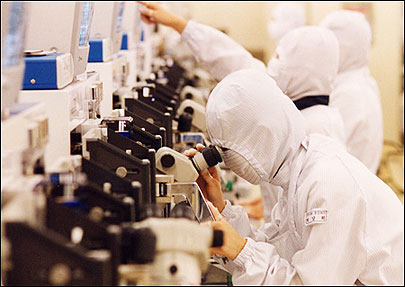
Inside a chip factory

The pandemic has underscored longstanding concern by the U.S. about protecting global supply chains from disruption, especially from Taiwan Semiconductor Manufacturing (TMSC), the world’s largest contract chip manufacturer. TSMC is one of only 3 companies capable of making the fastest, most-cutting-edge chips. U.S. officials are in talks with Intel, the largest American chip maker, and with TSMC, to build factories in the U.S. TSMC said it is open to building an overseas plant.

Strengthening U.S. domestic production and ensuring technological leadership is “more important than ever, given the uncertainty created by the current geopolitical environment,” says Intel’s CEO. Chip-factory development plans have gotten under way as concern mounts about the fragility of the Asian supply chain and the defense industry’s access to domestically sourced advanced chips.

The U.S. already has dozens of semiconductor factories, but only Intel’s are capable of making the fastest and most-power-efficient chips (those with transistors 10 nanometers or smaller). Intel, however, mostly makes silicon for its own products. Among foundries that make chips on contract for other companies, only TSMC in Taiwan and Samsung in South Korea make chips at 10 nanometers or lower.

U.S. chip makers have backed off on building cutting-edge chip factories domestically largely because of their cost, which can surpass $10 billion, and a rapid development cycle that means the benefits of being ahead don’t last long. But other governments, including China, Taiwan, Singapore and Israel, have poured generous financial support into developing their own domestic manufacturing.

Classroom discussion questions:

1, How does this idea mesh with the theory of comparative advantage (see Ch. 2 in your Heizer/Render/Munson text)?

2. Where do Intel and TSMC fall on the international operations strategies graphic seen in Figure 2.9 on page 48?

OM in the News: Chip Makers Push Spending for Faster Processors

South Korean manufacturer Samsung’s chip-fabricating facility under construction

“Chip makers are seeing the light. And it is costing them,” writes The Wall Street Journal (Nov. 6, 2019). Companies like Taiwan Semiconductor Manufacturing (TSMC), Intel, and Samsung are racing to produce smaller and faster processors. But the latest manufacturing processes, which require new types of production tools, are pushing the bounds of physics. These include systems that use extreme ultraviolet light, or EUV, to produce chip circuitry at a much thinner width than was possible with more commonly used light sources.  This requires special equipment for testing and process control– and means investments are reverberating through technology supply chains..

EUV tools are expensive—especially if one has to equip an entire semiconductor fabrication facility with them. ASML, the largest supplier of EUV lithography tools for chip makers, saw revenue of $827 million from the sale of just 7 EUV systems in the last 3 months. That works out to about $118 million per machine. Such systems also require other types of equipment for process control and testing. All told, the cost of building a new leading-edge chip-fabrication facility is now well into the billions. TSMC disclosed plans two years ago to spend $20 billion on just one new fab.

So it is little surprise that chip makers are cracking open their wallets. TSMC  plans to spend $14-$15 billion this year in capital expenditures—nearly 40% above its  stated target. Intel says its $16 billion capital expenditure (capex) target this year is a company record—and 36% above what it spent just two years ago. Samsung said it plans to spend about $20 billion this year on total semiconductor capex.

Classroom discussion questions:

  1. Why is chip making such a capital intensive business?
  2.  What is a “fab”?

OM in the News: Intel’s Chip Shortages

A shortage of high-end computer chips from Intel is being felt in other parts of the tech sector, reports The Wall Street Journal (Sept. 24, 2018). The question is how far it might spread.

Intel supplies the vast majority of CPU chips for the PC market today. Most are produced with circuitry measured at 14-nanometers—the most advanced manufacturing node Intel currently has in mass production. Intel has three facilities capable of producing chips at that level, but those facilities are also in high demand for the type of processors that power data centers, which is Intel’s business line with the best growth. Some of that capacity is also now going toward producing modem chips used in the latest generation of iPhones, which just hit stores.

Intel, in other words, has many demanding customers competing for a finite amount of manufacturing capacity. And while the company has already boosted its planned capital expenditure for the year by $1 billion, such facilities can’t be expanded quickly—especially while the company is struggling to shift some of its production to a new, more advanced 10-nanometer process. That makes it difficult to respond to rapid changes in the market, like the recent surprising jump in PC demand. Second quarter PC shipments grew globally for the first time in six years.

Server-chip demand is also booming, fueled mostly by capital spending from tech giants like Google, Amazon, Microsoft and Facebook, which are building data centers to power cloud-based services. Those four invested over $34 billion in the first 6 months of this year, up 59% from a year earlier.  Capital spending by big tech companies could slow if those they aren’t able to get enough server processors to meet their own expansion plans.

Classroom discussion questions:

  1. Why is Intel unable to fully meet current chip demand?
  2. Who are Intel’s main customers and what is Intel’s main product?

OM in the News: Intel, Mobileye, and Autonomous Cars

In the world of driverless cars, household names like Google and Uber have raced ahead of rivals, building test vehicles and starting trials on city streets. “But when it comes to what is under the hood, an array of lesser-known companies will most likely supply the technology required to bring driverless cars to the masses,” writes The New York Times (March 14, 2017). And in a $15.3 billion deal to acquire the Israeli firm Mobileye, Intel just moved to corner the market on how much of that technology is developed. Jerusalem-based Mobileye makes sensors and cameras for these vehicles.

Intel estimates the market for autonomous-driving systems, services and data will reach $70 billion by 2030. “You can think of the car as a server on wheels,” says Intel’s CEO. “The average autonomous car will throw out 4 terabytes of data a day, so this is one of the most important markets and one of the fastest-growing markets. The deal with Mobileye merges the intelligent eyes of the autonomous car with the intelligent brain that actually drives the car.”

 Mobileye’s technology helps a car see and understand the space around it, providing functions such as automatically keeping a car in its lane. It includes 360-degree vision and mapping, and integrates various sensor elements such as cameras, radar, sonar and the laser-sensing technology known as LiDAR. 

Intel has struggled lately with the persistent decline of PC sales, which show little sign of reversing. To drive growth, the company is focusing on artificial intelligence, and self-driving cars are among the more promising applications of AI.

Classroom discussion questions:

  1. Why is Intel leaving its core business? Advantages? Disadvantages?
  2. What is Mobileye’s strength?

OM in the News: Chip Makers Plot a Future in the U.S.

Degowning at the IM Flash plant

Nestled at the foot of Utah’s Wasatch Mountains, the IM Flash plant is a paragon of American high-tech manufacturing. Robots glide along the ceiling, moving silicon wafers the size of dinner plates between hulking machines that deposit and etch microscopic layers of material to build the most advanced memory chips in the world. For the 1,700 technicians and scientists who tend to the robots and troubleshoot problems in the delicate manufacturing process, the jobs offer generous pay and benefits.

For Intel and Micron Technology, the two American companies that jointly own and operate IM Flash, the venture allows both of them to sell cutting-edge, 3-D memory chips while sharing the multibillion-dollar costs of a modern semiconductor factory. In many ways, however, the IM Flash plant is an outlier. “While companies based in the U.S. still dominate chip sales worldwide, only about 13% of the world’s chip manufacturing capacity was in this country in 2015, down from 30% in 1990,” reports The New York Times (Feb. 27, 2017).

“It’s quite a bit more expensive to build a factory in the U.S.,” says Intel. The firm (which also has factories in Ireland, Israel and China) estimates that the extra cost for an American plant is more than $2 billion. Chip makers are hopeful that President Trump, who has promised large corporate tax cuts and a tougher approach to trade with China, will help them. The chip industry spends 1/5 of its revenue on R&D.

Looming in the background is China, which is currently a bit player in the industry but has committed to spend upward of $100 billion to create a world-class chip industry. “China is the largest market for us on the planet,” says an Intel OM exec. “It made sense to locate some production in China.”

Classroom discussion questions:

  1. Why has chip manufacturing declined in the U.S?

      2. Why is this a critical industry to retain?

OM in the News: Intel’s $7 Billion Arizona Chip Plant

intelNew chip plants are tremendously expensive,” writes The New York Times (Feb. 9, 2017), “requiring large tracts of land, reliable electricity and water, and a skilled work force that includes people with doctorates in chemistry and technicians who can repair a malfunctioning robot.” Sophisticated equipment is necessary to deposit and etch microscopic layers of material on silicon wafers, which are then cut and packaged into the microprocessors that run PCs, servers, smartphones and, increasingly, other electronic devices.

Countries compete to land such plants, especially modern factories that produce the most valuable chips and bring high-paying R&D jobs. Government subsidies are common, with China vowing to spend tens of billions of dollars to expand its domestic chip industry. While most technology manufacturing, such as computers and smartphones, has moved overseas, American factories still account for 1/7 of global chip production and produce many of the most valuable computer chips, including Intel’s flagship processors. Seventy-six chip plants are scattered across the U.S., from Maine to California.

Intel’s new $7 billion, 3,000 employee, chip plant in Arizona plant will build ultradense chips that Intel refers to as 7 nanometer, with transistors packed more closely together than in the chips the company now builds. The tighter spacing allows for faster, more energy-efficient chips. “This factory will produce the most powerful computer chips on the planet,” says Intel’s CEO, who adds: “the company had decided to proceed because of the tax and regulatory policies we see the (Trump) administration pushing forward.” Intel also has factories in China, Ireland and Israel.

Classroom discussion questions:

  1. Why are chip factories important to the U.S?
  2. Why is chip manufacturing a tough business to enter and succeed in?

OM in the News: Troubleshooting Intel’s Supply Chain in the Congo

congo minesAmerican manufacturers have for years been under pressure from Congress to avoid buying “rare earths” and minerals from rebel held mines in the Congo. Government commanders and rebel ­militias in the Democratic Republic of the Congo earn about $185 million annually through the illicit trade of gold and so-called 3T minerals (tin, tantalum, and tungsten)—crucial ­elements in consumer electronics such as cell phones and tablets. The revenue has financed a brutal ongoing conflict resulting in the deaths of millions of innocent people. Intel no longer wanted to contribute to an economy of suffering. Just recently, reports FastCompany (April, 2015), Intel became the first company to build microprocessors entirely from conflict-free minerals.

But controlling the supply chain process at Intel was not at all simple. Identifying how conflict minerals entered its supply chain was key to eliminating them. Smelting plants, where raw ore is refined, offered one place to trace the origin of minerals, if only the facilities would comply with a transparent auditing process.

Over five years, Intel’s supply chain director, Carolyn Duran, and her team visited 91 smelters in 21 countries, using Intel’s purchasing power to put pressure on smelters to develop and implement an auditing system to track minerals so corporate buyers can source responsibly. The result: Nearly half the world’s 3T and gold smelters have now passed conflict-free audits, shrinking the market for illegally traded minerals and reducing warlords’ profits. Intel hopes to be able to declare its entire product line conflict-free by 2016, inspiring other firms to do the same.

Classroom discussion questions:

1. Why are rare earths critical to the supply chain and which countries supply them?

2. Why did Intel try to set this precedent?

OM in the News: New Product Design Keeps Intel a Generation Ahead

Chapter 5 discusses the critical importance of new product design in OM and the impact it can have in the technology arena. Indeed, as The New York Times (May 4,2011) breaks the news about Intel’s success in a 3-D transistor design, we see how important staying ahead of the fierce competition can be. Breaking away from a design (called the planar transistor) that has been a constant in the chip industry since 1959, Intel has found a way to make smaller, faster, and lower-powered chips.

Its designers are turning from 2-dimensional transistor switches (the basic building block of the information age) to a third dimension to find more room. Intel said yesterday that the new process allows chips to run 37% faster in low voltage applications (like iPhones and iPads), while power consumption drops 50%. 

This exciting news is significant because it means the world’s largest chip maker (see yesterday’s blog about the industry) is not slipping from the pace of doubling the number of transistors etched onto a sliver of silicon every 2 years, a phenomenon known as Moore’s Law. This “law”, named after Intel’s co-founder, has set the computer industry apart from other manufacturing because it continued to improve at an accelerating rate.

Intel currently uses  a photolithographic process to make a chip and the current generation is called a 32 nanometer chip. (By comparison a human red blood cell is 7,500 nanometers in width). “Intel is on track for  22 nanometer manufacturing later this year”, says the scientist in charge of the project. By 2015, the firm is on target to make chips in a 10 nanometer generation.

Being first out with the 3-D chip technology gives Intel a full generation lead over competitors, but it does not guarantee success in a fast-changing consumer products market where “ultra-low power” chips are critical in consumer products.

Discussion questions:

1. Why is Moore’s Law a critical part of the chip industry?

2. What is Intel’s gamble in developing the 3-D chip?

OM in the News: Chip Makers Bet the Farm on Future Demand

The New York Times (May 3, 2011) has just reported some good news for US manufacturing, namely, the massive expansion of chip makers who are counting on continuing heavy demand for chips in smartphones, tablet computers, refrigerators, cameras, and GPSs. Samsung, the huge Korean chip maker, is betting $3.6 billion in expanding  its US factory to make logic chips for iPhones and iPads. The plant in Austin, scheduled to be completed next month, will be 2.3 million sq.ft., about the size of 40 football fields and one of the biggest factories in the country. Samsung chose Austin because of “the infrastructure and support system here–you can’t get that from anywhere else”.

Intel, the world’s largest chip maker, is spending $13 billion to build 2 new factories and upgrade 4 others in Oregon and Arizona, with the work to be complete in 2013. “When you make an investment in a factory, you’re essentially placing a bet on a manufacturing process that’s not yet done, for products that are not yet designed,  to sell in market that is not yet there”, says Intel.

Global Foundries, a contract maker (also called a foundry) of chips, is investing $4.6 billion in a new plant near Albany, NY,  that will build 28-nanometer chips for customers. (Small companies cannot afford the $ multibillion investment in making their own). Its 1.5 million sq. ft. plant will also open in 2013. “The appetite for tablet computers is a huge part of this move” to become the biggest contract chip producer in the world, says the  Milpitas, CA, company.

The chip industry “is a risky business that’s not for the faint at heart. Its like putting down $1 billion on the craps table”, adds an industry analyst.

Discussion questions:

1. The NYT article focuses on new chip plants in the US. But chip makers are also expanding this year in China, Germany, Japan, S. Korea, and Taiwan. Why the global move?

2. What happens to plants that are out-of-date?

OM in the News: Intel Brings Good News to US Manufacturing

In these troubled times, Intel’s announcement  (Computerworld, Feb.18,2011) that it would start construction this year on a new $5 billion microprocessor plant in Chandler, Arizona is indeed good news. The company, which also does manufacturing in Oregon and  New Mexico in the US, and in Israel, Ireland, and China overseas, will open the Arizona plant in 2013 with 1,000 highly paid permanent workers.  When complete, the factory will be the most advanced, high-volume semiconductor facility in the world. Fab 42, as it will be called, will produce 14-nanometer chips. (Nanometers, billionths of a meter, measure the width of chip circuits. Shrinking them makes chips more powerful or cheaper to make). The chips will be used in PCs, electronics, and mobile phones.

Intel has already committed another $6-8 billion this year to make upgraded chips at its other plants and to build a new plant in Oregon. This will provide those facilities the ability to produce 22-nanometer chips, which are in turn faster than the company’s current 32-nanometer chip-making process. The upgrades budgeted by this money will create yet another 1,000 high-skilled jobs, along with 6,000+ construction jobs. Intel will further hire 4,000 new R&D workers this year to round out the positive news. Revenue is expected to rise 14% to $49.5 billion, according to Bloomberg (Feb.18,2011).

The company, which makes 3/4 of its chips in the US,  was praised last week by President Obama, who stated: “By and large, Intel has placed its bets on America”. Intel execs, meanwhile, have called on the US government for tax breaks to make it cheaper to build facilities in the US.

Discussion questions:

1.Why is the Intel announcement such good news?

2. Why does Intel have plants abroad?

3. What makes chip manufacturing such a difficult business?

OM in the News: Layout and the Shrinking Office

Office layout may not be the most exciting topic we teach in Chapter 9, but  an article in The  New York Times (Jan.19,2011) will definitely catch your students’ attention. Titled “Office Work Space is Shrinking”, students will discover that their future office may be a lot smaller than they anticipated, but that’s not all bad.  As employees become more mobile and less tied to their desks, the work space per employee nationwide (across all industries) has dropped from 400 sq. ft. in 1985 to 250 sq. ft. today. And it’s heading towards 150 sq. ft. within 10 years.

“A lot of thinking about the office has changed”, says the president of Steelcase, which is the leading office furniture maker. “The work setting was a reflection of your status.  A job focuses more on collaboration  than on the individual now”.

Intel, featured in the Times article, was known for decades for its endless rows of gray cubicles, low ceilings, and flourescent lighting. Intel was never one of those tech companies to offer beanbag chairs, designer desks, or pinball machines. But in the last 2 years, the company has completed a major relayout of over one million sq. ft. of office space. Gray walls are now yellow, purple, and white,  cubicle walls are low enough to see  other employees, and lounges have been equipped with flat-screen TVs, comfy chairs, and sleek kitchens. The whole idea was to get people to work more in groups, rather than be isolated at their desks.

This also saves money. With less space needed per person, one newly layed-out floor at Intel holds 1,000 employees, up from 600. In some departments where employees are on the road a lot, two people may be assigned to one desk. Even tradition-bound firms in accounting and banking are embracing the open-floor layouts. The thinking is that downsizing makes people interact more and become more productive.

Discussion questions:

1. What are the plusses and minuses of the new office layout concept.?

2. Which system do students prefer–private offices(or cubicles) vs. open floor plans?