
For decades, the Pringle has been one of the most recognizable snacks in the world—uniform, crunchy, and engineered for consistency. But behind that iconic saddle‑shaped chip lies a surprisingly complex manufacturing challenge, writes The Wall Street Journal (Aug. 11, 2026). At Pringle’s factory in Poland, engineers have spent the last four years pursuing a bold goal: use AI to make every single Pringle a perfect one.
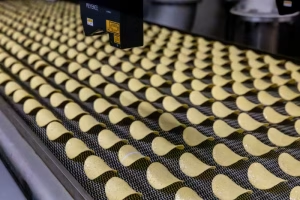
This ambition led to a deep partnership with Siemens and a $4–5 million investment to build an AI‑powered digital twin (our topic in Module F of the text) of the Pringles production line. Unlike traditional 3‑D models, this digital twin operates in real time, ingesting more than 200 data points every millisecond—from flour particle size to dough humidity to subtle variations in potato batches. These micro‑changes matter. Even potatoes from the same supplier can behave differently depending on the season, affecting texture, shape, and fry behavior.
Historically, dough makers relied on intuition: stretching dough by hand, weighing chips fresh from the fryer, and adjusting machines after spotting issues. Today, AI models simulate outcomes continuously, predicting how each batch will behave and recommending precise tweaks—more oil here, less water there—to keep quality stable. Human operators still make the final call, but the system’s guidance has already delivered measurable results: 10% improvement in chip quality, 13% reduction in waste, and a 40%+ return on investment on the Poland line alone.
The success is prompting expansion. Belgium is next, followed by U.S. production lines in 2027. Siemens sees this as part of a broader shift—digital twins are maturing across industries, from rockets to batteries to microchips. What began as static models are now intelligent optimization engines.
For Pringle, the future is even more ambitious. The company hopes its AI will eventually handle multiple varieties of potatoes, corn, and rice, adapting automatically while still producing the same signature chip. In other words, the perfect Pringle may soon be less a product of uniform ingredients and more a triumph of adaptive, intelligent manufacturing.
Classroom discussion questions:
- How might AI‑driven digital twins change the future of food manufacturing, and what new skills will workers need as these systems become more common?
- Should companies rely on AI to make real‑time production decisions, or is it important that humans remain the final decision‑makers? Explain your reasoning.