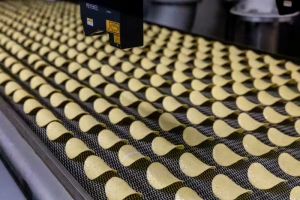
OM in the News: PepsiCo Turns To Digital Twins To Rethink Plants

We posted recently about the joint nuclear fusion digital twin work of Siemens and NVIDIA. Today’s news is that PepsiCo is working with the same two firms  to change how it designs, tests, and expands its plants and warehouses using AI and digital twins. “Physical industries are entering the age of AI. For companies with real-world assets, digital twins are the foundation of their AI journey,” said NVIDIA’s CEO.

By modeling factories and distribution centers digitally before making physical changes, PepsiCo hopes to cut down on costly mistakes while improving speed and capacity.

With AI-driven digital twins, teams can simulate plant layouts, equipment movement, and supply chain operations in detail, reports SupplyChain (Jan. 7, 2026). Instead of expanding facilities the old way, which can be slow and expensive, they can test changes virtually and see what works before spending money on physical upgrades.

“The scale and complexity of PepsiCo’s business is massive—and we are embedding AI throughout our operations to better meet the increasing demands of our consumers and customers,” said PepsiCo’s CEO. The digital models recreate machines, conveyors, pallet routes, and even worker movement, helping teams spot problems early and test different setups in weeks instead of months.

By finding bottlenecks and unused capacity in a virtual setting, teams increased throughput by 20%. The same approach has also shortened design cycles and helped cut capital spending by 10-15%. Testing ideas digitally first, teams can plan ahead, compare options, and move faster without the usual surprises that come with physical expansion.

Classroom discussion questions:

  1.  How is PepsiCo employing digital twins?
  2. How do AI and digital twins work together?

OM in the News: Digital Twins and Nuclear Fusion

Digital twins, which we cover in Module F (Simulations and Digital Twins), is a big topic at Nvidia and Siemens as they work together to make nuclear fusion a commercial reality. In that chapter (see p. 847), we define a digital twin as:  “an electronic virtual replica of an operation that allows organizations to mimic how a product, process, or system will perform.”

Workers at Commonwealth Fusion Systems’ campus in Devens, Mass

Fusion engineers at the Nvidia/Siemens venture, called Commonwealth Fusion Systems (CFS), will use its digital twin to run simulations, ultimately to hasten the goal of producing fusion energy at a commercial scale. CFS “will be able to compress years of manual experimentation into weeks” with the AI assistance, said its CEO.

Nuclear fission, which splits atoms to produce energy, is already in use in power plants, reports The Wall Street Journal (Jan. 7, 2026).  But many companies see fusion, the energy process that powers the sun by joining atoms together, as a longer-term bet because it can provide much more energy in a cleaner process. Nuclear energy appeals to tech giants because it releases minimal carbon emissions while providing round-the-clock power—particularly as they look to fuel their AI ambitions.

CFS said it was working with Google on an AI project, and explained that that effort has created something like a co-pilot for its fusion machine, while the digital twin plan “is the virtual airplane.” Google also recently signed a power purchase agreement with CFS to secure energy from what could be the first grid-scale fusion plant.

“The race is on for AI. Everyone is trying to get to the next frontier,” said Nvidia’s CEO.

Classroom discussion questions:

  1. Provide other examples of how digital twins can be used.
  2. Why is this fusion project so important as an OM tool?

OM in the News: 3-D Printing–or Additive Manufacturing?


A new way to turbocharge  turbine-making
A new way to turbocharge turbine-making

Engineering companies now prefer to talk about “additive manufacturing” rather than “3D printing,” writes The Economist (May 3, 2014). One reason is that printing is not quite the right word for some of the technologies given this label. Whereas hobbyist-scale 3D printers typically build a product by squirting out drops of plastic, a newer manufacturing technique called selective laser melting zaps successive layers of powder with a laser or ion beam, hardening only certain bits. Larger firms want to stress the “manufacturing” aspect: that technology has moved beyond the development labs and is now being used on the factory floor to make complex metal parts. In Siemen’s gas turbines, for example, elaborately shaped blade components are hard to design and costly to make. But Siemens is using additive manufacturing machines to cut the cost and the time needed to replace the blades on customers’ turbines when they break– eventually from 44 weeks down to 4.

For simpler mechanical parts, the approach allows designers to imagine shapes that would be impossible to create through older techniques, besides greatly speeding up prototyping—for turbine blades and similar parts, from 16-20 weeks to just 48 hours, Siemens says. Additive manufacturing cuts the cost of tooling and materials: a piece can have all of its holes incorporated into it, with great precision, as it is built up from powder, instead of needing to have them expensively drilled afterwards. Siemens hopes to cut the cost of some parts by perhaps 30%.  As it gets easier to make low-volume, specialized parts in-house, Siemens gains bargaining-power when it comes to outsourcing such parts to other firms.

Aircraft engines, subject to even higher standards of reliability than turbines, are another area in which the engineering giants have implemented additive manufacturing. GE is using it to make fuel nozzles for its next-generation Leap engines. GE says the nozzles will be 25% lighter and five times more durable than their predecessors—and since there are 20 or so in each engine, the weight savings are significant.

Classroom discussion questions:

1. Is there a difference between 3-D printing and additive manufacturing?

2. How will 3-D printers change the world of manufacturing?

OM in the News: Germany Exports Jobs Training to the US

Germany’s transplant-factories, like the sprawling VW complex in Chattanooga, aren’t just cranking out cars, machinery and chemicals. They are also bringing, writes The Wall Street Journal (June 14, 2012), a German training system that could help narrow America’s skilled labor gap. VW, which will graduate its first class of U.S. apprentices next year, is one of dozens of companies introducing training that combine German-style apprenticeships and vocational schooling.

These programs are winning adherents as manufacturers grapple with a paradox: Though unemployment remains stuck above 8%, companies can’t find enough machinists, robotics specialists and other highly skilled workers to maintain their factory floors. An estimated 600,000 skilled, middle-class manufacturing jobs remain unfilled nationwide, even as millions of Americans search for work.

“In the U.S. we’ve evolved to the point where we think the only thing people should strive for is a four-year college education, and factory work is seen as dirty, dangerous and repetitive,” says the director of the Aspen Institute’s Manufacturing and Society program. “In Germany, the work that is done on the factory floor and prepared by its vocational education system is highly valued.”

In Germany, 2/3 of the country’s workers are trained through partnerships among companies, technical schools and trade guilds. Last year, German companies took on and trained nearly 600,000 paid apprentices. In the U.S., such close cooperation doesn’t often exist. One stumbling block has been companies’ fear of spending on training, only to see apprentices go elsewhere. Siemens spends approximately $165,000 an apprentice in its new three-year mechatronics training program in Charlotte.  VW warns that without training its own skilled workers, it will struggle to expand: As it ramped up production this year, it needed a nationwide advertising campaign to fill 100 of the more specialized new jobs at the Chattanooga plant.

Discussion questions:

1. Why is VW willing to invest so much money in an apprentice?

2. Why are these programs more popular in Germany than in the US?