
As we note in Chapter 5, Design of Goods and Services, the dynamic market places changing demands on products. Such is the case for M&M. Mars, the manufacturer of M&Ms, under pressure from the “Make America Healthy Again” (MAHA) campaign, is striving to make them without artificial dyes.
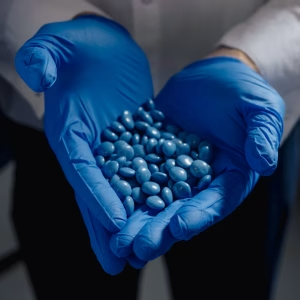
So M&M’s will mark a milestone in their 85-year history in August, debuting a version temporarily missing two hallmarks colors: brown and blue. Mars plans to color the remaining foods with dyes derived from natural sources.
The task is proving much harder and more expensive than it sounds, writes The Wall Street Journal (June 23, 2026). Blue is proving difficult to re-create affordably, and at scale. To complete the challenge, the company couldn’t reliably churn out brown M&M’s, which, it turns out, include a fair bit of blue. Some 100 employees are working on its natural-color efforts. A quarter of them are dedicated solely to finding a proper blue!
Companies have scoured the globe in search of raw materials to create a natural blue food color that can withstand changes to heat, light and pH. They have experimented with juice from a fruit found in Central and South America, petals from the butterfly pea flower in Southeast Asia, and spirulina (which works best, but leaves a sticky film akin to dental plaque inside the factory pipes).
All this means that Mars must upgrade more than 300 machines across its plants to handle spirulina. The company is installing new mixing tanks, paddles and motors. Moreover, new cleaning equipment will also be required to blast machines on the M&M’s lines for longer stretches, with hotter water and more force.
The company pledged a decade ago to cut artificial dyes from all of its human food. But it changed course for candy, saying many consumers weren’t worried about the dyes in those products.
This M&M story illustrates the pervasiveness of issues with new or altered designs. As is often the case at M&M and elsewhere, cross functional teams are needed for experimenting, international suppliers must be developed, capital investment for new equipment must be devoted, and new maintenance procedures to keep equipment working must be created.
Classroom discussion questions:
- Why is the move to healthier candy so difficult?
- Why not just drop the brown and blue M&M’s?
 Artificial intelligence tools like ChatGPT and Microsoft Copilot have already proven their value in many product designers’ daily design work, asking questions about design decisions and giving advice on design and CAD strategies. (See Chapter 5 in your Heizer/Render/Munson OM text).
 IKEA is today the world’s biggest seller of furniture, with 460 mostly franchise-operated stores spread across 62 countries that carry some 9,500 products. Its price-conscious shoppers wonder: How does a nice chair cost only $35?


