OM in the News: 3-D Printers and Jet Parts

A worker operates one of the large-scale 3-D printers developed by Norsk

Aerospace suppliers are eager to start using 3-D printing technology to turn out large, high-volume structural parts for jetliners, but U.S. FAA safety regulators are taking a go-slow approach toward approving such production. “Three-dimensional printing is a darling of the aerospace industry because it is relatively inexpensive compared with more-prevalent ways of making components,” writes The Wall Street Journal (June 21, 2017). Experts see the potential of eventually using 3-D technology to produce thousands of different parts at 30% lower cost than traditional milling methods.

But the FAA has to approve the overall process and certify that the cutting-edge, plasma-deposition technology is reliable enough to ensure identical strength and other properties from batch to batch. The Norwegian firm, Norsk Titanium, which has been laying the groundwork for the initiative for several years, already has FAA approval to produce a limited category of structural titanium parts for Boeing’s 787. By using titanium wire, rather than powder, as the raw material, the company is able to tackle larger parts and churn them out much faster than would be possible otherwise. Norsk’s 3-D printed production runs can be 100 times faster than those using powder, meaning some parts could be ready in a matter of hours, instead of days or weeks.

There are scores of companies itching to join the 3-D printing trend for aerospace alone. A large jetliner has between 300 and 1,000 structural titanium parts. GE is using a different, more time-consuming process for more intricate parts. It has approval to print thousands of fuel nozzles, for jet engines powering new planes from Boeing and Airbus , featuring complex internal structures that would be impossible to produce by traditional methods.

Classroom discussion questions:

  1. Why is 3-D printing a major issue for operations managers in aerospace?
  2. What is the FAA issue here?

OM in the News: Doctors Reveal They Can 3-D Print Body Parts

3d earUsing a sophisticated, custom-designed 3-D printer, regenerative medicine scientists at Wake Forest Medical Center have proved that it is feasible to print living tissue structures to replace injured or diseased tissue in patients. The scientists said they printed ear, bone and muscle structures, reports Fortune (Feb. 16, 2016). When implanted in animals, the structures matured into functional tissue and developed a system of blood vessels. Most importantly, these early results indicate that the structures have the right size, strength and function for use in humans.

“This novel tissue and organ printer is an important advance in our quest to make replacement tissue for patients,” said the team’s director. “It can fabricate stable, human-scale tissue of any shape. This technology could potentially be used to print living tissue and organ structures for surgical implantation.” The school aims to implant bioprinted muscle, cartilage and bone in patients in the future.

Tissue engineering is a science that aims to grow replacement tissues and organs in the laboratory to help solve the shortage of donated tissue available for transplants. The precision of 3-D printing makes it a promising method for replicating the body’s complex tissues and organs. To demonstrate the printing system can generate organized soft tissue structures, printed muscle tissue was implanted in rats. After 2 weeks, the muscle became vascularized and induced nerve formation. And, to show that construction of a human-sized bone structure, jaw bone fragments were printed using human stem cells. The printed segments of skull bone were implanted in rats. After 5 months, the bioprinted structures had formed vascularized bone tissue.

Classroom discussion questions:

  1. Why is this an important advance?
  2. Where else in OM are 3-D printers being used to help society?

OM in the News: UPS Tries On 3-D Printing

3d-printerAt its hub in Louisville, Ky., UPS just rolled out 100 industrial-grade 3-D printers to make everything from iPhone gizmos to airplane parts. UPS wants to find out if 3-D printing centers could shorten supply chains and cut into its $58 billion-a-year transportation business—or give it a leg up in a potentially emerging market for local production and delivery. The difference could be existential. It doesn’t want 3-D printing to disrupt its business the way the Internet pulled the rug out from overnight document deliveries more than a decade ago. The company, writes The Wall Street Journal (Sept. 19-20, 2015), plans to expand next year with another 900 printers, and is looking at opening “print factories” outside the U.S.  (Sales in the 3-D printing industry have risen 34% annually for the past 3 years).

UPS isn’t the only delivery company exploring the printing business. FedEx is examining the field, while Amazon.com has filed a patent for a 3-D printing truck, aimed at creating an on-demand system printing goods from inside delivery vehicles. UPS expects more companies will migrate some production to 3-D printing from traditional manufacturing on an aggressive growth curve.

In Louisville, UPS has used its own service. The company needed to develop a replacement floor beam support bracket for its fleet of Airbus A300 aircraft, which are out-of-production. 3-D printers made the part within hours and workers walked it across the runway for testing in a UPS plane.

Classroom discussion questions:

  1. Why is UPS so interested in 3-D printing?
  2. What are the shortfalls of 3-D printers?

OM in the News: How 3-D Printing is Saving the Italian Artisan

A worker in Italy polishes a lampshade created by a 3D printer.

Northeast Italy’s industrial heartland stretches roughly from Milan to Venice. In the 1960s, farmers in the region began setting up small family-owned businesses, each specializing in just one small part of a finished product. Within a generation, many of these companies became world leaders in their respective fields, and small Italian cities thrived as manufacturing hubs. The town of Montebelluna once produced 3/4 of the world’s ski boots. About 70% of Europe’s chairs were designed and manufactured by 1,200 small outfits near Manzano.

But the region has fallen on hard times. Italy’s craftsmen have been undermined by competition from China–and the industrial sector has shed about 135,000 jobs—17% of its total workforce. A few years ago, in an effort to diversify offerings, one firm teamed up with an artist to create manufacture-to-order lamp shades and jewelry on 3D printers. The pieces take shape slowly, each layer fused from powdered nylon by a high-power laser. The project was a surprising success, building products that no one had earlier envisioned.

Techniques such as the 3D printing have helped turn northeastern Italy into an unlikely hothouse of innovation, writes BusinessWeek (May 5, 2015). Last year growth in the region was positive for the first time since 2007. A trade school in Trento for 14-18 year olds, specializing in fashion design and tailoring, recently added a class in which students incorporate 3D printing, laser cutting, and microcontroller chips into their designs. “You have to offer the jobs of the future,” says the administrator.

The use of 3D printing and other similar technologies is expected to boost revenue at Italy’s small-scale manufacturers by 15% and allow companies to compete with multinationals, like YouTube videos hold their own against traditional video production. The advent of rapid prototyping and other innovations means “you can compensate for your disadvantages with variety, customization, and a rapid response to what the market is demanding,” says an Italian business professor. “If something doesn’t work, you simply stop producing. You haven’t filled a warehouse.”

Classroom discussion questions:

1. Name several other clusters and their products.

2. What are the advantages of 3-D printing in this Italian industry?

OM in the News: 3-D Printing Heads for the Moon and Mars

The European Space Agency's proposed moon colony to be built on site by a robotic 3-D printer using lunar dust as ink
The European Space Agency’s proposed moon colony to be built on site by a robotic 3-D printer using lunar dust as ink

Dutch television producers chose 100 contestants in February to vie for a one-way trip to Mars. If all goes as advertised, winners might be landing there sometime in 2027. They’ll quickly need permanent shelter. The nearest Home Depot will be 140 million miles away. The only readily available construction material on Mars is sand.

That might be all they need if a plan by NASA works out, reports The Wall Street Journal (April 13, 2015). NASA is experimenting with a 3-D printer that would make bricks suitable for airtight buildings and radiation-proof shelters using the grit that blows across Mars’s red surface. In Huntsville, NASA’s 3-D printer is starting to print curved walls and other structures using imitation Martian sand as an ink.

And engineers at the European Space Agency (ESA) are exploring ways to use lunar dust as an ink to print out an entire moon base. On a recent trial run, ESA used a 3-D stereo-lithography printing process that can print objects up to 19 feet long on each side. They mixed simulated lunar dust with magnesium oxide and printed out stone-like building blocks weighing one-and-a-half tons each. That could reduce the need to launch raw materials into orbit at a cost of thousands of dollars per pound. “It would be economically impossible to send all these bricks from Earth to the Moon,” said an engineer at ESA.

And if astronauts ever do reach Mars, they may survive the journey by eating pizza made with a 3-D-printed food system for long duration space missions. Aboard the international space station last December, one astronaut printed out a ratchet wrench—the first tool to be printed in orbit. Typically, an astronaut might have to wait a year or more for a new tool to be shipped into orbit. In all, the crew printed 25 experimental parts.

Classroom discussion questions:

1. Will 3-D printing revolutionize space travel?

2. How can this technology be used by operations managers on earth?


OM in the News: 3-D Printers vs. European Guns Laws

The Liberator hand gun's files were downloaded 100,000 times in 2 days
The Liberator hand gun’s files were downloaded 100,000 times in 2 days

The gun fired four shots into a gelatin block,” writes The New York Times (Oct. 18, 2013). Each nine-millimeter bullet punched deep into the substance, which was meant to mimic the density of a human body. For the experts at the Austrian Interior Ministry performing the test, it was a clear sign: This was a deadly weapon. But it was no ordinary gun. The officials had downloaded the gun’s digital blueprints from the Internet and “printed” the weapon on a type of 3-D printer that any person could buy online for about $1,360. It took the Austrian authorities $68 worth of plastic polymer, built up layer by layer according to the software instructions, to make the gun.

Law enforcement agencies across Europe are on alert over the proliferation of gun-making software that is easily found on the Internet and can be used to make a weapon on a consumer-grade 3-D printer. In May, after a 25-year-old law student from Texas posted designs for a 3-D-printed handgun online, the files were downloaded more than 100,000 times in just 2 days before the State Department demanded they be removed. Stoking the anxiety have been well-publicized examples in recent months of people evading airport-style security scanners with 3-D-printed plastic weapons, whose only metal components are firing pins no bigger than a short common nail. Last summer, an Israeli TV reporter successfully toted a 3-D-made handgun into the Israeli parliament, where Prime Minister Netanyahu was giving an address.

The manufacture of weapons using 3-D printers is already banned by a European Union directive to member nations. Enforcing that rule, however, may prove a challenge. A total of 35,508 personal printers were sold worldwide last year, up nearly 50% from 2011. Most of these machines were sold to hobbyists, engineering students, and colleges. Tightening airport security might be one possible response, according to the German Police Union. “It is quite conceivable that this technical development will make full-body scanners at airports mandatory.”

Classroom discussion questions:

1. Why are 3-D printers an important OM tool?

2. Can such blueprints be permanently blocked?

OM in the News: 3-D Printing at Staples Office Supply

Printing of the head, from the movie "Bring Me the Head of Alfredo Garcia"
Printing of the head, from the movie “Bring Me the Head of Alfredo Garcia”

The exciting topic of 3-D printing (see Chapter 5) continues to evolve, now with a new process called “Selective Deposition Lamination” (SDL). Each 3-D printer builds up objects, layer by layer, but what the layers are made of varies from one to another. Some extrude filaments of molten plastic. Some spray special “inks,” such as liquid polymers that solidify when exposed to ultraviolet light. Some use powdered plastic or powdered metal that is then fixed in place with a laser or an electron beam.  For all of these, the process can be expensive, as manufacturers put a high markup on their printing materials, just as the producers of 2-D printers do on their ink. Now, reports The Economist (Aug. 10, 2013) there is yet another way.  Office supply company Staples is introducing machine prints that are made of a substance that Staples has in abundance: sheets of paper–at 5% of the cost of the materials for other 3-D systems.

In the case of SDL, the process starts by the machine applying drops of adhesive to a sheet of paper. Then the machine slides a second sheet of paper on top of the first and presses them together to bond them. The process continues, layer by layer, until the object is complete. It is then removed from the machine, the supporting material is peeled away, and the finished item, which has a consistency similar to wood, is revealed. Adding color involves old-fashioned 2-D printing. Each sheet, before it is put in the stack, is printed top and bottom with appropriate ink in a pattern that follows the edge of the item at the level this sheet of paper will occupy.

Staples hopes people will use their imaginations and print all sorts of other things as the firm expands the service throughout its chain. One day, as more office documents migrate to cyberspace, 3D printing with paper may even overtake the 2D sort. (For a lengthy overall look at 3-D printers, see The Economist –Sept. 7, 2013).

Discussion questions:

1. Why are 3-D printers an important OM tool?

2. How does this printing differ from earlier technologies?

OM in the News: Barbies, Auto Parts Hot Off the 3-D Press

Ford forges ahead with 3-D printing of this engine cover

Companies such as GE, Ford and Mattel are pushing 3-D printing further into the mainstream than most people realize, writes The Wall Street Journal (June 6, 2013). Unlike traditional techniques, where objects are cut or drilled from molds, resulting in some wasted materials, 3-D printing lets workers model an object on a computer and print it out with plastic, metal or composite materials.

Ford Motor The auto maker sees a future where customers will be able to print their own replacement parts. A customer could log onto the Web, scan a bar code or print up an order, take it to a local 3-D printer, and have the part in hours or minutes. Ford is currently using 3-D printing to prototype automobile parts for test vehicles. Ford engineers use industrial-grade machines that cost as much as $1 million to produce prototypes of cylinder heads, brake rotors, and rear axles in less time than traditional manufacturing methods. Using 3-D printing, Ford saves an average of one month of production time to create a casting for a prototype cylinder head for its EcoBoost engines. The traditional casting method, which requires designing both a sand mold as well as the tool to cut the mold, can take 5 months.

General Electric GE’s Aviation unit prints fuel injectors and other components within the combustion system of jet engines. Building engine airflow castings by melting metal powders layer by layer is more precise than making and cutting the parts from a ceramic mold.

Mattel The toy maker used to sculpt prototypes of toys from wax and clay before building the production models out of plastic. Today, Mattel engineers use any of 30 3-D printers to create parts of virtually every type of toy that it manufactures, including popular brands such as Barbie, Max Steel, Hot Wheels cars and Monster High dolls.

Discussion questions:

1. Can Mattel ever let its customers print their own toys from software files?

2. Why are 3-D printers such an important OM tool?

OM in the News: Six Ways 3-D Printers Can Change the World

3D printing technology, which allows you to produce 3-dimensional solid objects from a digital model, have become more affordable -as low as $499. Here are just a few amazing products we will see from this developing technology, compliments of OnLine Business degree.org.

  1. Vintage car parts: Vintage car lovers are sometimes stuck with a vehicle that will no longer run because a single part is broken. Replacement parts for antique cars often no longer exist. You can now scan a part that needs to be replaced, and then print a plastic or metal replacement part.
  2. Body organs: Organovo is the first company to create a bioprinter, which replaces the ink drops of a printer with human cells. Although this technology is 5 years away,  it will one day be possible to use an adult’s stem cells to print and grow a kidney, heart valve, or pair of lungs.
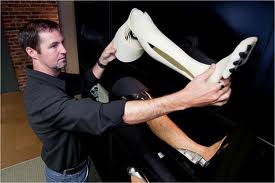
  3. Artificial limbs: Bespoke Innovations is using 3D printers to produce functioning artificial limbs for a much lower cost than what has been previously available. With digital modeling, a prosthetic limb can be customized to suit the recipient’s body and needs.
  4. Space missions: Getting a replacement part from Earth to the space station is not only technically challenging, it also costs a whole lot of money. 3D printers may soon allow astronauts to resupply as needed.
  5. Structurally sound houses:  Construction companies are using ‘Contour Crafting’ to cheaply build structurally strong buildings. Italian designer Enrico Kini is working toward using large-scale 3D printing technology to produce entire stone buildings made of sand and an inorganic, liquid binding agent.
  6. Prosthetic jaw: European researchers have created a prosthetic jaw for a patient suffering from a severe infection of her mandible. The replacement was made with a 3D printer and powdered titanium, instead of plastic, to sculpt the jaw. A bioceramic coating was applied so that the patient’s body would not reject the implant.

Discussion questions:

1. Why are 3-D printers an important new OM tool?

2. How can the printers be used in a factory environment?

OM in the News: 3-D Printing Moves to Human Organs

“Need an artery for bypass surgery or custom cartilage for that worn-out knee?”, asks The Wall Street Journal (Sept.18, 2012). Then just hit “print” on your 3-D printer.

In laboratories across the U.S., biomedical engineers are working on ways to print living human tissue, with the goal of producing personalized body parts and implants on demand. These tissue-engineering experiments represent the next step in a process known as computerized adaptive manufacturing, in which industrial designers turn out custom prototypes and finished parts using inexpensive 3-D computer printers.

Instead of extruding plastic, metal or ceramics, these medical printers squirt an ink of living cells– called shorthand bioprinting. The machines can build up tissue structures, layer by layer, into all sorts of 3-D shapes, such as tubes suitable for blood vessels, contoured cartilage for joints, or patches of skin and muscle for living Band-Aids.

At Cornell, researchers are printing heart valves, knee cartilage and bone implants. At Wake Forest, bioengineers are printing kidney cells and are working on a portable unit to print healing tissue directly into burns or wounds. At the University of Missouri, researchers have printed viable blood vessels and sheets of beating heart muscle. Biomedical engineers hope to print out tailored tissues suitable for surgery and entire organs that could be used in transplants, to eliminate long delays for patients awaiting suitable donor organs and the risk their bodies may reject the tissue.

Leading the way is Organovo Inc., which introduced the first commercial 3-D bioprinters in 2010, and has so far made 10 of its “NovoGen” bioprinters. “It allows us to print a tissue structure that is a functional, living, human tissue,” says Organovo’s CEO.

Discussion questions:

1. Relate these 3-D printers to those currently being used in industry (see Chapter 5).

2. How is this advancement an OM issue?

OM in the News: 3-D Printers–The Next Frontier in OM

When the dishwasher in a Boeing cafeteria in St. Louis broke down recently, the  company’s plumber didn’t want to wait for a plastic replacement part to be shipped to the site. He asked an engineer to replicate the part on a computer screen and “print it out”. That took about 30 minutes. Hence we witness the start of another major OM advancement –the 3-D printer revolution (as reported in The Wall Street Journal, July 14-15, 2012).

Pratt & Whitney’s aircraft-engine unit is using the 3-D process to make blades and vanes in compressors inside jet engines. Honeywell’s aerospace unit employs it to build heat exchangers and metal brackets but expects to find far more applications. Boeing already makes about 300 different smaller aircraft parts using 3-D printing, including ducts that carry cool air to electronic equipment. Some of these ducts have complicated shapes and formerly had to be assembled from numerous pieces, boosting labor costs.

Abe Reichental, CEO of 3-D Systems, a printer manufacturer, says the technology also will “re-localize” manufacturing of many items. He notes that printers, costing from $500 up to $1.2 million, can be set up almost anywhere, which will allow for production of items when and where they are needed and eliminate the costs of shipping and warehousing. The Defense Department is enthusiastic about the technology, which could at some point allow it to make parts in the field rather than waiting for them to be shipped from another continent.

3-D printing also is “an enabler” for entrepreneurs who want to make products but can’t afford elaborate factories and don’t want to entrust their manufacturing to faraway firms, says Reichental. They wouldn’t need to create expensive tools or molds. Some makers of 3-D printing equipment believe that car-part stores eventually will keep their inventories in digital form—as software containing the instructions for making each item—and print out items on demand.

Discussion questions:

1. How can new start-up businesses benefit from this tool?

2. What are the disadvantages of 3-D printers?