
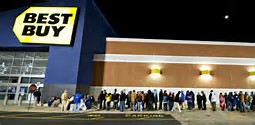
 “Standing in line is a pain. At the post office. At the box office. At a restaurant. But on Black Friday, it’s an experience,” writes The New York Times (Nov. 24, 2017). The first spot outside some Best Buy stores is usually claimed weeks in advance, often by a person in a tent. Shoppers at Walmart will print out maps of the store, with circles around their primary targets. Someone, somewhere, will try to cut in line at a Target, arousing the wrath of the cold, cranky people who played it fair.
“These queues are quite different from the usual annoying ones we encounter day-to-day at the A.T.M. or in the subway,” said MIT prof Richard Larson. “People’s willingness to wait is, in some sense, proportional to the perceived value of whatever they’re waiting to acquire. Even if they don’t know what the line is for, they reason that whatever’s at the end of it must be fantastically valuable.”
Lines test patience, personal space and principles of fairness and rationality, especially on Black Friday, when the crowds can be overwhelming. Still, the promise of a once-a-year score lures hordes of shoppers to queues that start before sunrise.
Queuing theory examines why lining up by yourself induces more anxiety than being in a group, why choosing between multiple lines is more aggravating than standing single file and even how music and scent can improve the wait. Black Friday’s preordained opening hours mean that the time the line should start moving is predictable, which can sometimes cause customers to become more agitated as the end approaches. In 2008, a crowd of more than 2,000 shoppers waiting at Walmart store on Long Island began pounding on the glass doors a few minutes before the scheduled 5 a.m. opening time. The doors shattered and shoppers stampeded through, fatally trampling a worker.
Classroom discussion questions:
- How many of your students participated in the Black Friday queues?
- Is queueing theory more mathematical or psychological?