Guest Post: Rethinking Queuing Theory in the Age of Virtual Lines

Jon Jackson,  Associate Professor of Operations Management at Providence College, raises an interesting issue regarding waiting lines. 

Queuing theory emerged in the early 20th century with the rise of telephone systems and has since become a core part of operations management education. Classic models like M/M/1 and Little’s Law—staples of Module D: Waiting-Line Models—help us analyze everything from grocery checkouts to airport security.

But in recent years, a shift has occurred, one that challenges our assumptions about what a “line” even is. Increasingly, companies are replacing physical queues with virtual ones. Customers now “get in line” via app or text, receive real-time updates, and arrive just in time for
service. Disney’s Virtual Queue and Yelp’s Waitlist are a well-known examples, but virtual queues are also popping up in healthcare (e.g., Canadian ERs) and government services (e.g., North Carolina DMVs).

From a customer-experience perspective, virtual queuing offers obvious benefits: more flexibility, reduced perceived waiting time, and greater comfort. But from an operational lens, it raises a deeper question: are we still managing a queue, or managing something entirely new?

At first glance, queues—physical or virtual—follow the same logic: customers arrive, wait, and are served. But virtual systems change how that waiting is experienced. In physical lines, customers can see how many people are ahead, assess progress, and make real-time decisions about balking or reneging. In virtual lines, those cues disappear.

Virtual queues also alter arrival rates. Traditional models assume random arrivals and FIFO service. But virtual systems can shape arrival patterns via notifications and estimated wait times. This introduces a hybrid between queuing and appointment systems.

Fairness and prioritization are evolving too. In physical lines, order is usually determined by arrival time. In virtual systems, paid priority (e.g., Disney Lightning Lane) complicates this logic.

Should we optimize for efficiency or fairness—or both? Even foundational concepts like Little’s Law may need rethinking. If a customer isn’t physically present, are they still “in” the system? Ultimately, virtual queuing is more than a customer-experience improvement. It’s a meaningful shift that invites us to revisit historical queuing models and the assumptions behind them.

Classroom Discussion Questions:
1. In a virtual queue, does a customer “enter the system” when he joins the queue virtually or when he physically arrives for service? How does your answer influence how we analyze the system?
2. How does paid priority—whether in virtual or physical queues—impact perceived fairness?

Guest Post: The Panama Canal Backlog

Prof. Howard Weiss shares his OM insights with us monthly.

Recently, there has been a bottleneck of ships waiting to go through the Panama Canal with over 120 ships waiting, reports Institute for Supply Chain Management (Aug. 29, 2023). The main cause is that there has been a drought, lowering the canal’s water level which reduces its capacity. (This also happened in 2016 and 2019). Normally, 36 ships would pass through the canal every day. At the moment the limit is 32 ships. The waiting time average is roughly 10 days rather than the 6 days it had previously been. Shipping companies have three options to mitigate the problem.

Reduce ship weight Some companies have reduced the number of containers on a ship. This reduces the ship’s weight which reduces its “draft”. The reduction in containers can take place at the ship’s origin or in Panama by placing the containers on the Panama Canal Railway which runs across the country. As a result of this reduction, shippers have been adding surcharges to their clients. For example, Hapag-Lloyd has added a $500 per container fee on Asia to US east coast routes.

A caravan of cargo ships sits in the Pacific Ocean last week, waiting to enter the Panama Canal

Use a different route There are several alternatives both by sea and land to avoid using the Panama Canal, each with its own advantages and disadvantages. By sea, a ship can go around South America. While the distance is considerably longer, the ship can make stops at major ports in South America such as Brazil, Argentina and Chile. The Suez Canal may be a less expensive option to the Panama Canal as the Asia to U.S. East Coast distances are roughly the same as when using the Panama Canal. Going around South Africa is another option. Land routes include the Panama Canal Railway.

Increase priority at canal In order to use the canal, shippers need to reserve a slot. The fee depends on the type of ship and other factors and ranges from $10,500  (small vessels) to $400,000 (largest vessels fully loaded).  A few daily slots are left open and auctioned off through the “Transit Slot Auction” which essentially allows ships to jump the line. This auction fee is paid in addition to the normal fee. The base price for the auction is $100,000 and recently a company paid $2.4 million.

Discussion Questions:
1. Cite a waiting line situation where one can improve his/her place/priority in the line.
2. What other operations decisions require examining time and cost tradeoffs?

Guest Post: Reducing Waiting in Mass Transit

Prof. Howard Weiss shares his insights with our readers monthly.

A recent article in the Philadelphia Inquirer noted that SEPTA, the transit authority for Philadelphia and its suburbs, “is shopping for a contractor to build a new fare collection system with more convenient payment options.”

Work on the current SEPTA fare system began in 2011, and like many projects, the system was delivered two years late in 2016 and at nearly double its original $122 million budget. While the fare system is only 7 years old, it was almost obsolete when it was delivered because riders could not purchase their tickets or fare cards from home as they can for transit systems in several cities. Of course, purchasing at home or by app saves time when traveling by not having to wait in line at a kiosk to buy a ticket or put money on a fare card. It also reduces the probability of missing a train because you are stuck in line.

Several cities go a step further to improve transit times. You do not even need to go through a turnstile or wait for a bus driver to check your ticket. These cities use an honor system that relies on riders to purchase their tickets. This reduces boarding times and lines for busses and waiting times on the subways. Also, passengers can board busses using any door not just the front door which reduces the boarding time. There are controllers who may check tickets and if the rider does not have one the rider is fined – for example, $60 in Hamburg, Germany, $150 in Copenhagen, or $250 in Los Angeles.
Roads, Bridges and Tunnels
Thirty-five states have toll roads, bridges or tunnels. Many of these have been allowing drivers to use the web to upload money to their passes since their inception. In addition, some toll areas have express lanes for EZ pass drivers making collection times faster than driving through a toll booth. Some roadways have implemented toll by plate where rather than staffing a toll booth a picture is taken of a license plate and a bill is sent to the driver by mail if the car did not have a transponder for the system.

Roughly half of the toll collection locations in the U.S. collect tolls in only one direction rather than both directions. Obviously, this reduces waiting time in the toll-less direction.

Classroom discussion questions:
1. What is the downside to the toll collection agency using one-way tolling?

2. What are the disadvantages of operating a toll by plate system?


OM in the News: The Queue Returns

With social-distancing measures in place for the foreseeable future, queue management—our topic in Module D—is being recast as a health-and-wellness hero. “The design practices and software tools that line experts have been working on for years might become as common as the queues they manage”, writes The Atlantic (Oct.28, 2020).

Disney is thought to have invented the “switchback queue” (that snakes back and forth) during the 1964 World Fair in NYC. Guests stopped complaining about the long queues at the Disney attractions, even if the lines hadn’t actually gone down. Over the next decades, the company perfected the waiting experience with props and preshows designed to entertain but also distract its guests from the endless waiting. In 1999, Disney’s FastPass allowed guests to pick their battles by skipping lines that weren’t worth the wait. Ever since, having fewer people in queues and more roaming the park has been the name of the game.

Queues of shoppers maintaining distance against coronavirus outside a market in Piura, Peru

Distractions give human minds pause. But designers and engineers still have not figured out how to vanquish long lines. In a pandemic, frivolous distractions won’t cut it. The people who waited for 5 hours today to cast a ballot don’t need distractions from the wait; they need measures that will keep them safe and, better yet, allow them to avoid waiting in the first place. (On average, people overestimate how long they’ve waited in a line by about 36% by the way. This means that the actual wait time, no matter how short, isn’t the main problem; it’s is how long people feel they’ve been waiting).

WaitTime, a creator of crowd-intelligence-software designed for stadiums, uses ceiling-mounted cameras, computer vision, and patented AI to interpret crowd conditions in real time, so published wait times are always up to date. 

New fear of proximity could spell the end of the physical line. Eight months into the pandemic, make-do solutions such as tape markers and DIY signs are giving way to more deliberate strategies such as magnetic queuing grids, virtual lines, and timed-entry passes.

Classroom discussion questions:

  1. Why do queues depend on cultural/social habits?
  2. What measures can be used to force people to stand 6 feet apart?

OM in the News: Do You Hate Waiting in Line?

Conventional wisdom says that the fastest-moving line is a single “pooled” line. We have long subscribed to this mathematical approach with Models A and B in Module D, Waiting Line Models in our OM text. But a new study, reported in The Wall Street Journal (Oct, 26, 2020), just found that splitting the pool into individual lines made them move faster.

The researchers looked at patient wait times and length of stay in the ER of a California hospital. They found that when the hospital switched from a pooled line to a dedicated-queue system in which patients were assigned to a specific doctor, average wait times decreased 9% ( by 39 minutes) and lengths of stay decreased 17%.

Single lines may not be the fastest in knowledge-intensive fields.

With a dedicated-queue system, physicians could see who they were helping, who in the waiting room had been assigned to them and exactly how long their individual queue was. The doctors seemed to feel more ownership when they could see which and how many patients were assigned to them.

But would service providers in other industries behave the same way as? The study concluded that a dedicated queue would also speed up wait times in fields that are knowledge-intensive and have high levels of customer ownership, such as medicine, personal banking or places like the Apple Genius Bar.

“The phenomenon is not expected to translate to anonymous call centers or other settings where the service provider doesn’t have a relationship with the customer or the service is very routine, like at a grocery checkout or a factory with machines,” says one of the researchers in a forthcoming article in the journal Operations Research. “Companies may want to look at their organizational culture, seeing where there is room to encourage more customer ownership, and consider ways to change to a dedicated-queue configuration to achieve shorter wait times. Encouraging customer ownership by dedicating assignments to each server when planning queue configurations might shorten the wait and service time.”

Classroom discussion questions:

  1. Explain the difference between Models A (M/M/1) and B (M/M/s).
  2. What model is being described in this study?

Guest Post: Waiting Lines and the Coronavirus

Our Guest Post today comes from Howard Weiss, Professor of Operations Management Emeritus at Temple University.

A couple of thoughts have come to my mind recently with respect to the coronavirus.

As more citizens become infected with a virus, fewer citizens are available to become infected. This is identical in principle to the arrival rate in a finite population waiting line system. Consider, Example D7 from your Heizer/Render/Munson textbook. There are 5 printers that each break down at the rate of .05 per hour. Thus, if all five computers are working, the system arrival rate is 5*.05=.25 while if all 5 are broken down the system arrival rate is 0. Over time, the arrival rate changes depending on the number of printers that are working and we can compute the weighted average arrival rate, which we term the effective arrival rate. The Excel worksheet for this example, available on MyOMLab, computes the effective arrival rate as .218 printers per hour. This effective arrival rate is similar to the effective reproductive number that epidemiologists use for viruses.

Data Results
Arrival rate (l) per customer 0.05 Average server utilization(r) 0.436048
Service rate (m) 0.5 Average number of customers in the queue(Lq) 0.203474
Number of servers 1 Average number of customers in the system(Ls) 0.639522
Population size (N) 5 Average waiting time in the queue(Wq) 0.933264
Average time in the system(Ws) 2.933264
Probability (% of time) system is empty (P0) 0.563952
Effective arrival rate 0.218024


An interesting graphic related to the virus spread is at this Washington Post web site.

Observation: I recently had the opportunity to attend a concert at the Amalie Arena in Tampa. At intermission, the men’s room had a long line. This is not unusual. However, the line was not for the urinals or stalls but rather for the sinks. This was unusual. The design of the bathrooms was clearly for normal use rather than for a situation like the one we currently have with increased demand for handwashing. I was wondering what an arena might do to handle the increased sink demand.

OM in the News: No More Lines in the Supermarket?

A woman scans the bar code of an item she is buying at a Tesco store

A man recently strolled down the candy aisle of a grocery store in England, picked up a bar of chocolate and stashed it in his back pocket. He wasn’t stealing. Specially equipped surveillance cameras were tracking both his body and the products he was taking off the shelves, to help him pay for them. The giant supermarket chain Tesco wants to make shopping at its stores more convenient. Tesco is one of several grocers testing cashierless stores with cameras that track what shoppers pick, so they pay by simply walking out the door.

The retailers hope the technology will allow them to cut costs and alleviate lines as they face an evolving threat from e-commerce giant Amazon, reports The Wall Street Journal (July 8, 2019). European efforts to scale up the technology in traditional stores—economically and without privacy issues—will likely be closely watched in the U.S. Grocers in the U.K. often pioneer new technology like online delivery and self-payment kiosks that their American peers eventually adopt.

Tesco plans to open its self-styled “pick and go” or “frictionless shopping” store to the public next year after testing with employees. It then wants to use the technology, developed by Israel’s Trigo Vision, in more stores. The test store uses 150 ceiling-mounted cameras to generate a 3-dimensional view of products as they are taken off shelves. Israel’s biggest supermarket chain, Shufersal, plans to deploy similar technology across all its stores. “The whole notion of waiting in line will vanish,” the company said.

U.S. retailers face concerns about excluding low-income shoppers who tend to pay with cash. Lawmakers in several cities, including San Francisco, have been considering bans on cashless stores. U.S. retailers also operate many large stores, where tracking thousands of products all day long would be expensive.

Classroom discussion questions:

  1. How does this compare to Amazon Go stores? (See our Jan. 28, 2018 blog).
  2. What are the difficulties in implementing the technology in huge supermarkets?

OM in the News: The Psychology of Standing in Line on Black Friday

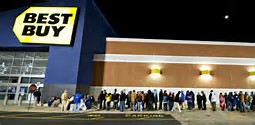
“Standing in line is a pain. At the post office. At the box office. At a restaurant. But on Black Friday, it’s an experience,” writes The New York Times (Nov. 24, 2017). The first spot outside some Best Buy stores is usually claimed weeks in advance, often by a person in a tent. Shoppers at Walmart will print out maps of the store, with circles around their primary targets. Someone, somewhere, will try to cut in line at a Target, arousing the wrath of the cold, cranky people who played it fair.

“These queues are quite different from the usual annoying ones we encounter day-to-day at the A.T.M. or in the subway,” said MIT prof Richard Larson. “People’s willingness to wait is, in some sense, proportional to the perceived value of whatever they’re waiting to acquire. Even if they don’t know what the line is for, they reason that whatever’s at the end of it must be fantastically valuable.”

Lines test patience, personal space and principles of fairness and rationality, especially on Black Friday, when the crowds can be overwhelming. Still, the promise of a once-a-year score lures hordes of shoppers to queues that start before sunrise.

Queuing theory examines why lining up by yourself induces more anxiety than being in a group, why choosing between multiple lines is more aggravating than standing single file and even how music and scent can improve the wait. Black Friday’s preordained opening hours mean that the time the line should start moving is predictable, which can sometimes cause customers to become more agitated as the end approaches. In 2008, a crowd of more than 2,000 shoppers waiting at Walmart store on Long Island began pounding on the glass doors a few minutes before the scheduled 5 a.m. opening time. The doors shattered and shoppers stampeded through, fatally trampling a worker.

Classroom discussion questions:

  1. How many of your students participated in the Black Friday queues?
  2. Is queueing theory more mathematical or psychological?

OM in the News: Why You Shouldn’t Walk on Escalators

It’s more efficient if everyone stands on an escalator instead of some people walking on it

The train pulls into the station, the doors open and you make a beeline for the escalators. You stick to the left and walk up the stairs, figuring you can save precious seconds and get a bit of exercise. But you’re doing it wrong, seizing an advantage at the expense of other commuters. Boarding an escalator 2-by-2 and standing side by side is the better approach, says The New York Times (April 5, 2017)  and it is more efficient if nobody walks on the escalator.

The question of standing versus walking flared up recently in Washington, D.C. after the Metro said the practice of walking on the left could damage the escalator. The escalator company Otis said this is not true, but passengers should not walk on escalators, as a matter of safety.

The Metro is not the first mass transit operator to try to address this issue. Last year, the London Underground tried to change passengers’ behaviors and get them to stand side-by-side riding — not walking. The Underground had concluded that in very tall stations, much of the left side went unused, causing blockages and lines at the bottom. It campaigned to fill the available space on the escalators with people, rather than leaving the left side of each step largely empty, except for those who chose to hike up. It found that standing on both sides of an escalator reduced congestion by about 30%. Walking up the escalator took 26 seconds compared with standing, which took 40 seconds. However, the “time in system” — or how long it took to stand in line to reach an escalator then ride it — dropped sharply when everyone stood.

When 40% of the people walked, the average time for standers was 138 seconds and 46 seconds for walkers. When everyone stood, the average time fell to 59 seconds. For walkers, that meant losing 13 seconds but for standers, it was a 79-second improvement. The length of the line to reach and step onto an escalator dropped to 24 people from 73.

Classroom discussion questions:

  1. Will this happen in the U.S?
  2. Explain the concept of “time in system”?

Video Tip and OM in the News: Why the Other Line Always Moves Faster

wsj-queueQueuing (see Business Analytics Module D) is always a popular topic with students–and evidently with readers of the Wall Street Journal (Oct. 7, 2016) as well. This Journal article is a very basic tutorial on the history (Erlang discussion) and logic of waiting line modeling.

The piece writes: “You’ve probably participated in this familiar dance: Given a choice of checkout lines, you’ve somehow picked the slowest. You could wait it out. You could chassé to another queue. Or you could bail out altogether. After all, no one likes to wait. But are the other lines really faster? When parallel lines feed multiple cashiers, you may not be in the slowest one, but chances are, you also are not in the fastest.”

 Prof. Bill Hammack, at the U. of Illinois (YouTube’s “Engineer Guy”), explains it like this in his 4-minute video: “Imagine three lines feeding three cash registers. Some shoppers will have more items than others, or there may be a delay for something like a price check. The rate of service in the different lines will tend to vary. If the delays are random, there are six ways three lines could be ordered from fastest to slowest—1-2-3, 1-3-2, 2-1-3, 2-3-1, 3-1-2 or 3-2-1. Any one of the three (including the one you picked) is quickest in only two of the permutations, or one-third of the time.”
Classroom discussion questions:
1. Why doesn’t every service provider use the multiple-server, single line approach?
2. Explain Erlang’s theory.

OM in the News and Video Tip: The Psychology and Math of Queuing in Supermarkets

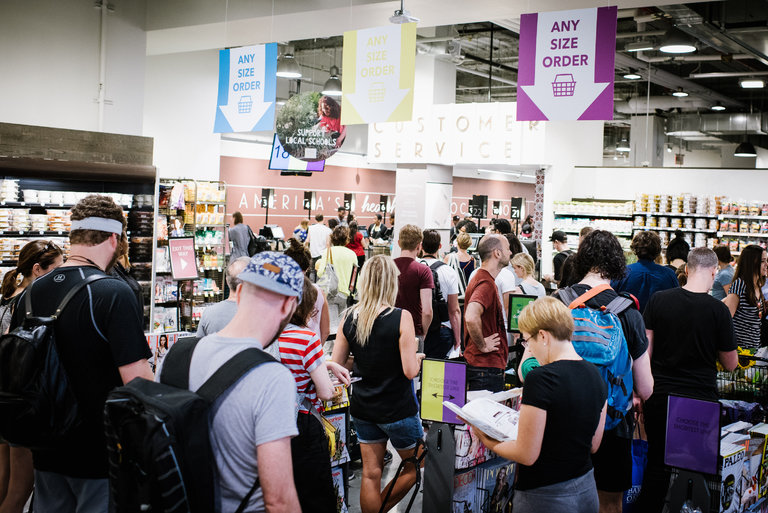
Inside a Whole Foods in Brooklyn

You dash into the supermarket for a few quick items. But when you get to the checkout lanes, they are full. Your plan for a quick exit evaporates. For anyone who has ever had to stand in line at a supermarket, here are some tips from The New York Times (Sept.8, 2016) for picking the line that will move the fastest.

  1. Get behind a shopper that has a full cart. That may seem counterintuitive, but every person requires a fixed amount of time to say hello, pay, say goodbye and clear out. That takes an average of 41 seconds per person and items to be rung up take about 3 seconds each. So getting in line with many people who have fewer things can be a poor choice. (One person with 100 items will take an average of 6 minutes to process. A line with 4 people who each have 20 items will take an average of 7 minutes).
  2. Study the customers ahead of you. It is not just the number, but their age and what they are buying. Older people will take a bit longer because they can have technical difficulties that delay the process. Also consider the number of different items they are buying. Six bottles of the same soda will go faster than 6 totally different items, some of which cannot be scanned, such as vegetables.

  3. Choose a line that leads to several cashiers. In Module D of the text, we show that this approach, known as a serpentine line, is the fastest. The person at the head of the line goes to the first available server in a system often seen at airports or banks. Getting into a single line also provides psychological relief because it eliminates the choice of where to go and second-guessing about the best line to choose. Your students will love this 90 second queuing video.

  4. The psychology of queuing has also found that waits seem shorter when you are distracted. Try talking to the person next to you or reading the magazines in the store’s racks.

 Classroom discussion questions:

  1. Why is the “serpentine” line faster on average?
  2. What does Disney do to keep visitors happy during 45-minute lines?


OM in the News: TSA Turns to OM, and Improves Queue Times

HIDE CAPTION Peak wait times measured by airport officials at Chicago O’Hare International Airport, pictured May 16, fell from 105 minutes in early May to just nine minutes in the two weeks before the Fourth of July
Peak wait times at Chicago O’Hare Airport fell from 105 minutes in May to just 9 minutes in late June

After hours long lines at some airports and public outrage over stranded passengers, the beleaguered Transportation Security Administration (TSA) just pulled off a major restructuring, dramatically reducing wait times even as summer air travel surged to record levels. Nationally, over the 4th of July, wait times averaged 10 minutes and PreCheck lines averaged 5 minutes.

“How TSA dug out of its checkpoint quagmire is both a remarkable story of rare, quick change inside a big government agency,” writes the Wall Street Journal (July 21, 2016)–and it all involved a series of basic OM analyses that your students could have developed. Here are some of the TSA changes:

  1. Put more agents on passenger screening checkpoints.
  2. Provided a barrel to dump out water bottles before they went through X-ray machines and brought screening to a halt.
  3. Added 600 contract workers to move bins and direct passengers so TSA screeners (who used to do that) could go back to screening and open more lanes.
  4. Created a maintenance desk in each command center to quickly dispatch techs instead of the old process of writing a repair ticket and waiting.
  5. Summer vacations for screeners were limited; nonessential training was deferred.
  6. Slightly increased the number of people selected to get PreCheck printed on boarding passes.
  7. Created a Central Command Center which hosts daily conference calls with local directors, airports and airlines. Here they share best practices and coordinate efforts, shifting staff at airports with multiple terminals and regions with multiple airports as needed.

“We completely changed the way we operate,” said TSA’s administrator.

Classroom discussion questions:

  1. Can students expand this list with more suggestions?
  2. What will happen in Fall, when short-term fixes like overtime, delayed vacations and training, etc., dissolve?

OM in the News: Queuing Up for Airport Security

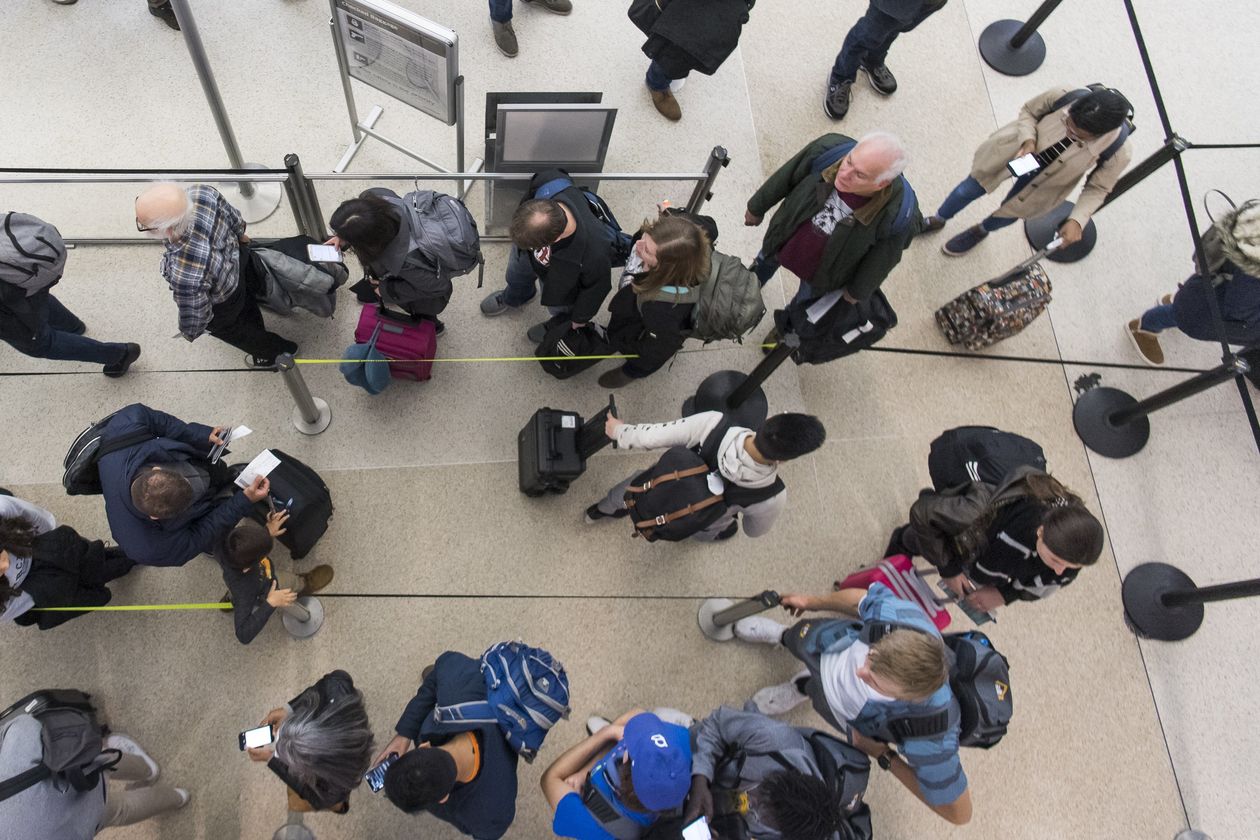
tsa2Queuing up at the Orlando airport last week, en route to giving a lecture at Tulane University, I encountered a 40+ minute wait for TSA security checks. Returning from New Orleans a few days later, the TSA walk through took less than 2 minutes. Reading the Wall Street Journal’s article “Airport Security Lines Grow” that day (March 3, 2016), leads me to believe this is a good topic for class when you cover Waiting Line Models in Module D. Here is what the Journal writes: “Longer lines are the result of a collision of three changes: reduced staffing from federal budget cuts, a surge in travelers at some airports, and efforts to fix significant screening lapses.”

Current staffing is about 41,000 screeners, below the congressional cap of 42,500, and 5,600 fewer screeners than in 2011. At the same time, TSA has been intentionally slowing down security screening to tighten it up. This comes after some failures to identify weapons and other mistakes during covert government testing.

It  is not just Orlando International. Chicago O’Hare has had lines this week snaking through concourses, delaying hundreds of flights. Atlanta has seen peak-time security screening waits of an hour recently because checkpoints are “woefully understaffed.” TSA and airlines have started advising travelers to arrive up to 2 hours before a domestic departure and 3 hours for international flights.

American Airlines says it has had to delay hundreds of flights in January. At Delta’s New York Kennedy terminal, the PreCheck expedited screening line stretched almost out the building door on a recent Friday morning. Airports in Minneapolis, Las Vegas, Denver, Seattle and Miami all say they have seen longer lines at checkpoints over the past two months.

Classroom discussion questions:

  1. What tools in the text could be used to analyze this queuing problem?
  2. Why the vast disparity between Orlando and New Orleans TSA?

OM in the News: Wal-Mart’s “Checkout Promise” to Speed Queues

Wal-Mart's "check-out promise" aims to alleviate chronic long lines
Wal-Mart’s “check-out promise” aims to alleviate chronic long lines

My mother-in-law recently commented that she won’t shop at Wal-Mart anymore, primarily because the checkout lines are too long. It turns out she is not alone. The Wall Street Journal (Aug.15, 2014) writes that “to lure more customers this holiday season, Wal-Mart is promising to staff each of its cash registers from the day after Thanksgiving through Christmas during peak shopping times.” The move, called the “checkout promise,” is aimed at addressing my mother-in-law’s very complaint.

“Taking the possibility of waiting in long lines off the table will attract more people into stores,” says the chief merchandising officer. The move comes as Wal-Mart has struggled to win back U.S. shoppers after 7 straight quarters of falling traffic. Many customers have ditched the chain in favor of quicker trips to smaller rivals. The company also has battled with complaints about too many out of stock items and empty shelves. Refilling shelves alone could bring back $3 billion in sales.

Wal-Mart’s supercenters typically have about 30 traditional checkout lanes—giving it more than 100,000 across the U.S.—but the number that are staffed varies throughout the day. It has made aggressive use of technology to cut back on labor costs and more precisely schedule checkout lanes based on real-time demand. But the drop in traffic and customer complaints have forced it to reassess the economics of that approach. After increasing the number of self-checkout systems across its 4,000 U.S. stores, longer lines began forming at its staffed checkouts to deal with customers with more complicated and time-consuming transactions, such as shoppers who use coupons.

The company also recently nixed “Scan & Go,” a program which allowed shoppers to use their mobile phones to scan items as they walked through stores and pay at self-service kiosks, skipping the cashiers’ lines. Wal-Mart said the process was too complicated for customers.

Classroom discussion questions:

1. How has technology complicated Wal-Mart’s queues?

2. What other approaches could the company try to speed up lines?

OM in the News: Canada’s Psychology of Queuing

Queuing in Canada
Queuing in Canada


When Israeli-born author Ayelet Tsabari first immigrated to Canada in 1998, a strange sight caught her eye on the sidewalks of Vancouver. Beneath every Canadian bus stop sign, as if commanded by an invisible drill sergeant, citizens young and old automatically formed into neat, ordered lines. “I was wondering, ‘Why are people standing like that?’” she said. And the phenomenon is not only baffling to Israelis, writes Canada’s National Post (July 25, 2014). Ms. Tsabari described bonding with an Iraqi friend over the “foreign and strange” practice.

But from Russia to China to Italy to the entire Middle East, there are billions of people around the world who are genuinely confused by the penchant of English-speaking people to constantly form into queues. At the Canadian School of Protocol and Etiquette, lineup training comes on the same day students are taught about North American-style introductions. Students are taught where to line up, how to maintain one’s proper place in the lineup and — most importantly — how close to stand. “In certain cultures, queue etiquette is just not on the radar,” said the school director. Particularly among students from China and the Middle East, Canadian queuing norms simply would not jibe with the crowded train stations and marketplaces of their home countries.

Non-queuing in China

In China, queue-jumping is so widespread that in the lead-up to the 2008 Beijing Olympics, the Chinese Communist Party began posting queue monitors to city streets and establishing “Queuing Days” each month in which citizens were asked to “voluntarily wait in line” at shops and transit stations. Similar anti-queuing norms hold in India, where the simple act of boarding a train can become the scene of a miniature stampede. “We live in a hugely-populated, resource-constrained country … in this environment, he who hesitates is lost for sure,” wrote a New Delhi writer in a 2012 piece for the Wall Street Journal.

Classroom discussion questions:

1. What is the US culture with regard to queues?

2. Why is the psychology of queuing so different across the globe?