OM in the News: Plastic Water Bottles Threaten a Crisis

“Bottled water, which recently dethroned soda as America’s most popular beverage, is facing a crisis,” writes The Wall Street Journal (Dec. 13, 2018). A consumer backlash against disposable plastic plus new government mandates and bans in many stores have bottled-water makers scrambling to find alternatives.

Workers sort plastic bottles at a Swiss recycling facility

Evian this year pledged to make all its plastic bottles entirely from recycled plastic by 2025, up from 30% today. It hopes the move will help it regain market share and win over plastic detractors who are already pressuring the makers of straws, bags and coffee cups. There’s a big problem. The industry has tried and failed for years to make a better bottle. (A decade ago, for example, Evian pledged to use 50% recycled plastic in its water bottles by 2009. Nestlé’s plastic water bottles use just 7% recycled material in the U.S., while Coca-Cola’s use 10%, and Pepsi uses 9%.)

Existing recycling technology needs clean, clear plastic to make new water bottles, but low recycling rates and a lack of infrastructure have stymied supply. Danone, Evian’s parent company, is betting its reputation on a new technology that turns old plastic from things like dirty carpets and ketchup bottles into plastic suitable for new water bottles. Less than a third of plastic bottles sold in the U.S. are  now collected for recycling, with less than 1% processed into food-grade plastic. The bottled-water industry says using more recycled plastic in bottles will incentivize the collection of old bottles by giving them value. Companies are launching new marketing campaigns, employing more waste pickers and backing new bottle deposit schemes to encourage recycling.

Bottled-water sales have boomed in recent decades amid safety fears about tap water and a shift away from sugary drinks. Between 1994 and 2017, U.S. consumption soared 284% to nearly 42 gallons a year per person. Recently, images of bottles overflowing landfills and threatening sea life have soured consumers. Plastic drink bottles are the 3rd most common type of item found washed up on shorelines—behind cigarette butts and food wrappers.

Classroom discussion questions:

  1. How is this a triple bottom line issue (people, planet, profit)?
  2. What other consumer products are facing similar backlash crises?

OM in the News: Making Packaging Recyclable

Mouth of the Los Angeles River, Long Beach

By now most people are aware of that a lot of plastic is floating in our waterways. One study estimated that 8 million tons of plastics are swept into waterways annually — equivalent to a garbage truckload every minute. In the marine environment, plastics break down into indigestible particles that marine life mistake for food. If no actions are taken, oceans are expected to contain more plastic than fish by 2050.

In an effort to reduce waste, many companies are reviewing their packaging plans, reports IndustryWeek (Oct.11, 2018). And they have been pushed to do this over the past several years by an activist group called As You Sow.This month, food and beverage giant Mondelez International committed to making all of its packaging recyclable by 2025. Mondelez packaging was the fifth most frequently found brand waste collected as part of more than 200 audits done in 42 countries by environmental groups working on plastic pollution.

In 2014, P&G agreed to make 90% of its packaging recyclable, and Colgate-Palmolive pledged to make packaging recyclable in 3 of 4 operating divisions, both by 2020. In 2017, Unilever agreed to a similar commitment by 2025, Target agreed to engage with its suppliers to phase out the use of harmful polystyrene foam for e-commerce packaging, and Unilever agreed to make 100% of its packaging recyclable, reusable, or compostable by 2025. This year, McDonald’s agreed to stop using polystyrene foam cups globally by year end, and made a bold, unprecedented commitment to recycle all packaging in its restaurants worldwide by 2025. At the same time, Dunkin’ Brands publicly committed to a schedule for phasing out foam coffee cups. And KraftHeinz agreed to make all packaging recyclable, compostable, or reusable by 2025.

Classroom discussion questions:

  1. Why is sustainable packaging an important OM issue?
  2. What more can be done to eliminate plastic garbage?

OM in the News: Levi’s Turns Recycled Plastic into Jeans

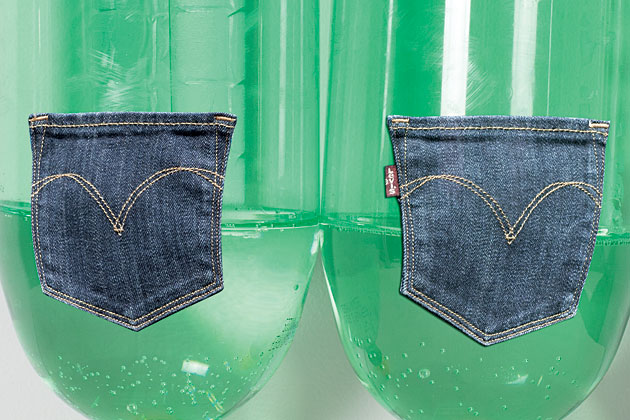
Most apparel companies work hard to give their clothes the sheen of sophistication or whimsy. Levi Strauss is trying hard not to. The upcoming pitch in stores: “These jeans are made of garbage.” Crushed brown and green plastic bottles will be on display nearby. Eight of those are blended into each pair of Levi’s new Waste‹Less jeans, which are composed of at least 20% recycled plastic, reports Businessweek (Oct. 22-28, 2012).

The Waste‹Less collection is part of a bigger push to reduce Levi’s environmental impact throughout the entire process of making jeans. “We want to build sustainability into everything we do,” says the VP- environmental sustainability. Resource scarcity and increasingly volatile prices for cotton make this a necessity more than a choice.

In 2007, Levi’s was among the first in the apparel industry to conduct a life-cycle assessment. It found that 49% of the water use during the lifetime of a pair of jeans occurred at the very beginning, with cotton farmers. (Another 45% of the water was used by consumers to wash their jeans, typically about 100 times.) So Levi’s began to teach farmers how to grow cotton with less water. In 2010, it also began a marketing campaign to encourage people to wash their jeans less often, in cold water only, and line-dry them. This year, Levi’s will ship 29 million Water‹Less jeans, saving 360 million liters of water.

After the Water‹Less project got underway, Levi’s began thinking about plastic and began testing fibers from recycled colored plastic bottles. When plastic bottles are recycled, they’re sorted by color, cleaned, and sold as polyester flakes. Those flakes can be stretched, or extruded, into fiber, which can be spun into yarn and woven into cotton fabric on high-speed machines. The first batch of Waste‹Less jeans used about 3.5 million bottles all together. “Is turning 8 bottles of plastic into a pair of jeans worth it? I think so,” says the CEO.

Discussion questions:

1. Why is sustainability an important OM issue?

2. What other clothing firms in active in environmental sustainability? What does each do?