OM in the News: Unilever’s Green Thumb

Unilever CEO Polman and his products

“Our purpose is to have a sustainable business model that is put at the service of the greater good,” says the CEO of consumer products giant Unilever in Fortune (June 10, 2013). This sounds like the boilerplate that fills corporate-responsibility reports, but Unilever has gone beyond companies like GE, IBM, and Wal-Mart by putting sustainability at the core of its business. In a 2010 manifesto, Unilever promised to double its sales even as it cuts its environmental footprint in half and sources all its agricultural products in ways that don’t degrade the earth. The company also promised to improve the well-being of 1 billion people by, for example, persuading them to wash their hands or brush their teeth, or by selling them foods with less salt or fat.

Whether Unilever’s do-good agenda has driven its financial success is hard to know.  The firm’s global hand-washing campaign, for instance, lifts sales of Lifebuoy soap, while a “brush day and night” campaign helps Pepsodent. Socially responsible marketing around self-esteem for women helped Dove become Unilever’s bestselling brand in the U.S.

The model drives innovation too. Unilever researchers are working to develop a laundry detergent that can clean clothes in a few minutes at any water temperature. The company wants to reduce the sugar in its ready-to-drink teas and remove calories from ice cream. It’s telling the farmers who supply it with palm oil, soybeans, tea, cocoa, and tomatoes to get their crops certified as sustainable. The chickens that lay the eggs that go into Hellmann’s mayonnaise or Ben & Jerry’s ice cream must be cage free. No other company has a sustainability program as wide and deep. Unilever’s plan includes 60 targets, with timetables, such as sourcing “75% of the paper and board for our packaging from certified sustainably managed forests or recycled material.”

Discussion questions:

1. Is sustainability helping to grow Unilever?

2. What is the role of operations in this model?
OM in the News: Hershey Goes Sustainable

hersheyIt’s almost Valentine’s Day, the time of year that truly tests logistics and supply chain management at jewelry,  flower, gift shops, and restaurants. But few companies will be challenging their suppliers as seriously as Hershey, writes Food Logistics (Feb. 6, 2013). Just recently, the company announced its intention to use cocoa beans from Rainforest Alliance Certified farms in 100% of its products by 2020, in an effort to promote sustainable, ecologically-sound farming practices and safe conditions for workers and families.

While testing its supply chain, Hershey is trying to improve the quality of its products as it expands business into China, India and Brazil, which are rapidly developing a middle class consumer base.  “We can deliver chocolate to many people around the world that haven’t had it before and create the demand for the cocoa farmers. But the only way those cocoa farmers are going to be able to meet that demand is they’ve got to become better,” says Hershey’s VP of global commodities.

Hershey has been procuring cocoa beans from West Africa for over 50 years and  70% of the world’s cocoa currently comes from West and Central Africa. (There are 800,000 cocoa farmers across the Ivory Coast). In recent years, there has been a noticeable shift toward more environmentally- and socially-conscious sourcing.  Mobile technology usage in West Africa has greatly increased in the last 2-3 years, which is a great tool for farmers to access proper farming practices and also connects farmers with vital information about child labor and safety. The International Cocoa Institute is further creating community-based programming in 550 West African communities. Hershey projects over the next two years it will enroll 100,000 of those farmers to help develop a sustainable supply of cocoa for the world.

“We know it’s very feasible to increase farmer productivity by 50 percent,” says Hershey, “as long as farmers: (1) have access to fertilizers and pesticides; (2) are educated on how to apply them safely; (3) modernize their harvesting methodologies; and (4)  have access to modern information on farming practices.”

Discussion questions:

1. Why is it difficult to create sustainable cocoa operations?

2. Discuss the OM issues involved.


OM in the News: Levi’s Turns Recycled Plastic into Jeans

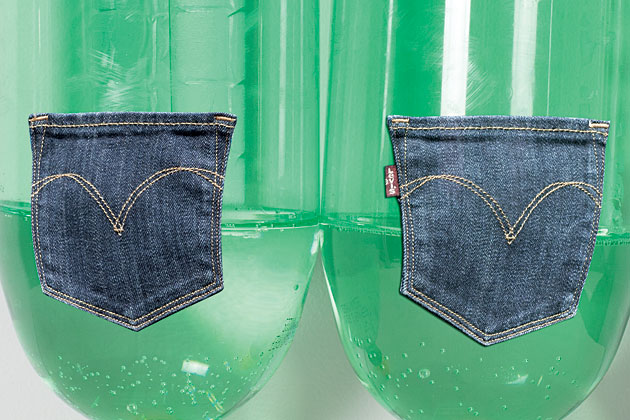
Most apparel companies work hard to give their clothes the sheen of sophistication or whimsy. Levi Strauss is trying hard not to. The upcoming pitch in stores: “These jeans are made of garbage.” Crushed brown and green plastic bottles will be on display nearby. Eight of those are blended into each pair of Levi’s new Waste‹Less jeans, which are composed of at least 20% recycled plastic, reports Businessweek (Oct. 22-28, 2012).

The Waste‹Less collection is part of a bigger push to reduce Levi’s environmental impact throughout the entire process of making jeans. “We want to build sustainability into everything we do,” says the VP- environmental sustainability. Resource scarcity and increasingly volatile prices for cotton make this a necessity more than a choice.

In 2007, Levi’s was among the first in the apparel industry to conduct a life-cycle assessment. It found that 49% of the water use during the lifetime of a pair of jeans occurred at the very beginning, with cotton farmers. (Another 45% of the water was used by consumers to wash their jeans, typically about 100 times.) So Levi’s began to teach farmers how to grow cotton with less water. In 2010, it also began a marketing campaign to encourage people to wash their jeans less often, in cold water only, and line-dry them. This year, Levi’s will ship 29 million Water‹Less jeans, saving 360 million liters of water.

After the Water‹Less project got underway, Levi’s began thinking about plastic and began testing fibers from recycled colored plastic bottles. When plastic bottles are recycled, they’re sorted by color, cleaned, and sold as polyester flakes. Those flakes can be stretched, or extruded, into fiber, which can be spun into yarn and woven into cotton fabric on high-speed machines. The first batch of Waste‹Less jeans used about 3.5 million bottles all together. “Is turning 8 bottles of plastic into a pair of jeans worth it? I think so,” says the CEO.

Discussion questions:

1. Why is sustainability an important OM issue?

2. What other clothing firms in active in environmental sustainability? What does each do?

Good OM Reading: Kimberly Clark’s Drive for Sustainability

The latest MIT Sloan Management Review (May 15, 2012) reports on consumer products giant Kimberly Clark’s efforts towards sustainability, an important topic in our OM courses (Supplement 5). The 140 year old company (57,000 employees in 36 countries)has more than a billion people use its products (which include Kleenex, Huggies, and Kotex) every day!

The company has had 4 global five-year goals, looking at energy reduction and energy efficiency, water use reduction and efficiency gains. For 2000, it addressed chemical issues. For 2005, it addressed packaging, and had a 10% reduction in weight in packaging goal. For 2010, it looked at lifecycle analysis of all product initiatives. For 2015, the focus is broader– on people, the planet and products. “That equates to the social, environmental and economic pillars of sustainability. That’s the triple bottom line for us,” says Peggy Ward, director of sustainability.

“On the planet side, we’re still following our traditional focus on energy, waste and water,” she adds, “but we’re pushing ourselves even further. So, we’ve set an absolute greenhouse gas reduction goal of 5%. On the water side, our goal is a 25% reduction in water use. And in waste, our goal is to achieve zero manufacturing waste sent to landfill. About 48% of our mills are landfill-free currently.”

New products at Kimberly Clark include Scott Naturals Tube Free– bath tissue rolls that do not have that cardboard core ( meaning you can use every single sheet of the roll.) The amount of waste that will be eliminated that’s going to landfills is large — basically it’s enough to go to the moon and back two times.  Huggies Pure and Natural  diapers have a component that has a renewable alternative material in it — instead of a petrochemical-based input. It has organic cotton, it’s fragrance-free and dye-free and it has 20% post-consumer recycled content.

This is a good article to share with your class when you are discussing sustainability.

OM in the News: Leading the Sustainability Charge at Patagonia

Yvon Chouinar, founder and sole owner of the $414 million outdoor-clothing brand Patagonia, has just published a new book, “The Responsible Company,” which  offers detailed checklists for making money without inflicting undue societal harm. And according to The Wall Street Journal Magazine (May, 2012), even megacorporations are paying attention to him these days.

Chouinard has partnered with Walmart—an odd couple if there ever was one, in terms of size (Walmart’s revenue exceeds Patagonia’s 800-fold) and customer base—to advise the retail giant on reducing packaging and water use in its supply chains. Together the two companies teamed up to create the Sustainable Apparel Coalition, inviting other major brands, such as Levi Strauss, Nike, Gap and Adidas to join them in crafting clear, quantifiable standards for environmentally responsible clothing production.

Chouinard looks at everything Patagonia makes, shipped or processed, and resolves to do it all more responsibly. He changes materials, switching  from conventional to organic cotton—despite the fact that it initially tripled his supply costs—because it was less harmful to the environment. He created fleece jackets made entirely from recycled soda bottles.  He also convinced Levi Strauss—with more than 10 times the annual revenue of Patagonia–to embrace efforts to set data-driven benchmarks for improving apparel makers’ environmental practices. Levi’s has spent the past 18 months redesigning processes to save 45 million gallons of water, along with the energy that would have heated that water.
In 1970, Milton Friedman wrote a legendary essay for the New York Times Magazine titled “The Social Responsibility of Business Is to Increase Its Profits.” Friedman pooh-poohed companies’ charitable efforts, arguing that it’s the sole duty of a business executive to maximize profits for shareholders. But Patagonia would disagree over the role of corporate social responsibility—since 1985 it has given 1 percent of revenue (sales, not profit), totaling $41.5 million, to grassroots environmental organizations. Over the years it has convinced 1,400 other companies worldwide to join this “1% for the Planet” initiative.
Discussion questions:
1. Do companies still follow Friedman’s philosophy?
2. How has Patagonia impacted the business world?

OM in the News: Recycling Hits the Airplane Industry

In Supplement 5, we point out that the auto industry recycles more than 84% of cars scrapped each year. The new Mercedes S550 sedan is designed to be 95% recycled, years ahead of the EU standards that take effect in 2015. In general, auto manufacturers now design in such a way that materials can be easily reused in the next generation of cars. The same can not be said of the commercial airplane industry.

But the latest Businessweek (March 3-9, 2012) points out that sustainability is now on the minds of airlines for a variety of reasons. Older planes are being disassembled for their parts at an increasing rate, and the average age of planes has dropped by a third, to 18 years, over the past decade and a half. Rising fuel prices have made kerosene-guzzling old-timers unpopular with carriers. (Fuel makes up about 30% of operating expenses). United, which burns $25,000 of fuel every minute, is thinking of grounding the dated Boeing 737-500 and 767-200ER jets from its 1,200 plane fleet.

Older planes such as these used to end up in developing countries from Mexico to Indonesia to Kenya, where they found a home after being retired by Western carriers. But prodded by safety and environmental concerns, more and more countries are choosing new over used planes. Production of single-aisle jets, the most widely used type in the industry, is now at an all-time high. This leaves no shortage of cadavers to be recycled for parts.

Especially popular are engines coming off A320s and 737s.The turbines that house rotating parts (such as disks or blades that operate at 2,700 degrees F) require routine replacement and can cost $4.4 million new. Recycled disks and blades drop the price in half. Since an engine off the older 737-700 can be used in the newer 737-800 model, economic obsolescence has fueled the airplane recycling industry.

Discussion questions:

1. Why is the life cycle of airplanes getting shorter?

2. Why is recycling a major issue for operations managers?

Good OM Reading: The Greening of the Chinese Supply Chain

Given how much of the world’s manufacturing takes place in China, and the damage it has wrought on that country’s environment, more and more multinationals are under pressure to clean their supply chains, writes MIT Sloan Management Review (Winter, 2012). For companies that ignore the problems, the costs can be considerable. Just last August, a group of 5 Chinese environmental NGOs focused attention on our beloved Apple for using suppliers with public pollution problems. The international headlines forced Apple to immediately tackle its–and its suppliers’– act.

This  excellent article says that even industry green leaders such as Nike and Adidas may never completely cleanse their supply chains . But rather than just monitoring Chinese suppliers compliance with health, safety, and environmental standards, top US firms are giving them tools and incentives to improve independently, helping use energy, water, and materials more efficiently. They are also reaching deeper into 2nd and 3rd tier suppliers, where the greatest damage occurs. Nike, for example, sends environmental engineers to 40 footwear suppliers to help them set targets to reduce waste and scrap, and improve efficiency. Instead of auditing, the Nike team spends 80% of its time driving new green initiatives.

The MIT Sloan piece points out that audits alone are very limiting, as factories have become adept at hiding problems from auditors. There is even an indigenous consulting industry designed just for that purpose. (Auditors are also commonly susceptible to bribery.) “Corruption is widespread,” says a former rep for Wal-Mart, which has 20,000 tier 1 suppliers in China alone!

The lengthy article includes a 12 point plan for companies to follow to deal with this major supply chain issue. It makes for valuable reading as you cover Chapter 11.

Good OM Reading: Sustainability Nears the Tipping Point

Now that your Fall semester is complete and you have some time for holiday reading, we can give you a sneak preview of the upcoming MIT Sloan Management Review (Winter, 2012) article on the  characteristics of companies that are profiting from sustainability practices and the factors that have driven the recent surge in sustainability adoption.The article also highlights the challenges companies face in building a business case for sustainability.

Results from this, MIT’s third annual sustainability survey, indicate that an increasing number of managers and companies are taking sustainable business practices seriously. Two-thirds of respondents said that sustainability is critically important to being competitive in today’s marketplace. And despite ongoing economic uncertainty, many companies are increasing their commitments to sustainability initiatives. In fact, 31% of respondents said their companies are profiting from sustainable business practices. Yet, it should be noted that “green” still ranks only 8th on companies’ agendas for action.

The article also points out that sustainability comes from both internal and external drivers. External factors include regulations, green score cards and other metrics, media, climate change science, resource scarcity, and consumer demand. “Consumers today have higher expectations that brands deliver sustainable products: sustainably sourced, produced and packaged, but remaining competitively priced”, says the head of sustainability at Kimberly-Clark (maker of Huggies and Kleenex).

Yet internal drivers may be more influential than external ones. “I would say the internal drivers are 80% responsible for our sustainability efforts”, states the VP of Clorox, who sees benefits relating to operating costs, revenue growth, brand integrity, and employee engagement.

This is a good article to keep handy when you are teaching Supplement 5, Sustainability.

OM in the News: Shipping Our Batteries to Mexico for Cheaper Recycling

When we discuss the 3R’s of Sustainability in Supplement 5 we emphasize how important it is to build sustainable production processes.  But the  lead article in The New York Times (Dec.9,2011) asks what really happens when our American car battery industry claims to have the highest recycling rate for any commodity–97% of the lead is recycled–and most states mandate that stores take back old batteries. It turns out that spent batteries we turn in are increasingly being sent to Mexico, where their lead is usually extracted by crude methods that are illegal in the US, exposing plant workers and local residents to dangerous levels of a toxic metal.

The rising flow of batteries is the result of strict new EPA standards, making domestic recycling more difficult and expensive. (The allowable lead levels have dropped by a staggering amount in the past 3 years and cost of compliance is about $20 million per plant). So about 20% of batteries (20 million) are being legally shipped to Mexico this year (up from 6% since the new EPA rules), with many more smuggled across covertly. “Along the border, where US vigilance focuses on drugs and illegal immigrants, there is little effort to staunch the flow”, writes the Times.

Whereas lead battery recyclers in the US now operate in sealed, highly mechanized plants outfitted with scrubbers, the vast majority of Mexican plants just break the batteries, releasing the lead as dust and emissions. Spent batteries house up to 40 lbs. of lead, which can cause high blood pressure, kidney damage, abdominal pain in adults, and serious neurological development in children. Lead pollution remains in the ground for decades. The EPA says it “does not inspect, monitor, or verify the Mexican facilities.” Adds a Dallas recycler: “We’re shipping hazardous waste to a neighbor ill-equipped to process it and we’re doing it legally, pretending it’s not a problem.”

Discussion questions:

1. Do your students view this as an ethical dilemma?

2. What other harmful products do we ship abroad for recycling, and why?

OM in the News: How “Green” is That Company?

A Rollins College colleague stopped by yesterday to tell me about his research relating sustainability to corporate success. He has shown that “greener” companies yield higher net profits than their less-ecologically responsible competitors. But who determines each firm’s water usage, carbon emissions, workforce well-being, recycling  levels, and a score of other sustainability factors? The new Businessweek (Dec. 4,2011) tries to address who the arbiters of sustainability are with its article “The Race to Decide Who’s Greenest”.

It turns out that investors and the public are demanding detailed information on metrics that define sustainability. And in response, scores of rating outfits have sprung up, each trying to be the judge of who’s really green. One of the largest, Global Reporting Initiative (GRI), provides over 100 metrics on such areas as workplace safety, toxic waste spills, and recycled materials. But GRI does not audit company survey replies and does not judge performance. Newsweek rates companies on their commitment to the environment. Dow Jones publishes an index of “most sustainable companies”.  And the Ethisphere Institute ranks the “World’s Most Ethical Companies”.

In 2000, there were 21 such raters. By 2010, that number swelled to 108. IBM’s environmental affairs chief says: “It’s our collective American culture to rate. Look at Dancing with the Stars“.

Wal-Mart has created its own Sustainability Consortium and index for tracking its 1,000’s of suppliers’ green efforts. It is creating standards for cotton towels, TVs, yogurt, and scores of other products. Each product has its own specific set of metrics. “We want to make sure we are measuring the right things”, says Wal-Mart’s director of sustainability.

The bottom line: With more than 100 groups ranking companies on sustainability, is it time for global reporting and assessment standards?

Discussion questions:

1. How is sustainability good for operations management?

2. Why do OM managers need a “green” index?

OM in the News: Water as a Sustainability Issue

One of my favorite features in Fortune magazine is called The Chartist, a graphical analysis of any number of various topics. This week’s issue of Fortune (Oct 17,2011) deals with the vast amount of water used in manufacturing, agriculture, and by us as individuals. It ties in directly to our treatment of sustainability in Supplement 5 in discussing short-term problems and long-term solutions.

With all the bottled water we swig and all the showers we take, one would think people consume most of the earth’s water. In fact, according to the Chartist’s excellent graphs, agriculture accounts for 71% and industry for 16% of global water use. A pair of blue jeans requires 2,906 gallons, most of it from growing cotton. A car requires 104,000 gallons, most of it from rubber. It takes 252 gallons to make a pair of rubber gloves, while a pound of steel uses 31 gallons. And it takes 71 gallons of H2O to produce an 8 oz. cup of Starbucks. (That company, by the way, plans to cut its water use by 25% in the next 4 years with more efficient machines).

Who uses the most water per capita? It’s the US at 2,057 gallons. Australia uses 1,675: Argentina 1,163: Russia 1,340: Sweden 1,033: China 775: and the Congo 400. The world average is 1,003 gallons per capita  per day.

And who pays the most for 100 gallons of tap water?  Copenhagen is highest at $3.03, followed by Paris at $1.48, London at $0.73, Phoenix at $0.59, Tokyo at $0.46, NYC at $0.39, Moscow at $0.24, Shanghai at $0.07, Mumbai at  $0.04, and Buenos Aires at $0.01.

Expanding populations in developing nations will swell the demand for agricultural water some 42% by 2013. The hope is that OM can find new technologies to grow more with less water by then.

Discussion questions:

1. How can OM help solve the water shortage problems being faced in many parts of the world?

2. Will water be the gold of the 21st century?

OM in the News: Is Wal-Mart’s Sustainability Index Sustainable?

Two years ago, Wal-Mart CEO Mike Duke dropped a bomb on the retailing world when he announced that his firm would be creating a “sustainability index” to measure the environmental and social impact of every product sold in its stores. Wal-Mart had not suddenly turned green (see our blog of  May 17, 2011 )–it turns out that a vast amount of money is to be made by reducing energy and waste up and down the supply chain. Duke’s message suppliers was clear: “Treat the planet well and get prime access to its 200 million customers each week; pollute and despoil, and you will be shunned”.

But as Fortune (July 25, 2011) reports, Wal- Mart had no idea how hard the job of creating the index would be.  Five million dollars into the project, it has only examined 7 products closely so far. The trouble with a scoring system (and others have tried it), is that in the end consumption is about trade-offs. How much phosphate was used to make a laundry detergent? How much waste was generated by the zipper factory in China? Is soil erosion less important than carbon emissions? A company may get high marks for recyclable packaging, but Stonyfield reduced its carbon footprint by switching to yogurt cups that aren’t recycled. (Cups made from plants, it turns out, generate fewer greenhouse gasses than recycled plastic ones). And Patagonia’s switch to organic cotton for jeans (from synthetic fabrics) now requires 1,200 gallons of water to manufacture a single pair!

Many companies in the developing world don’t even recognize the words “corporate sustainability policy”. Hank Paulson says he asked the manager of a Chinese factory about the belching smoke pouring out of his plant. The response: “See those two camels and a goat? When they fall over from pollution, we turn off the factory”.

Discussion questions:

1. Why is the index so hard to create?

2. Name some products with trade-offs that would impact their score.

Good OM Reading: The Unlikely Story of Wal-Mart’s Green Revolution

It was clear that Wal-Mart was taking a leadership stand in sustainability when we wrote the Supplement 5 case study Environmental Sustainability at Wal-Mart 2 years ago. However,  an excellent  book called Force of Nature: The Unlikely Story of Wal-Mart’s Green Revolution, by Edward Humes (Harper Business, 265 pages), has just been published that will bring the case alive to your students. If you are to read one book on the company that is leading this unlikely second industrial revolution, this would be it.

That’s because Wal-Mart, long the target of environmentalists who hate its big-box footprint,  and others who feel it has destroyed small town businesses by the 1,000’s, has created nothing less than a green revolution. And as we see in Force of Nature, it is spreading this unprecedented makeover worldwide.  But the real story behind the changes at one of the world’s least earth-friendly companies is when river-guide turned consultant, Jib Ellison, enters CEO Lee Scott’s office.

Ellison singlehandedly persuades Scott that sustainability isn’t just for tree huggers–that it really meant eliminating waste and saving money. Hitting Wal-Mart at just the right moment, when it was plagued by bad PR and a slew of lawsuits, Ellison  convinced the firm’s execs that building sustainability into the business would create a powerful competitive edge. Wal-Mart did not embark, as the author says, on this course out of a sense of doing-good, but started with the attitude that it would give a PR boost…and also be profitable. It also was meant to appeal to a new generation of female shoppers who would leave for Target if Wal-Mart did not embrace sustainability.

Just a few of the recent changes: reducing packaging sizes (saving $3.4 billion a year while reducing trash), installing electric generators in refrigerated trucks (so they don’t have to idle overnight), donating 127 million pounds of food (that would otherwise be destroyed) to food banks, cutting printouts at stores (and saving 350 million pieces of paper and $20 million), making organic, earth-friendly, and natural products widely available, and forcing 100,000 manufacturers who supply products Wal-Mart sells to become more sustainable!

Good OM Reading: The Sustainability Embracers

Here at the  POMS meeting in Reno we see 14 paper sessions just on the hot topic of sustainability. But today’s blog is also influenced by some new material by MIT on sustainability. Earlier this week, I sat in on a live webcast on the subject and then the next day received a copy of the MIT Sloan Management Review research report called “Sustainability: The ‘Embracers” Seize Advantage” (Winter,2011). The webcast featured Peter Grof, SAP’s Chief Sustainability Officer, who was also quoted in the report.

This 27 page study compares two broad categories of companies–those that have embraced sustainability and those that have not (called cautious adopters). Who are the embracers and what practices do they share? As businesses increasingly turn to sustainability for competitive advantage, here are MIT’s 7 conclusions:

1. Embracers tend to be bold, see the importance of being an early mover, and are ready to act even before they have all the answers.

2. They balance their aims with narrowly defined projects in, say, supply chain management, which allow them to produce early, positive bottom-line results.

3. They drive sustainability not only from top down, but also involve  employees (who are often much more aware of sustainability challenges and solutions than management).

4. They do not treat sustainability as a separate function, but have a culture in which sustainability is applied to all business processes.

5. They establish baselines and set up assessment methods that can be identified and can measure progress.

6. They value intangibles as meaningful competitive benefits of their strategy.

7. They do not overstate motives or set unrealistic expectations, and they communicate their non-successes as well as their successes. For example, when Nike started producing labor supply chain reports 6 years ago, they announced that they had encountered noncompliance in numerous standards.

This report makes for interesting reading by providing a snapshot of how the future of the management of sustainability will look.

OM in the News: Nike’s Sustainability Push

Stung in the 1990’s by a public campaign against its Asian labor practices, Nike has been working hard in recent years to make itself a sustainability leader. Its goal (according to www.nikebiz.com/responsibility) is to embrace a “future where creation of products isn’t tied to scarce natural resources like water and oil; where manufacturing is lean, green, equitable and empowered; and where everyone, everywhere has access to sport.”

And indeed, here are just a few of Nike’s accomplishments:

1. Introducing sustainability practices into product design (eg., eliminating toxics and waste when possible).

2. Pushing lean manufacturing concepts onto contract manufacturers to create a greener supply chain and to reduce the CO2 footprint.

3. Using recycled materials throughout (eg, the DartVII running shoe is mostly from recyclables).

4. Taking defective returns, counterfeits, and used consumer shoes and turning them into material for resurfacing playing fields (called Nike Grand).

Now Information Age (April 11, 2011) reports that the company is recruiting to hire a Code for a Better World Fellow ( I have idea what this title means)– a person to help lead the effort to bring sustainability to every aspect of the company.

But the firm still does have its detractors. The daily Lean blog called Evolving Excellence, writes:  “According to your own data, 94% of your shoes are made in Vietnam, China and Indonesia.  At last check these countries rank 90th, 84th and 82nd out of 141 on the list of the greenest and most livable countries – compared to numbers like 23rd in the USA, 25th in the UK, and 8th in Australia – the places you sell your shoes.  You ship the shoes about 7,000 miles from where you make them to where you sell them… a pretty deep carbon footprint.  If you want to be sure “manufacturing is lean, green, equitable and empowered,” you might want to quit ducking the environmental regulations in the developed nations where you sell your shoes by having them made in some of the worst polluting places on earth.”

Discussion questions:

1. How important is Nike’s “green” drive?

2. On what grounds can its position be criticized?