
I know I have finished a good book about OM when I see just how many pages I have highlighted in yellow marker. Faster, Cheaper, Better, by 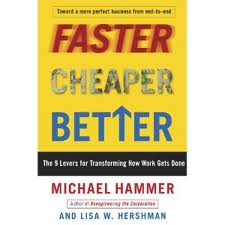 Michael Hammer and Lisa Hershman (Crown Business,2010), is such a book. Hammer, you may recall, was coauthor of the 1993 blockbuster, Reengineering the Corporation, which galvanized companies to rethink every aspect of operations. He was a rare genius, whose recent death was a major loss to our field.
Faster, Cheaper, Better focuses on end-to-end processes, how to shed tasks that don’t add value, and how to let workers make decisions. This is not a book for undergrads, but I would recommend assigning it if you are teaching a class of EMBAs.
The strength of the book is its real-world case studies (Tetra Pak, Clorox, Gamesa, to name a few). For a quick overview, just read the 1st four chapters and some of the cases. Here are 2 good quotes:
From the Shell Oil CEO regarding the transformation process: “We are going on a journey. On this journey we will carry the wounded and shoot the stragglers”.
About the automated factory of the (near) future: “There will be only 2 living creatures in it: a man and a dog. The man’s job will be to feed the dog, and the dog’s job will be to make sure the man doesn’t touch the equipment”.
My favorite story in the book, though, is about how precisely to perform a step in a process. Hammer gives the example of hospital bills that go on for pages, with reams of line items, including such things as tissues and pills. “Pareto was an optimist”, he writes. “His 80-20 rule is really more like 95-5 for a hospital”. After Hammer finished his process analysis, the hospital stopped collecting data on, or bill for, items costing less than $25. This reduced nurse overtime, and the hospital simply averaged the misc. costs into the basic room rate.