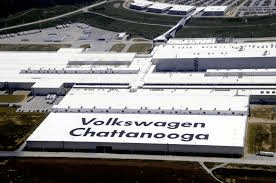
OM in the News: Why the VW Vote to Reject a Union is Big News

vwAs we note in Chapter 8, Location Strategies, the presence of labor unions can have a major impact on a company’s decision where to locate a manufacturing plant. So when workers at the Tennessee VW auto factory voted 712 to 626 last week against joining the United Automobile Workers, it was national news. VW did not oppose unionization, reports The New York Times (Feb. 17, 2014), and seemed to give tacit approval for unionization as a step toward establishing a “works council” at the plant. A works council is a committee, common at German factories, in which white-collar and blue-collar workers elect representatives who establish policies on issues like work hours, vacations and standards for firing workers. But it would be illegal under U.S. law for a company to establish a works council unless workers first voted to have a union represent them. Had a works council been set up at the VW plant, it would have been the first in the U.S.

U.A.W. officials were stunned by the defeat; they had expected to win because VW was not fighting the effort and, just months before, a majority of the plant’s employees had signed cards saying they favored union representation. One industry expert called the loss “a very serious setback for the union, a setback that will resonate throughout the South.” The U.A.W. campaign was clearly hurt by the anti-union sentiment common in the South, as well as an intense campaign by anti-union workers inside the plant who argued that they did not need a union or union dues because VW already treated and paid them well. Wages at the plant average $19.50 an hour.

Union officials accused Tennessee Senator Bob Corker of poisoning the atmosphere and preventing a fair election before the vote. Corker had told the media that VW had assured him they would add another production line at the plant (instead of going to Mexico) to make a new SUV if the factory’s workers rejected the union. This story can make for a lively class discussion of incentives, unions, worker rights, and more.

Classroom discussion questions:

1. Why did state officials take a position against the union vote?

2. Why did VW encourage creation of a works council?

OM in the News: Incentives Drive Boeing Back to Washington State for the 777X

777XAfter much wrangling and predictions that Boeing would locate its new 777X plant in nonunion South Carolina, the firm may have reached deals with state and IAM union officials to win the aerospace giant new tax breaks and 8 more years of labor peace in exchange for building its planned jetliner in Washington. The Wall Street Journal (Nov.6, 2013) reports that Gov. Jay Inslee called for a special session of the state legislature to approve a package of tax and policy incentives valued at $18.7 billion. Inslee said approval of that package and of the labor agreement are necessary for Boeing to make the 777X in its longtime Puget Sound base. “Inaction will cost the state of Washington,” said Inslee.

The moves capped an intense period of maneuvering over the plans for the 777X, a long-range jetliner considered pivotal to Boeing’s future. The 777X, scheduled for its 1st delivery by 2020, is likely to be the last major new jet from Boeing for many years, and there has been intense speculation over where the plane and its huge carbon-fiber composite wings would be built. The Wall Street Journal reported just last week that Boeing was leaning towards a nonunion plant in South Carolina. Boeing also announced it would give “much” of the engineering work on the 777X to engineers in 5 U.S. states and Russia, with no mention of plans to use engineers in Washington.

The South Carolina facility, Boeing’s first aircraft assembly plant manned by a nonunion workforce, has been a source of tension with the IAM. Boeing selected it in 2009 as the site of its second 787 Dreamliner assembly line, prompting a complaint from the National Labor Relations Board that the move was retaliation for a 2008 strike by the IAM that halted Boeing’s assembly lines for 58 days. The potential new agreement with IAM leaders conveys to 2024 and includes a $10,000 signing bonus for workers. The union said the deal would provide an “unprecedented degree of labor stability in the volatile and competitive industry.” “It’s a tough one, if you call their bluff and you’re wrong, then you’re just kicking yourself,” adds a machinist.

Classroom discussion questions:

1. Why is this such a critical OM decision for Boeing?

2. What factors discussed in Chapter 8 did the company consider in selecting Washington over S. Carolina?

OM in the News: Mississippi’s “Right-to-Work” vs. the UAW

A Canton Nissan worker signing a petition calling for union recruitment

The United Automobile Workers, desperate to make inroads in the anti-union South where Toyota, Volkswagen and other foreign automakers have assembly plants — has never tried a unionization drive quite like the one at the Nissan plant here in Canton, Miss.,” writes The New York Times (Oct. 7, 2013). It has enlisted thousands of union members in Brazil to picket Nissan dealerships there and sent a team of Mississippi ministers and workers to South Africa, where Nissan has an assembly plant, to try to embarrass the company with accusations that it violates workers’ rights at the Canton plant.

At a time when the U.A.W. has fewer than 1/3 of the 1.5 million workers it had in 1979, its organizing push in the South has taken on urgency and is being watched closely by labor leaders across the country. “It’s a life-and-death matter for the U.A.W. to succeed in the South,” says a U. of California prof. “If the U.A.W. fails to win at the foreign companies’ plants in the South,” adds an industry expert, “they will pull down wages at General Motors, Ford and Chrysler.” The union faces rough going in Mississippi, considering the embarrassing loss it suffered in 2001 when workers at Nissan’s plant in Tennessee voted two to one against joining the U.A.W.

“We’re a right-to-work state,” says a Canton businessman. “Back in the Industrial Revolution I could see why unions were needed, but we’re now in 2013, and I don’t see the need.” For Mississippi, landing Nissan was a coup. The 10-year-old auto plant was the state’s first, and its work force has climbed to 5,200, making Nissan the state’s second-largest private employer. Nissan has invested $2 billion in its state-of-the-art plant, which uses 1,200 robots. The base wage for most of the plant’s workers is $23.22 an hour, making them the envy of many blue-collar workers in Mississippi.

Classroom discussion questions:

1. Justify the positions of the union, of Nissan, and of the state.

2. Why is this a “life or death matter” for the UAW?