Guest Post: Curbside–The New Greyhound Location

Prof. Howard Weiss has developed the Excel OM, POM, and Active Model software that comes free with our text.

The Location chapter (Ch. 8) of your Heizer/Render/Munson textbook discusses the location of a new facility but a related question is the closing of a current facility. Figure 8.1 lists as its first factor for determining the site as : “size and cost”.

Recently, Greyhound has decided that one way to reduce costs is to close its bus terminals. It has closed terminals in Philadelphia, Knoxville, Louisville and Houston, where riders are dropped off and picked up at the curb; in Tampa where riders are dropped off in a parking lot; and in Columbus which now uses a public bus terminal.

Of course, curbside or parking lot usage leads to a number of difficulties for passengers. In many cases there is no shade, no heat or air conditioning, no food, no place to sit, nor any restrooms. In addition, buses idling at the curb takes away a lane for cars or bikes. There are several reasons that bus terminals are being closed.

Relocation Often times a facility will be closed because it is being relocated to another location. This is true in some cases for Greyhound which recently moved its downtown Cincinnati station to the suburbs. This relocation did hurt riders who needed a more central location.

Condition of Terminal In midtown Houston the Greyhound bus station is an old, dilapidated station and for sale. However, the area around the station is improving, as new apartment buildings, restaurants, bars and grocers open.

Property value One main reason for leaving the bus terminals is to sell the properties which have become very valuable. In addition to Houston, the Louisville site will be turned into a 256 unit apartment complex. In Chicago, which serves 500,000 passengers each year and 55 busses per day, the station is for sale, with no replacement in the plans.

One stated reason for closure of terminals is because there will be a new bus terminal. But in Louisville construction has not started on the new terminal, even though the old terminal is closed. Greyhound is not alone. In Minneapolis, the Uptown Transit Station closed months ago and a facility will not reopen until Spring 2024. The station has been beset with vandalism, drug use and other activities which make it unsafe.

Classroom Discussion Questions:
1. How can bus terminals be made safer?
2. What other facilities have been sold due to the value of the land?

OM in the News: It Takes a Long Time to Repair a Tesla

Some owners have had a Tesla waiting 3 months for parts to arrive.

Tesla has cranked up its Model 3 production in recent months, enabling many buyers to get their vehicles after long waits, reports The Wall Street Journal (Feb. 11, 2019). But as Tesla’s U.S. sales approach those of luxury auto makers like BMW and Mercedes-Benz, it has encountered new logistical problems, from delivery and servicing of a growing fleet to balancing supply and demand. A Florida resident who recently damaged his bumper in a low-speed collision, had to wait 3 months for the repair shop to get the spare parts from Tesla and fix his car.

The unusually long wait for a repair underlines a drawback of being a Tesla customer. The upstart car company has created a coveted luxury brand but is still learning some of the basics of the auto business. Tesla CEO Elon Musk has acknowledged some of the operational challenges, saying: “We’ve just been very silly about where we store our parts. Tesla was shipping spare parts from China to the U.S. and then back to customers in China.”

Tesla plans to deliver as many as 400,000 vehicles world-wide this year, roughly four times what it sold 2 years ago. Customers in recent months have been venting on social media about trouble getting repair appointments, long waits for those fixes and flaws in newly delivered vehicles, whether they are the paint job or cracks in windows. Part of the problem is that Tesla, unlike other auto makers, doesn’t have a network of hundreds of franchise dealerships to sell and service its vehicles. It has long touted this as an advantage, giving it more control over the customer experience. But it means Tesla has to pay for service centers and to staff them.

Tesla slid to 27th of 29 automotive brands ranked for reliability by Consumer Reports last year. The Model 3 earned an “average” rating.

Classroom discussion questions:

  1. How can Tesla address this problem?
  2. What are the main operations issues that the automaker has had to deal with in the past 2 years?

OM in the News: RFID and Luggage Tracking

Radio chips are embedded in the tags being used at Las Vegas' airport ensure that suitcases move more quickly and accurately through the system.
Radio chips are embedded in the tags being used at Las Vegas’ airport ensure that suitcases move more quickly and accurately through the system.

One of my favorite new video cases for this edition is called Alaska Airlines: 20-Minute Baggage Process–Guaranteed! in Chapter 7. This is great example of process analysis and how OM can be applied in a way to improve customer service in the airline industry.  And industry-wide, airlines show a steadily decreasing likelihood of bags going astray. Last year had the lowest rate of wayward luggage — 6.5 bags per 1,000 — in the past 12 years. Why?

Various advances in technology and bag-handling procedures deserve credit, including improvements over the years in the bar-coded tags and optical scanners that have long been in use for identifying and sorting checked luggage. Where bar-coded tags fall short is if the tag is wrinkled, smudged or torn, or not in line of sight of the scanner. If the tag is not readable, the bag can get lost without being noticed. Bar code readers have a “read rate” of only 80%- 95% of baggage tags.

“That is why the industry is intent on improving the tracking rate by looking beyond the 30-year-old baggage bar code,” writes The New York Times (Aug.23, 2016). They are adopting RFID tags that do not need to be seen to be read. Embedded chips can store travel information and need to be only close to radio scanners along the way for the bag’s progress to be recorded. Fliers can use travel apps to keep track of their bags. Delta is spending $50 million on the necessary scanners, printers and radio tags, which look little different from conventional bar-code tags. The system is now in place at all of the 344 airports into which Delta flies.

R.F.I.D. technology is hardly new, of course. But updating to the latest technology requires infrastructure changes that can be expensive and disruptive. And because most airports leave it to each airline to handle its own bag-checking system, the technology and procedures vary widely.

Classroom discussion questions:

  1. What are the advantages of RFID over bar codes?
  2. What does Alaska Air do to make sure bags arrive in 20 minutes?

OM in the News: Why Customer Call Centers Matter

dollar shave clubDollar Shave Club, a quickly growing California company with 2.2 million members known best for its viral commercials, has 36 member service agents who answer phones and emails, conduct online chats and reply to queries on social media — all while channeling the brand’s distinctly playful and irreverent tone. But finding the right personalities is challenging. Training takes weeks.  It would be a lot easier to contract with a third-party customer service firm.

Online retailers, though, including pioneers Zappos and Bonobos, have found the investment in unscripted customer service worthwhile, reports The Los Angeles Times (Sept. 25, 2015). The interactions, they say, feel more authentic and help humanize e-commerce brands that are, by their very nature, faceless.

The approach is “high cost, difficult to execute, but the word of mouth” makes it worth it, said an industry analyst.  That’s imperative for Zappos, which relies on repeat customers and word-of-mouth marketing to power its $2 billion in sales. Zappos has been at the forefront of unscripted customer relations and instills what it calls “WOW” service in its 600 agents through a 7-week training course. That results in some extreme cases of customer satisfaction, like the time an agent visited a rival shoe store to fill an order Zappos couldn’t because it didn’t have the right size. “It certainly would be cheaper to contract out customer service,” said a Zappos exec. “But it wouldn’t be better. 75% of sales come from return customers, so it’s important for us to control the customer experience as much as possible.”

A similar approach is taken by online clothing retailer Bonobos, whose team of 40 customer service “ninjas” are encouraged to be playful and spontaneous with customers. Many are recent college grads, aspiring comedians and actors. “Rather than looking at customer service as an expense, we see it as a fundamental investment, just as we invest in the design and quality of our clothing product,” said Bonobos’ VP.

Classroom discussion questions:

  1. Compare the approach these 3 firms take with the bank’s service documentation in Example 2 in Chapter 5.
  2. Why do most firms outsource their call centers?

OM in the News: Walmart’s Inventory Dilemma

At this N.Y. Walmart, the produce section is poorly stocked

The dairy section in the Walmart supercenter near Queens, N.Y., was sparsely stocked. Some gallon jugs of milk were dented, others soiled with what looked like dirt. The meat aisle had run out of ground beef patties and strip steak, and residue streaked some shelves. But the disarray and out-of-stock items at this store appear to be examples of wider inventory problems that Walmart is facing. Last month, the retailer issued a confidential “urgent agenda” memo to its 4,965 U.S. store managers pushing them to improve performance in their grocery departments to maximize the chance that items will sell before their expiration dates. The memo also urges managers to reduce backup inventory to trim costs, but warns them not to exceed weekly employee budgets for their stores.

The inventory problems often stem from Walmart’s failure to have enough employees in its stores to do the many chores needed, like marking down aging items, rotating milk or getting needed goods from the back room to stock shelves.  “The fact that they don’t do some of these things every day, every shift, shows what a complete breakdown Walmart has in staffing and training,” says one industry expert (The New York Times, Nov.12, 2014). And a new investment report writes: “If its employees’ growth had kept up with square footage growth in the U.S. over a number of years, Walmart would have 200,000 more employees than its current 1.3 million.”

A visit to the back of the N.Y. store, as well as various YouTube videos shot by employees, point to great clutter and thousands of cases waiting to be put on shelves. A customer service manager at a Louisiana Walmart said, “Understaffing from the sales floor to the front end has greatly affected the store.” She said substantial staffing cuts began in 2010, and added that there used to be 5 customer service managers per shift, while now is there just one. “That,” she said, “sometimes causes long lines and customers having to wait 30 minutes.”

Classroom discussion questions:

1. Why has inventory control been a major OM issue for Walmart?

2. Is this really an inventory problem?

OM in the News: A Cure for Hospital Design

Directional guiding hospital kiosk

Endless corridors that seem to lead nowhere. Poorly marked entrances. Multiple elevator banks and incomprehensible signs. “Hospitals,” writes The Wall Street Journal (Feb. 4, 2014), ” are realizing they have a design problem as patients and visitors struggle to navigate the maze of the modern medical complex.” Confusing layouts and signage add to patients’ anxiety at a time when many are feeling ill and are coming to the hospital to undergo tests and procedures.

Now, many hospitals are borrowing strategies from shopping malls and airports to make it easier for people to get around—a process design experts call wayfinding. Technical names for departments, such as Otolaryngology, are being replaced on signs with plain language—Ear, Nose and Throat.

Confusing layouts can result from years of hospital renovations and building additions. When hospitals expand they often fail to update their signs for multiple new entrances, wings and unconnected buildings. At Rapid City Regional Hospital in South Dakota, patients from distant ranching and farming communities frequently complained about finding their way through the 650,000-square-foot complex. So medical jargon directing patients to Antepartum and Postpartum services, for instance, was changed to Labor and Delivery. The Rapid City hospital, which spent about $300,000 on its wayfinding project, installed direction-finding digital information kiosks at each of the three entrances. Different patient areas were given a different color code. If patients or visitors look lost, employees are expected to stop what they are doing and offer to help, even to escort them to their destination.

Universal symbols to help people find departments have caught on in some hospitals, especially when patients speak various languages. The symbols, such as a teddy bear to signal the pediatrics department, have reduced patient confusion at Children’s Mercy Hospital in Kansas City.

Classroom discussion questions:

1. Why are hospital layouts often confusing?

2. What can be done, besides the ideas noted in the WSJ, to improve flows?

OM in the News: U.S. Call Centers Dial Up Employee Service

Handling a customer call at PNC's new Pittsburgh center
Handling a customer call at PNC’s new Pittsburgh center

In Chapter 2, we discuss the advantages and disadvantages of outsourcing such “non-core” functions as call centers to countries like  India and the Philippines. But despite the offshoring of some call centers, it is still a big business in the U.S., reports The Wall Street Journal (Nov.27, 2013). As of last year, 2 million Americans worked as customer service representatives, many of them in call centers. That was up 6% from a decade before. About 68% are women.

“Companies are more likely to keep call center operations in the U.S. today than they were 10 years ago,” says one industry expert. “Workers have become more available amid a weak job market, and employers like the idea of having more control over their call centers.”

Companies also are striving to avoid being blasted on Facebook or Twitter for lousy service. As a result, they are making more efforts to recruit and retain high-quality call center people. Those efforts sometimes include offering something more than “nondescript buildings in nondescript locations.” Upgrading call center workspaces makes economic sense. They tend to handle more complex customer questions and problems than they did years ago. Customers get basic information from websites, and that leaves the more complicated matters for the call centers.

For example, in the heart of downtown Pittsburgh, call center employees of PNC Financial just moved into luxurious space inside a 6-story granite building that once housed Mellon National Bank and later served as a Lord & Taylor department store. The newly renovated Classical building features the original marble columns and 32 foot ceilings. The new space is so bright and white that “it feels like we’re in the Apple Store,” said one of the 700 PNC employees.

Classroom discussion questions:

1. Why are companies “nearshoring” their customer call centers?

2. Why upgrade call center workplaces?

OM in the News: Reversing Self-Service Technology in Supermarkets

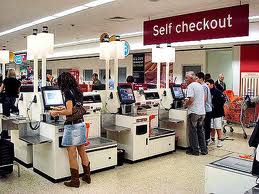
Supermarket chains started introducing self-service lanes about 10 years ago, touting them as an easy way for shoppers to scan their own items’ bar codes, pay, bag their bounty and head on their way. Retailers also anticipated  labor savings, potentially reducing the number of cashiers as they encouraged shoppers to use the do-it-yourself technology (one of our topics in Ch.7, Process Strategy). But Forbes (Sept. 26, 2011) is reporting that some grocery chains nationwide are bagging this “wave of the future” option by eliminating self-serve lanes.

Big Y, a Northeast US chain, just announced it was phasing out self-checkout lanes. Albertsons is also reducing its unstaffed lanes and adding more clerks to traditional lines. Why? Because a recent Food Marketing Institute study found that only 16% of supermarket transactions in 2010 were done at self-checkout lines in stores providing that option–down from a high of 22% three years ago. Overall, people reported being much more satisfied with their shopping experience when they used cashiers. Big Y  found that its self-service lines caused delays because of coupons and payments. Intentional and accidental theft  and misidentifying products also helped reach the tipping point.

Other chains plan to keep the self-service option in place because they think giving shoppers that choice is an important part of customer service. “People shop in different ways”, says a Stop & Shop spokeswoman. Home Depot and some other businesses that cater to a do-it-yourself mentality, have had more success with their self-service lanes. And it may all come down to demographics–such as whether the store is in a tech-savvy region. “It is a match between technology and the customer base”, says a St. Joseph U. prof.

Discussion questions:

1. What other businesses have reversed direction in terms of new technology?

2. Why have ATMs succeeded at airports and banks?

OM in the News: Service Quality vs. Maintenance Time at Disney World

You might not think that maintenance of  Walt Disney World’s monorail line in Orlando would be a controversial topic (see Ch.17). But the Orlando Sentinel (July 12, 2011) reports that plans to give maintenance crews more time to work on the aging system are certain to anger Disney’s premium-paying hotel guests. Disney had previously kept its trains running until at least 1 1/2 hours after theme parks closed.  Now service will shut down 1 hour after normal closing hours.

The beef is that guests who stay at these hotels on Disney property have “late night privileges”. This means the parks will stay open for them–and not for regular guests–  as late as 3 am and then reopen at 7 am. But Disney says that trains take 90 minutes to “cycle down” and another 90 to “cycle up” the next  morning, leaving only 1 hour of downtime for maintenance.

Reliability has suffered in recent years, perhaps because of the limited repair time. In 2009, the monorail system lost power at 1 am and it took Disney’s crews 3 hours to unload the weary passengers. “It’s been pretty obvious that transportation maintenance is one of the areas they cut back on during the recession”, says the popular website  Disney Blog. The blog also predicts Disney will suffer a backlash from guests staying at the most expensive hotels on the property, since they are the ones who “expect the most preferential treatment”.

Discussion questions:

1. Discuss the tradeoff between customer service and the need for more maintenance time.

2. What else can Disney do to deal with the problem?