OM in the News: Supply Chains and Tariffs

For more than a decade, US manufacturing has achieved growth in employment, output, the number of manufacturing establishments, and investment to expand or construct new facilities. This strong growth was driven by a desire to derisk supply chains and establish facilities closer to US customers. Increased supply chain volatility in recent years  has led organizations to shift their supply chain strategy from cost minimization to a focus on balancing cost with resilience.

Some manufacturers have reconfigured supply chains by reshoring portions of  production, by nearshoring—leveraging the USMCA free trade agreement (see Ch.2) to source more from Mexico and Canada—and by growing trade with countries such as India and Vietnam, which offer cost advantages.

And this trend is likely to continue: Over 70% of CEOs plan to alter their supply chains over the next 3-5 years.

President Trump’s policy priorities include cutting taxes, reducing regulations, lowering energy costs, and bolstering fair trade, all of which could accelerate continued investment in the US manufacturing sector. The policies could also drive a shift in supply chain strategy by prioritizing reshoring while potentially disrupting recent nearshoring and global sourcing trends. Tariffs comprise a component of this economic strategy.

Here are some key takeaways from a new Deloitte report (April 1, 2025) called Enhancing Supply Chain Resilience:

1.  US manufacturers import a variety of products, parts, and raw materials from around the world, and supplemental tariffs levied on these items could impact supply chains, costs, and the industry’s profitability.

2. Economically viable opportunities for reshoring production to the US are likely to be higher-value, complex products with strict quality standards, produced with technologically advanced, higher-capital intensity processes, and a workforce with higher-level skills.

3. For labor-intensive or lower-value goods, it might not be as economically viable for manufacturers to reshore. Instead, manufacturers may diversify their supply chains by seeking suppliers in countries that offer labor cost advantages—and minimize the long-term risk of supplemental tariffs, trade tensions, and geopolitical friction.

4. Digital tools and technology will play an important role in any supply chain strategy. For example, simulation, supply chain planning tools, and enhanced visibility can help mitigate risks in global supply chains.

Classroom discussion questions:

  1. What are the advantages and disadvantages of tariff adjustments?
  2. How are nearshoring and reshoring impacted?

OM in the News: Everybody Now Wants Supply Chains to Be ‘Resilient”

Container ships sit moored outside a terminal in Hong Kong , reflecting the disruption of global supply chains.

Supply chains as front-page news? That would have seemed unlikely—until the pandemic exposed many of the vulnerabilities in the far-flung networks that connect manufacturers, suppliers and buyers around the globe.

At first, the impact mostly reflected rapidly shifting patterns in demand, whether in PPEs or work-from-home and consumer products. But a subsequent spending boom left companies struggling to find import capacity on key trade lanes. Flotillas of container ships waited outside ports, wreaking havoc on shipping schedules, and importers struggled to hire enough truck drivers or warehouse workers to move all the cargo. As bottlenecks spread across the economy, they in turn exacerbated the shortages, as companies resorted to excess ordering and stockpiling.

The disruption exposed deep interconnections in supply chains, and just how dependent some sectors like the auto industry were on a few semiconductor factories in Taiwan, or the pharmaceutical sector on Chinese ingredients and chemicals. This challenged companies and governments worldwide to question their dependence on distant suppliers and logistics links that might be prone to interruption.

As a result, “resilience” has become the new watchword, writes The Wall Street Journal (Dec. 11. 2021) . How quickly can a company or a country bounce back from an interruption in the supply of critical products, components or raw materials? What if China suddenly cuts off U.S. access to rare-earth minerals, semiconductor chips or the ingredients used to make antibiotics and other drugs?  But if we equate resilience with domestic self-sufficiency, we would have to relocate chip packaging, materials supplies, tool sources and much more from across Asia and Europe.

So who doesn’t want a resilient supply chain? But while there are some things that companies and governments can—and will—do to increase their ability to respond to future shocks, these will all come with costs. For instance, if better resilience means a more geographically diversified supply base, we will get some of it from “China +1” strategies that many companies are already implementing. Politically sensitive gear such as telecom and computing equipment have been in the lead, with firms shifting production to Southeast Asia and Mexico.

Will Americans pay higher prices for goods made in the U.S.A.? That is still a hard sell, so the real question is: how much of that kind of production will move back into the country? Not only will the finished products likely be costlier, but somebody has to pay for the transition costs—the move, the training, bringing in suppliers.

Classroom discussion questions:

  1. Describe the supply chain risks listed in Chapter 11.
  2. What are the difficulties in making supply chains more “resilient”?

Good OM Reading: Automating Supply Chain Resilience

supply-chain-risk“Substantial investments in supply chain resilience have enabled companies to vastly improve their capacity for bouncing back after a disruption,” writes MIT Sloan Management Review (Jan. 2017). With the benefit of digital technologies, companies are using Big Data to identify supply chain risks and create early warning systems with much greater speed and precision. A digital supply chain is defined as “a customer-centric platform model that captures and uses real-time data coming from a variety of sources.” If a potential disruption is detected, the system decides on the best mitigation strategy and executes that strategy.

 A recent survey of 30 global companies found that 88% have incorporated elements of the digital supply chain into their business model. All of the companies surveyed were working to adopt game-changing technologies such as the internet of things and robotics. To keep pace, companies need to develop ways to automate resiliency. There are various strategies to make the supply chains more resilient, including diversification of the supplier base, establishing safety stocks, and planning for spare transportation capacity.
 One example is a loaded freight container equipped with sensors that track the temperature and humidity of the goods in real-time. The data is analyzed using business intelligence rules and shared with authorized entities in the extended supply chain. These parties can take action should a problem be detected. For example, if the container readings indicate that perishable cargo has been damaged due to an equipment malfunction, an order is automatically placed for replacement supplies while the damaged shipment is still in transit. Such remedial actions are not confined to logistics; financial and contractual terms can also be adjusted when an unexpected disruption occurs.
 Risk-prone supply chains are generally perceived as less secure by governments, and for that reason are more frequently selected for auditing, control, and inspection. These activities create unnecessary delays in supply chains.

Good OM Reading: Supply Chain Resilience

disasterSemiconductor companies shaken by earthquakes; transportation companies battered by weather; retailers outwitted by rivals — nearly every company has endured some type of catastrophe, and then learned from its experience, disruption after disruption. For example, GM became more resilient with every crisis it faced, from the bankruptcy of its strategic supplier, Delphi, in 2005 to the Japan earthquake in 2012. “Technology is an increasingly important tool in the arsenal of resilience” writes MIT Sloan Management Review (Oct., 2015) .

From sensors to cloud computing to social media, various technologies can help prepare for, detect and manage disruption. Sensors can warn of impending events, from industrial accidents to earthquakes. When interconnected into Internet of Things networks, these smart devices can alert employees to a potential or existing disruption. During and after disasters, every human being on the scene can now be a sensor. Social media channels can provide an informal, real-time damage assessment. But even as technology makes it easier to detect and manage risk, it is also a major source of risk. A cyber-security breach can disrupt as much as an earthquake can– as the many retailers that fell victim to digital theft discovered in 2014. A large part of the problem is not rooted in sophisticated penetration of firewalls, but with insiders whose mobile devices are infected inside the firewall.

Collecting information from every source — weather reports, sensors, industrial intelligence — is only half the job. What organizations do with the information is key. The technology will sound the alarm, but the decision-making process that ensues is the real issue. Consider the actions taken by dispatchers when alerted to an earthquake in Mexico City a few years ago. Those empowered employees were able to shut down the subway system 40 seconds before the earthquake hit, avoiding a possible disaster. Employee empowerment illustrates a key difference between resilient and non-resilient companies: Resilient companies delegate to the lowest level. They organize in advance for disruption and consolidate crucial information in an emergency operations center. With the increasing use of cloud technologies, these centers can be virtual so that employees can work on the disruption, even from home.

Guest Post: Certifying Supply Chain Resiliency

Our guest post today comes from Prof. Matt Liotine in the Dept. of Information and Decision Sciences, University  of Illinois-Chicago. Jay and I had the privilege of lecturing in his MBA classes during the POMS Meeting in Chicago in April.

Supply chain resilience has taken center stage in recent years amidst the many adverse events that are taking place across the globe. We have seen first hand how tsunami, earthquakes, hurricanes, tornadoes, wildfires, volcanoes and other natural disasters can not only cause loss of life and asset damage, but can also disrupt business operations. While is it incumbent upon companies to establish business continuity and disaster recovery plans to continue their operations in light of such events, it is also necessary for them to evaluate or even audit such plans pertaining to their key suppliers.

Several standards have been issued across the globe that businesses can use in this regard, such as ISO 22301, BS 25999 (U.K.), and NFPA 1600 (U.S.), and ASIS SPC.1. Most recently, the U.S. Congress has mandated a voluntary program of accreditation and certification of private entities for business continuity. Called the Voluntary Private Sector Preparedness Accreditation and Certification Program (PS‑Prep), this initiative was an outgrowth of the 9/11 Commission Act of 2007. Companies can use any of the last three standards cited above as a compliance benchmark since these share many similar principles and characteristics. Compliance is evaluated by auditors representing a PS-Prep certifying body. The U.S. Department of Homeland Security has authorized that these bodies be accredited by the ANSI-ASQ National Accreditation Board. While totally voluntary, PS-Prep can provide a mechanism for companies to evaluate and certify their own business continuance as well as that of their suppliers. (AT&T has been the first company to become PS-Prep certified.)

It is important to note that such compliance is not only targeted towards large corporations, but also for small-to-mid size businesses, which in fact constitute a significant portion of the global supply chain. While it may be infeasible for smaller suppliers to acquire a certification, buyers can still encourage or even enforce good business continuance practices by their suppliers through either contract stipulations and/or business processes.

Guest Post: Supply Chain Resilience–a Visualized Introduction

Ben Benjabutr, at http://www.SCM-Operations.com, in Thailand, provides an interesting guest post in his Powerpoint explanation of supply chain resilience.
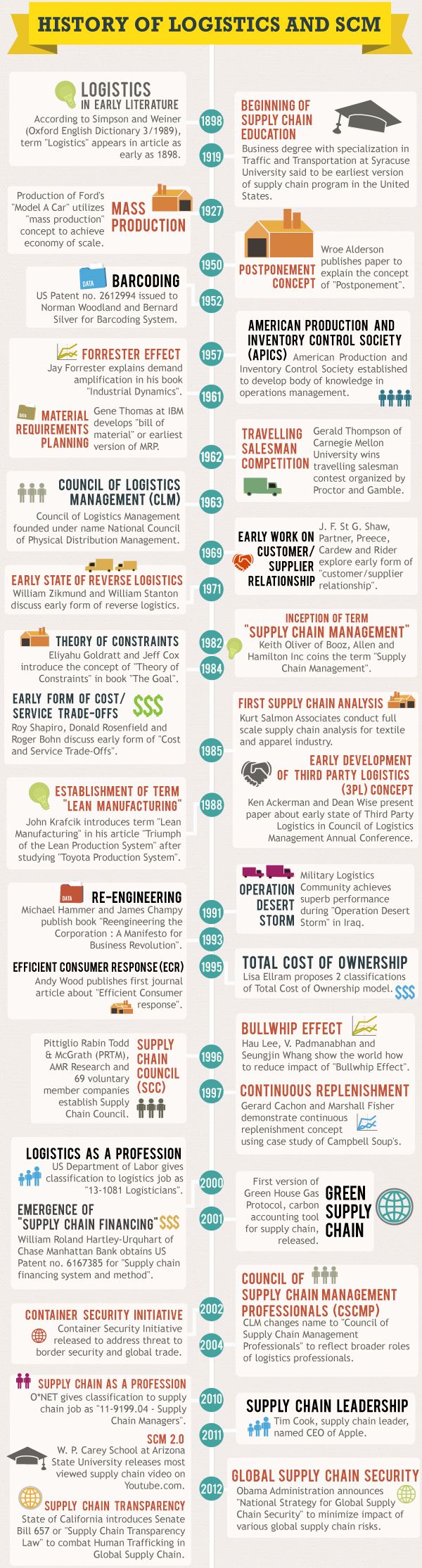
Supply chain resilience is a relatively new subject in supply chain management. During the 1970s, corporate decision making used traditional risk management techniques which have strong roots in financial models. Risks are usually quantified using assumptions based on historical data. In 1982, the term “Supply Chain Management” was coined by  a management consultant in the UK. The  primary goal of supply chain management was to reduce lead-time in distribution channel.

Risks in supply chains come in different terms– like variation, uncertainty, non-conformance, vulnerability and disruption. In the late 1990s, supply chain risk management emerged in academic literature. In 2000, research on the subject was conducted in the UK after transportation disruptions from fuel protests. Another research stream about resilience came in the United States after the 9-11 attacks in 2001. Then, in 2004, Martin Christopher and Helen Peck published their paper  “Building the Resilient Supply Chain.”  They defined resilience as “the ability of a system to return to its original state or move to a new, more desirable state after being disturbed“.

The most interesting year turned out to be 2011, with the tsunami in Japan followed by massive flooding in Thailand. The automotive and electronic industries were hit very hard by the disruptions. Since then, supply chain resilience has gain extraordinary attention from both academia and business professionals. The purpose of the Powerpoints I have created (click below) is to familiarize readers with the concept of supply chain resilience.  I hope this is something useful for instructors teaching from the Heizer-Render OM text.

[gigya id=”preziEmbed_n5tqhy_p-nhm” name=”preziEmbed_n5tqhy_p-nhm” src=”http://prezi.com/bin/preziloader.swf” type=”application/x-shockwave-flash” allowfullscreen=”true” allowFullScreenInteractive=”true” allowscriptaccess=”always” width=”550″ height=”400″ bgcolor=”#ffffff” flashvars=”prezi_id=n5tqhy_p-nhm&lock_to_path=0&color=ffffff&autoplay=no&autohide_ctrls=0″]
Source: SCM-Operations.com