OM in the News: UPS Turns to RFID

United Parcel Service is rolling out technology to more closely track the billions of small packages that move through its U.S. network each year, reports The Wall Street Journal (April 15, 2026).

UPS has invested $100 million to date to set up RFID technology across its network

The company said the change will increase visibility throughout its small-package delivery network, while increasing delivery accuracy and reducing the manual labor needed to scan individual parcels.

“What this does is it offers our customers real-time, near real-time, visibility of where their packages are at within our network,” said a UPS exec.

The capability is a step beyond the shipment-tracking information widely used today, which relies on workers scanning bar codes as packages enter and leave warehouses or vehicles. That tracking point typically lags behind a package’s current location, leaving gaps in visibility where packages may be misplaced or lost.

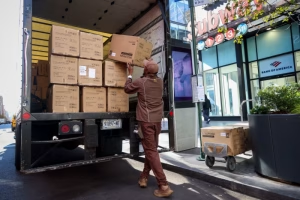
UPS is now embedding RFID tags into shipping labels and has installed RFID sensors on all its U.S. delivery trucks, at its more than 5,500 retail stores and in its final-mile delivery centers.

The technology allows UPS to automatically sense and track when a package crosses a threshold into or out of a building or vehicle. That will give customers a more up-to-date, accurate picture of where packages are, though it does not include real-time location tracking.

The company in part uses the technology to identify what it calls misloads, where packages are loaded onto the incorrect delivery truck. The RFID tag on a given package sets off a sensor as it’s loaded into a delivery truck and makes a noise indicating if the package is on the wrong vehicle.

UPS said misloads have dropped near 70% since it started using the technology in 2024, and that the RFID technology will eliminate about 20 million manual scans per day.

The high cost of individual tracking devices and the complexity of small-package delivery networks have limited tracking technology to more industrial applications as well as shipping high-value goods such as healthcare products, electronics and luxury items. UPS said the cost of RFID tags has come down to a few cents each, allowing the company to deploy the technology at scale.

Classroom discussion questions:

  1. What are the advantages and disadvantages of RFID?
  2. Why are misloads to be avoided?

OM in the News: Advances in Technology Are Shaking Up The Workplace

Schneider National drivers are tracked to see if they are breaking too hard

Dennis Gray suspected that workers in his pest-control company were spending too much time on personal issues during the workday. So the general manager of Accurid Pest Solutions in Virginia quietly installed a piece of GPS tracking software on the company-issued smartphones of its 18 drivers. The software allowed Gray to log onto his computer to see a map displaying the location and movement of his staff. One employee, he discovered, was visiting the same address a few times a week for a few hours during the workday. At that point, Gray told the driver he was being tracked.

“Blue-collar workers have always been kept on a tight leash,” writes The Wall Street Journal (Oct.23, 2013), “but there is a new level of surveillance available to bosses these days. Thanks to mobile devices and inexpensive monitoring software, managers can now know where workers are, eavesdrop on their phone calls, tell if a truck driver is wearing his seat belt and intervene if he is tailgating”.

A 2012 report found that 37% of companies that send employees out on service calls track the real time location of workers via their hand held devices or vehicles. High tech monitoring feels like a violation of privacy to some workers, but employers say such measures improve workplace safety and productivity while also helping to reduce theft, protect secrets and investigate harassment or discrimination claims. No federal statutes restrict the use of GPS by employers, nor force them to disclose whether they are using it.

Companies that keep quiet about tracking efforts may miss out on the benefits of deterrence. A recent study of NCR’s theft-monitoring software used in 392 restaurants found a 22% reduction in server theft after the software was installed and staffers were told about it. Drink sales, meanwhile, rose 10%. Being watched, researchers found, made waitstaff work harder. This is a great example of service technology to use when teaching Chapter 7.

Classroom discussion questions:

1. What are the ethical issues involved in monitoring employees?

2. What are the OM advantages of tracking?