OM in the News: UPS Turns to RFID

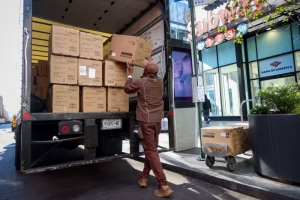
United Parcel Service is rolling out technology to more closely track the billions of small packages that move through its U.S. network each year, reports The Wall Street Journal (April 15, 2026).

UPS has invested $100 million to date to set up RFID technology across its network

The company said the change will increase visibility throughout its small-package delivery network, while increasing delivery accuracy and reducing the manual labor needed to scan individual parcels.

“What this does is it offers our customers real-time, near real-time, visibility of where their packages are at within our network,” said a UPS exec.

The capability is a step beyond the shipment-tracking information widely used today, which relies on workers scanning bar codes as packages enter and leave warehouses or vehicles. That tracking point typically lags behind a package’s current location, leaving gaps in visibility where packages may be misplaced or lost.

UPS is now embedding RFID tags into shipping labels and has installed RFID sensors on all its U.S. delivery trucks, at its more than 5,500 retail stores and in its final-mile delivery centers.

The technology allows UPS to automatically sense and track when a package crosses a threshold into or out of a building or vehicle. That will give customers a more up-to-date, accurate picture of where packages are, though it does not include real-time location tracking.

The company in part uses the technology to identify what it calls misloads, where packages are loaded onto the incorrect delivery truck. The RFID tag on a given package sets off a sensor as it’s loaded into a delivery truck and makes a noise indicating if the package is on the wrong vehicle.

UPS said misloads have dropped near 70% since it started using the technology in 2024, and that the RFID technology will eliminate about 20 million manual scans per day.

The high cost of individual tracking devices and the complexity of small-package delivery networks have limited tracking technology to more industrial applications as well as shipping high-value goods such as healthcare products, electronics and luxury items. UPS said the cost of RFID tags has come down to a few cents each, allowing the company to deploy the technology at scale.

Classroom discussion questions:

  1. What are the advantages and disadvantages of RFID?
  2. Why are misloads to be avoided?

OM in the News: Delivery Wars!

A decade ago, Walmart’s thousands of stores across the country made it look like a dinosaur in the online-shopping era, writes The Wall Street Journal (March 8-9, 2025). Now the retail giant is mounting one of the few serious challenges to Amazon’s dominance in e-commerce, and those very stores are central to its strategy.

Samantha Atkinson became a Spark driver last year to supplement her income. When Walmart workers load the car of a delivery driver, one order generally goes in the trunk, the second in the back seat and the third in the front passenger seat to prevent delivery errors.

Walmart delivered 5 billion items on the same day they were ordered last year, double the number delivered in 2023It can now deliver most of the 120,000 products in its supercenters, including meat, eggs and milk, to 93% of U.S. households the same day, sometimes in hours. “I am very, very grateful that we have 4,700 stores,” which now double as fast-delivery hubs, says Walmart’s CEO. To make most of those speedy deliveries, the retailer relies on thousands of freelance drivers using a system called Spark, created by Walmart, which uses an app to coordinate online orders. Tens of thousands of Spark drivers, who aren’t Walmart employees, make the majority of same-day deliveries.

About 41% of U.S. e-commerce sales go through Amazon, a much bigger share than Walmart’s 9%. But Walmart had $681 billion revenue in 2024 versus Amazon’s $638 billion. Over years of attempts, tests and failures, Walmart has carved out a niche that has Amazon working to catch up—fast delivery of online orders that often include inexpensive groceries, and increasingly other items it sells in its stores, such as clothing, batteries and prescription medicines.  Walmart gets more than 50% of its revenue from meat, eggs, lettuce and other groceries. It has used its scale to drive down prices for those items, which draw shoppers for regular trips.

Walmart’s same-day delivery coverage has stretched from 76% of U.S. households 2 years ago to 93% today.

Amazon also continues to expand rapidly. It has over 1,000 shipping facilities around the U.S., and more than 200 million people globally subscribe to its Prime membership. The similar Walmart+ offers free delivery for orders over $35.

But Amazon has struggled to dominate the fresh-food delivery business. It’s tried several models for delivery through Whole Foods and Amazon Fresh.

Classroom discussion questions:

  1. How does Walmart’s delivery service compare to Amazon’s?
  2. What is Walmart’s strategic advantage? Amazon’s?

OM in the News: Superfast Delivery Shifts into Low Gear

In Chapter 2, we describe how companies can achieve competitive advantage (see pages 36-39) through differentiation, cost, or response (speed). For years, Amazon.com set the pace for competition on speed with its investment in next-day and same-day delivery.

Companies like UPS are turning away from more expensive fast delivery as a way of trimming costs.

But retailers this holiday season, reports The Wall Street Journal (Nov. 10, 2022), are focusing on delivering packages to customers on specific dates, rather than competing on speed of delivery. The shift marks an easing in a race for delivery speed in e-commerce in recent years that has pushed goods to shoppers’ homes at an ever-faster pace while narrowing retailers’ profit margins on sales.

With inflation-conscious consumers now dialing back their online shopping, many retailers are focused on restraining the high costs of fulfillment and “last-mile delivery”.

Amazon now gives its Prime members the option to pick a specific delivery date. Other retailers and logistics operators are now following suit. The idea is to offer “an anticipated delivery time” … whether that is 2 days or that is 3 days.

Saks shows shoppers what day they can expect any given item to arrive based on factors such as their ZIP Code. The feature refines the retailer’s previous 3- to 5-day shipping window. The choice makes clear to consumers that faster delivery carries a higher cost.

Chinese giant online apparel retailer Shein, known for its low-price and trendy clothing, says that rapid sales growth and superfast delivery don’t have to go hand-in-hand, even in fast fashion. Online shoppers are now more willing to wait for certain deliveries, having gotten used to pandemic supply-chain disruptions. Shein focuses on the front end of its supply chain, which includes manufacturing and shipping out of Guangzhou, China. It has significant business in the U.S. even though its website says it takes 10 to 15 days for American customers to get orders. .

Shein plans to expand its North American business by opening three distribution centers in the U.S., but even those will only speed up delivery by 3 or 4 days. The most important factor for consumers has become the visibility of it all and being able to know when to expect a delivery, as opposed to the assurance that it’ll be a superfast delivery. “Sometimes they want it really, really fast, or they want it really, really scheduled,” said a UPS exec.

Classroom discussion questions:

  1. How is speedy delivery an OM issue?
  2. Are your students willing to wait longer for an “anticipated” delivery time?

OM in the News: The Case for the Electric Delivery Van

When you think of electric vehicles, you might think first of a Tesla. But a more financially rewarding use of the technology could be the vans that deliver your online shopping, reports The Wall Street Journal (Jan. 23, 2021).

Until recently, such unassuming vehicles occupied an easily ignored niche within the multitrillion-dollar automotive industry. That is changing fast. Rivian just raised $2.65 billion to fund its rollout of EVs, including a delivery vehicle for Amazon.com, which holds a stake in the startup. And GM just created a new company, BrightDrop, to focus on selling EVs to the delivery market. It expects to ship 500 units to its launch partner, FedEx, this year.

Electric delivery vans operated by DHL in Germany

Electric vans are at the confluence of two big trends. One is the rise of e-commerce at the expense of bricks-and-mortar retail, to which the pandemic has given a boost. The other trend is vehicle electrification. The likes of UPS, DHL and FedEx have all committed to reducing their carbon emissions and need electric delivery trucks to do it. So has Amazon, which ordered 100,000 electric vans from Rivian, the first of them due later this year.

Logistics operators and small contractors are focused on careful cost calculations, including over the lifetime of their vehicles, as we illustrate in Example S2 of Supplement 5 (Sustainability in the Supply Chain). That increases the attractions of EVs, which tend to have low running and maintenance expenses. One reason such calculations are possible is that vans don’t typically need the long driving ranges required of passenger cars. Vans are often driven around cities for predictable distances and can be recharged overnight at depots.

Another advantage of EVs, as Tesla has shown, is the facility with which software can be integrated into their overwhelmingly electronic systems. Unlike Tesla fans, van owners stand to benefit financially from this advantage. Logistics is a data business. The more tools for cost-efficient routing, driving, loading and the like that manufacturers can offer fleet owners, the more business they will attract. 

Classroom discussion questions:

  1. What are the advantages and disadvantages of electric vans?
  2. Why are retailers like Amazon investing in these vans?

OM in the News: The Challenge of Delivering Covid-19 Vaccines

UPS is combining multiple refrigerators at its airport hubs to store vaccines in transit.

Just 2 weeks ago, Prof. Jeff Heyl delivered his Guest Post from New Zealand saying 8,000 fully laden Boeing 747’s would be needed to deliver a single dose of a Covid-19 vaccine to the world’s population. The Wall Street Journal (Oct. 6, 2020) asks: “If just 50 million doses were available today, could we distribute them?” The answer is almost certainly ‘No,’ states the head of the International Air Transport Association.

The pandemic has revealed shortcomings in global supply chains and forced business to make logistics a bigger strategic priority. Nonetheless, the air-cargo industry is making plans for delivering as many as 20 billion Covid-19 vaccination doses, even before regulators have approved any of the treatments under development. (Pharma companies say they expect the bulk of vaccines to be transported by air.)

Carriers such as FedEx, DHL,and UPS have started preparations such as introducing new temperature-monitoring systems to track future vaccine shipments.  They are building “freezer farms” combining multiple refrigerators at their airport hubs to store vaccines in transit. Vaccines have to be kept at a very low constant temperature throughout the journey to prevent spoiling.

Cargo flights are fast filling up through February with bookings for consumer electronics, apparel and industrial parts through the holiday season and new year. Cargo executives said they expect it will take 2 years for a vaccine to reach all of the world’s population, with particular challenges in some emerging markets where infrastructure is limited. Fortunately, the air-cargo industry isn’t starting from scratch. Pharma products have been one of the fastest-growing and most profitable cargo types over the past decade.

Classroom discussion questions:

  1. Why is this such a complex logistics issue?
  2. What OM approaches can be deployed to increase the distribution efficiency?

OM in the News: Amazon Gets U.S. Approval for Drone Fleet

Amazon’s latest drone is designed to carry packages weighing 5 pounds and fly a round-trip distance of 15 miles.

Amazon just received federal approval to establish a fleet of drones and will begin limited tests of package deliveries to customers in the U.S., reports The Wall Street Journal (Sept. 1, 2020).

The approval from the FAA is a milestone in Amazon’s push to use unmanned aircraft to deliver packages to global consumers. The company also has testing sites in Canada, Austria, and the U.K.

Routine drone deliveries to U.S. consumers are still years away, partly because the FAA needs to complete rules for remote identification of more than 480,000 drones currently registered for commercial operations, and issue separate rules permitting drones to fly regularly over populated areas. Amazon has now joined UPS and Wing (a unit of Google) in gaining approval to operate unmanned air fleets in the U.S. for tests involving customer deliveries. Amazon has sought regulatory approval for a broader range of drones and over a larger geographic area than its competitors.

Amazon CEO Jeff Bezos made the ambitious prediction in 2013 that drone-delivered packages would arrive at the doors of customers in 5 years. Although the company completed its first test flight in England in 2016, the process has taken longer than Amazon expected.

Wing last year began to deliver food and other supplies to customers in Virginia. The company has been conducting tests in partnership with Walgreens and FedEx. UPS, which received FAA approval to set up an airline fleet last year, has been using its drones to carry medical supplies at a hospital network in Raleigh, N.C. Other companies such as Uber Technologies have also conducted limited drone-delivery tests in the U.S.

Classroom discussion questions:

  1. What are the strengths and weaknesses of this delivery approach?
  2. Why does Amazon wish to enhance its shipping strategy?

OM in the News: New York City Chokes on Deliveries from On-Line Orders

An Amazon order starts with a tap of a finger. Two days later — or even in a matter of hours — the package arrives. It seems simple enough. But to deliver Amazon orders and countless others from businesses that sell over the internet, the very fabric of major urban areas around the world is being transformed. And New York City, where more than 1.5 million packages are delivered daily, shows the impact that this push for convenience is having on gridlock, roadway safety and pollution.

The average number of daily deliveries to households in NYC tripled to more than 1.1 million shipments from 2009 to 2017, writes The New York Times (Oct. 27, 2019), With households receiving more shipments than businesses, trucks are pushed into neighborhoods where they had rarely ventured. About 15% of NYC households receive a package every day.

Delivery trucks double-park on streets and block bus and bike lanes. UPS and FedEx alone racked up more than 471,000 parking violations last year. The main entryway for packages into NYC, leading to the George Washington Bridge from New Jersey, has become the most congested interchange in the country. Officials are racing to keep track of the numerous warehouses sprouting up, to create more zones for trucks to unload and to encourage some deliveries to be made by boat or at night as the city struggles to cope with a booming online economy.

Amazon is now moving toward 1-day delivery rather than 2 days for Prime customers and plans to spend $1.5 billion this quarter to reach that goal. As the delivery armada has ballooned, so, too, have the complaints.  “There is just not enough room for all the trucks that need to make deliveries, the cars that need to get past them and the people who live here,” said a NYC councilman.  From 1990 to 2017, carbon dioxide emissions from automobiles and trucks in the NYC area grew by 27%, making the region the largest contributor of driving-related carbon dioxide emissions in the country.

Classroom discussion questions:

  1. What are the impacts from the surge in on-line deliveries in metropolitan areas?
  2.  Ask students who live in high-rises how the deliveries have affected them. Solutions?

OM in the News: The Roads Will Be Crowded on Sundays With UPS Trucks

UPS will start delivering packages on Sundays next year, following the move of FedEx as the two package giants battle to control the nonstop demands of online shopping. UPS, which currently delivers and picks up 6 days a week, will switch to 7 days in January. It will be assisted by the U.S. Postal Service, which delivers some UPS packages to homes for the final leg of a package’s journey.

UPS notes that Americans shop online 7 days a week and that there is increasing demand for deliveries every day. Amazon, one of the biggest package shippers, is building out its own transportation operations and fleet of local delivery vehicles. “The changes illustrate a grand realignment of America’s parcel delivery apparatus as companies try to determine how best to deliver packages for insatiable online shoppers at the lowest cost possible,” writes The Wall Street Journal (July 24, 2019).

UPS recently negotiated a union contract with its workers that created a new type of driver that would work weekend shifts at a lower pay scale than its regular delivery drivers. The company is taking additional steps to meet shipping challenges, including teaming up with the retailers CVS, Michaels. and Advance Auto Parts to use 12,000 of their stores as new drop-off points for deliveries and returns. More of these access points help lower delivery costs because its cheaper to deliver multiple packages to one location instead of singular deliveries to multiple homes.

FedEx itself has pushed ahead into expanding its own onsite network, recently announcing that it would work with Dollar General to use 8,000 of the retailer’s stores as drop-off and pick-up locations. UPS and FedEx both say that more than 90% of Americans will live within 5 miles of a drop-off location in their networks.

Classroom discussion questions:

  1. Referring to Figure 2.4 (Achieving Competitive Advantage Through Operations), which strategy is UPS following?
  2. What steps is UPS taking to compete successfully on Sundays?

OM in the News: Amazon’s Plane Ambitions

Amazon is expanding its domestic air-cargo operation, adding smaller jets to its rented fleet to link its distribution centers and extend the reach of its next-day delivery service. It is aiming to reach the capacity of its free 2-day option, which is available for more than 100 million products. The firm is also experimenting with local collection centers, its own delivery vans, on-demand taxis and even its own employees to speed deliveries to consumers at a lower cost, bringing it into direct competition, in some cases, with companies that also deliver its packages. FedEx recently said that it would end its air-shipping agreement with Amazon to concentrate on rapid delivery for other retailers that are making more sales online.

Amazon is renting another 15 Boeing 737’s converted to carry cargo, in addition to 5 it’s already leasing, alongside a fleet of 40 larger planes it uses to ship packages around the U.S. It expects to have a rented fleet of 70 planes by 2021 as it takes stronger control of its own logistics operations, writes The Wall Street Journal (June 19, 2019). “These new aircraft create additional capacity for Amazon Air, building on the investment in our Prime Free One-Day program,” says Amazon’s VP. Amazon is opening three more air cargo centers this year, in Fort Worth, Texas, Wilmington, Ohio, and Rockford, Ill. A new hub at Cincinnati’s airport that can handle 100 planes is due to open in 2021.

Amazon continues outsourcing its flying rather than start an in-house carrier. The domestic industry is highly regulated and has a history of turbulent labor relations, creating high barriers to entry.

Classroom discussion questions:

  1. How is Amazon taking more control of its logistics operations?
  2. What are the strengths and weaknesses of this approach?

OM in the News: FedEx Goes the “Last Mile” on Sundays

FedEx just announced it would start offering Sunday deliveries to most U.S. homes, the latest sign that online shopping habits are pressuring companies to revamp their operations to fulfill orders as they are placed. With people ordering everything from saunas to sandwiches online and expecting to have them quickly appear at the door, retailers and carriers are racing to adapt to service the last mile, writes The Wall Street Journal (May 31, 2019).

And Amazon, whose sprawl of warehouses has upped the ante, is promising 1-day delivery on many items later this year. “Online shopping is 7 days a week,” says FedEx’s CEO. “So there is increasing demand from online shoppers and e-commerce shippers for 7-day service.”

With the change, FedEx plans to deliver many of the packages it currently drops at local post offices. The shift will seek to lower costs by building density along FedEx Ground routes, while also shifting 2 million packages daily out of the U.S.P.S’s network.

FedEx and UPS have invested heavily in recent years to manage the volume of e-commerce packages moving through their sorting facilities. Until recently, the companies have taken steps to outsource last-mile delivery to the Post Office, worried that home deliveries would be less profitable than shipments between businesses. But as the volumes climb—to 50 million domestic packages a day—the companies are adjusting their operations to boost market share and handle weekend deliveries. They are also experimenting with more immediate delivery options, including drones and robots (both the subjects of recent blogs).

At the same time, FedEx’s traditional business of rushing deliveries by jet across the globe has slowed. Amazon, Walmart, and others have expanded their warehouse networks, adding locations near more U.S. cities where they can store goods and ship them shorter distances.

Classroom discussion questions:

  1. What major market shifts caused FedEx to add this Sunday service?
  2. What new OM issues will FedEx face now?

OM in the News: Who Comes to the Rescue of Stranded Robots? Humans

A stuck robot in Berkeley.

Fannie Osran just had to help. The student at the UC, Berkeley, came upon a food-delivery robot, one of 120 deployed around campus, in front of a long flight of

stairs. The cooler-sized robot can’t navigate stairs, so it immediately backed up into a plant bed—where it got stuck in some mud. Ms. Osran told it, “You’re so pathetic.” She lifted the robot back onto the sidewalk, and it flashed heart eyes at her on its digital display as it rolled off.

Robotics companies are jumping into food delivery, testing out different models in limited areas, writes The Wall Street Journal (April 11, 2019). While people fear that robots will someday take over everyone’s jobs –for now, the prototypes can run into trouble just getting a burger and fries to a dorm. As the competition

Agility Robotics’s delivery robot.

among automated delivery services heats up, robot makers see winning over love from pedestrians—and local officials—as paramount to helping expand into communities and ease potential regulations.

Researchers also staged stuck robots in public, then hid in nearby restaurants and office buildings to see if anyone helped. They found people helped the robots more often when they emitted audible signals for help.

Oregon-based Agility Robotics builds walking robots that could be used for delivery. They resemble a headless person. “We don’t aspire to be cute. We’re definitely not going down that road,” said the CEO, noting that cute rolling robots can’t handle obstacles like stairs.

Classroom discussion questions:
1. Will these delivery robots be ubiquitous in 5 years?

2. Name other industries where “service robots” can make an impact.

OM in the News: FedEx’s Delivery Robot

The new FedEx Same-Day Bot can climb stairs to deliver packages.

FedEx will soon start testing robots that could make same-day deliveries of medicine, pizzas and other items to consumers’ homes, pushing the parcel-delivery giant into a new market competing against startups like Postmates that use humans for rapid deliveries.

The project makes FedEx the latest in a growing stream of companies to test automated, unmanned machines to make deliveries, writes The Wall Street Journal (Feb. 28, 2019). Amazon and UPS have demonstrated drones to deliver packages in certain areas, and Amazon has displayed a rolling robot it calls Scout in trials on city streets. Grocery chain Kroger recently showed off an unmanned vehicle that can deliver groceries in certain markets, and several robotics startups are testing autonomous delivery robots that use sensors and cameras to navigate sidewalks for short trips, including lunch deliveries to crowded Beijing office buildings.

But on-demand delivery companies such as Deliv and DoorDash that make point-to-point trips carrying food or e-commerce purchases typically rely on armies of couriers who travel by car, scooter or bicycle. The FedEx “SameDay Bot” is starting off with tests planned in the corporation’s hometown of Memphis. AutoZone, Lowe’s, Pizza Hut, Target, Walgreens and Walmart are looking at using the FedEx bot. Retailers envision having robot fleets ready to make same-day deliveries that would be branded with the retailer’s logo and modified for different uses– a cooler for grocery, a heater for pizza.

“The economics of a point-to-point delivery versus a planned or even an overnight delivery, they’re just very different,” says a FedEx exec. “Eventually, we believe the majority of same-day, point-to-point will be delivered using the FedEx SameDay Bot.”

Your students will enjoy the 30 second video embedded in the article.

Classroom discussion questions:

  1. What makes delivery with the robot less than optimal?
  2. What are the robot’s main advantages?

OM in the News: The Drones Will Have to Wait at Amazon

Instead of charting a future that makes drivers obsolete, Amazon is so dependent on them it’s copying FedEx to build a network of independent couriers around the country in a frantic effort to keep pace with demand that peaks in December. Jeff Bezos captured the world’s imagination when he appeared on CBS’s “60 Minutes” and pledged to fill the skies with package delivery drones. “Five years on, Amazon’s CEO is betting on decidedly more terrestrial technology: drivers.,” writes Material Handling & Logistics (Dec. 18, 2018) 

Bezos this summer issued a call-to-arms to aspiring entrepreneurs, offering them a chance to earn $300,000 a year by starting their own businesses making Amazon deliveries. All for as little as $10,000 up front, far less than the $250,000 it takes to open a fast-food franchise like McDonald’s or the $1 million required to buy a typical FedEx delivery business. Instead of charting a future that makes drivers obsolete, Amazon is so dependent on them it’s copying FedEx to build a network of independent couriers around the country in a frantic effort to keep pace with demand that peaks in December.

So far, Amazon has attracted tens of thousands of aspirants eager for a ground-floor opportunity serving the fast-growing company led by the world’s wealthiest man. Applicants go through phone interviews followed by several days of training. In just a few months, hundreds of new businesses have sprouted up around the country that employ thousands of drivers.

Shipping is one of Amazon’s fastest-growing expenses and consistently outpaces online sales growth. The company must find cheaper ways to deliver packages or its e-commerce business could be unsustainable without further price hikes.

Classroom discussion questions:

  1. What are the strengths and weaknesses of this delivery approach?
  2. Would your students be interested in joining such a business?

OM in the News: Amazon Drives Deeper Into Package Delivery

“Amazon is pushing further onto the turf of its shipping partners UPS and FedEx, enabling small businesses to carry its overflowing supply of packages in the all- important last-delivery leg to the consumer’s door,” writes The Wall Street Journal (June 28, 2018). The online retail giant is inviting entrepreneurs to form small delivery companies employing up to 100 drivers and leasing 20-40 Amazon-emblazoned vans, an initiative that should help it rapidly build out its own delivery network across the country. It has also contracted with many small delivery companies to drop off its packages in major metro areas, many in unmarked white vans.

It is yet another major push by Amazon to gain more control over its own deliveries in a continued quest to build a vast freight and parcel shipping network. Amazon says it has to build out its own services simply to handle the surging number of online orders that UPS, FedEx and the U.S. Postal Service can’t. More than $4 of every $10 spent online in the U.S. is on Amazon, and the number of its deliveries topped more than a billion last year.

Still, Amazon has taken broad steps in recent years to poach some of the most desirable deliveries from its partners and could be on a collision course to one day compete directly with the shipping giants. Amazon expects that hundreds of entrepreneurs could sign up to help the company deliver packages the “last mile,” which is typically the most expensive piece of an online order’s journey.

The number of packages Amazon needs to ship in the U.S. has more than doubled over the past five years to roughly 1.2 billion packages last year. Projected growth is too much for existing delivery companies to handle. Amazon has advanced deeply into logistics over that same period, building out more than 70 delivery stations, buying more than 7,500 truck trailers, leasing 35 aircraft to fly its wares around the country and expanding into ocean freight. Amazon spent $21.72 billion on shipping world-wide last year, or about 12% of overall revenue.

Classroom discussion questions:

  1. How does Amazon handle the “last mile?”
  2. What are the advantages and disadvantages of Amazon’s logistics strategy?

OM in the News: Amazon Tries a New Delivery Spot–Your Car

After dropping off the package inside, the courier can close the trunk and consider the delivery complete

Amazon packages get delivered to all sorts of places. Front porches? Naturally. Cubicles? Of course. Inside locked homes? Yes, that, too. Now add a new one: the trunk of your car. This week, people in dozens of cities across the U.S. can start getting their Amazon orders delivered to a parked car, provided their vehicle has the proper technology, reports The New York Times (April 24, 2018). With a few taps on a smartphone screen, the courier can unlock the car and drop the box inside the trunk or on the back seat.

The new service is aimed at anyone who doesn’t want to risk having their package swiped from their front porch or who can’t receive an Amazon order at work, perhaps because an employer doesn’t allow it. (Package thieves have even earned a snappy moniker, “porch pirates,” by police). Amazon has dived into delivery convenience and security with gusto. To reduce package theft, it has installed lockers outside physical stores (like the 7-11 right around the corner from my house) where customers can pick up orders. And last year, it introduced Amazon Key, which lets its couriers unlock customers’ front doors and drop packages inside.

For in-car delivery to work, customers must have a recent model GM vehicle with OnStar, or a Volvo with On Call. Couriers can use those assistance services to find the cars through satellite location-tracking and unlock the trunk. The service will be expanded to other carmakers over time. The Amazon systems will allow couriers to unlock vehicles only once for each scheduled delivery, to prevent unauthorized access. Still, the service will require a hefty amount of trust that a courier won’t swipe any valuables. Car owners, who are frequently discouraged from leaving valuables in their vehicles, may rightly be concerned receiving an Amazon package to their cars when they’re not present could make them a target.

Classroom discussion questions:
1. What are the advantages and disadvantages of this new delivery service?

2. Outline all modes of delivery that Amazon and competitors are using now or might use shortly>