OM in the News: One Way to Power New AI Data Centers

Where is the energy to power the hundreds of new data centers that are popping up to run artificial intelligence demands coming from? “In the battle for AI dominance, every engine of the economy is getting recruited into the fight—including jet engines'” writes The Wall Street Journal (Feb. 18, 2026). 

Jet engines are a natural fit. Power equipment giants GE Vernova, Siemens Energy, and Mitsubishi Heavy Industries  already sell power turbines—known as aeroderivatives—that are modeled after these very jet engines. Aircraft engine companies such as GE Aerospace , Howmet Aerospace and Woodward also sell land-based aeroderivative turbines or components.

Yet designing the turbine, which keeps as much of the original jet engine features as possible, is a roughly 18-month undertaking.  Instead, it only takes 30 to 45 days to convert a plane’s jet engine to a power-generating turbine. (There are 2 main modifications to convert an aircraft engine to a land-based natural gas turbine. One is replacing the fuel nozzles to utilize natural gas instead of jet fuel. The other is replacing the large fan on the front of the flight engine with a much smaller fan).
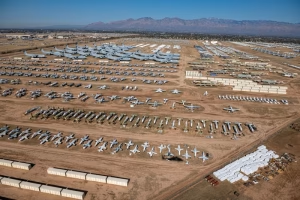
Retired aircraft, at an Air Force base near Tucson, Ariz

A company can remanufacture jet-engine parts with a few years of remaining life for use in power turbines, where they can operate for many additional years. Narrow-body jet engines experience higher stress from repeated takeoffs and landings. Power turbines can run as peakers—turning on only when demand surges—or continuously as baseload. Either way, they accumulate less wear and tear.

About 1,600 commercial aircraft engines are retired every year. If a third of those engines get converted into turbines, that would represent about 13 GW of capacity, or more than a quarter of the existing global natural gas turbine capacity.

AI-obsessed tech giants are planning to spend more than $700 billion in capital expenditures this year. The lure of that cash pile will generate a lot of creativity in the power sector.

Classroom discussion questions:

  1. Why is there a need to convert jet engines?
  2. Discuss the growth of data centers and the demands they create. (See our recent post on that topic.)

OM in the News: Alcoa Embraces Additive Manufacturing

Alcoa today can 3-D print the dies used to manufacture turbine parts

There’s a great deal of testing that goes into airplane parts to be sure they can handle the temperatures and stresses of aviation. Alcoa would know. The 125 year old metals producer makes parts for gas turbine engines used by Boeing and Airbus. The problem? All that testing takes time. Between tooling, development, and casting, it used to take Alcoa a year to manufacture one of the nickel-alloy parts that go into an engine, where it must withstand temperatures of up to 2,000˚F. Then, writes Fortune (Dec. 1, 2014), the company discovered additive manufacturing—better known as 3-D printing.

In past few years, the company has been using additive manufacturing to create the dies that shape engine parts. With additive manufacturing Alcoa cut the time by 50% and the cost by 25% required to develop the process and manufacture the part. “We’re really at the beginning of what I would call a second Industrial Revolution,” says Alcoa’s CEO. “You go from idea to product in no time. It’s almost like production at your fingertips.”

In the past, Alcoa built a die using a process called subtractive machining. It’s similar to sculpture: Start with a material—in this case, steel—then whittle it down into the shape you need. Ten to 30 weeks later, the company ended up with a custom die that it would then use to cast the needed engine part. Today, Alcoa pairs CAD with 3-D printing to construct the die from a computer file, layer by layer. A process that once took half a year is completed in 2-8 weeks, allowing the company to dramatically increase its output. Alcoa can now handle more parts orders—for commercial aircraft, business jets, regional jets, even helicopters—and ramp up to meet them faster.

Classroom discussion questions:

1. Why is 3-D printing so important to Alcoa?

2. What is the difference between additive and subtractive manufacturing?