OM in the News: Scrutinizing the Scheduling of Workers at Retail Chains

Aeropostale workers say they are being put under unnecessary stress.

The attorneys general of 8 states are scrutinizing big retailers over their staffing practices and whether they require workers to show up or stay home with little notice, reports Fortune (April 13, 2016). Warning letters have been sent to Target, Gap, Abercrombie & Fitch, Sears, J. Crew, Urban Outfitters, Williams Sonoma, and other chains they believe are using on-call scheduling.

On-call scheduling systems have made big retailers more nimble, allowing them to staff stores during busy times and save on payroll during slow days. The software used by many retailers forecasts staffing needs based on real-time sales and traffic information.

Some employers require on-call workers to check in by phone, email or text shortly before their shift. If the store is expected to be busy, they must come in; if things are slow, they are told not to report for work, and aren’t paid. These systems have been criticized by worker advocates, who say on-call scheduling makes workers’ lives and pay unpredictable.

The retailers are being asked to provide information about how they schedule employees, including whether they use software from vendors such as Kronos and Workplace Systems to schedule labor hours, or penalize employees who don’t follow on-call procedures. Schedule instability has emerged as a public policy issue in recent months, highlighted in hourly workers’ campaigns for higher wages. A 2015 report examined the prevalence of unpredictable schedules among young adults, and found that 41% receive their schedules a week or less in advance, and half have no input into the timing of their hours.

Classroom discussion questions:

  1. What are the advantages and disadvantages of on-call scheduling.
  2. Why has this become a public policy issue?
OM in the News: Employee Scheduling with Commercial Software

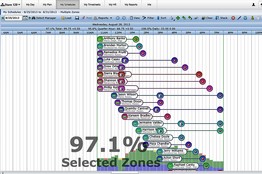
Dayforce software gives users an efficiency score for their scheduling

Say you own a thriving bakery that’s open 12 hours a day, seven days a week, and you have 9 full-time employees and 11 part-timers. The shop is busiest between 7 a.m. and 9 a.m. and then again from 11:30 a.m. to 3 p.m. How many people do you need on the noon to 6 p.m. shift?  This common problem is one we discuss in both Chapter 15 (Short-Term Scheduling) and Module B (Linear Programming). Behind the scenes are scores of software programs available to help businesses manage their scheduling conundrums, reports The Wall Street Journal (Sept. 16, 2013).

The biggest name in the “workforce management” software business, Kronos Inc., offers Workforce Ready, which allows small employers to start out with a single application, such as basic scheduling, and then add extra features, from calculating accrued time off to administering payroll. Kronos’s Workforce Central lets larger employers oversee a complex multistate or global employee base.

Because they can monitor workers’ hours better than traditional methods, the programs also allow employers to keep closer track of employees—reducing overtime, for instance, and syncing up with electronic time clocks to monitor tardiness and break times. And scheduling programs offer the ability to integrate with payroll software to tally workers’ paychecks, which helps reduce the simple mathematical errors that can plague manual scheduling and payroll processes.

There are benefits for workers as well. Ceridian’s Dayforce allows employees to view their schedules online, swap shifts with co-workers and record their availability. Guitar Center Inc., a music-instrument retailer with around 240 locations, began using Dayforce in 2010 after years of managing schedules with Excel spreadsheets. “Now we load customer traffic and transactions in 15-minute intervals into Dayforce, and it generates labor-demand curves that let each store know how many people they should staff for every 15 minutes,” says a Guitar Center exec.

Classroom discussion questions:

1. How can linear programming be used to solve scheduling problems?

2. Why is commercial software so useful?