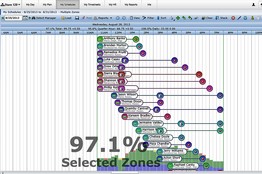
OM in the News: Changing How Factories Schedule Employees

Until last April, there had really been just two ways to make 350,000 pounds of cheese a day at the Land O’Lakes plant in Melrose, Minn,: Start at 5 in the morning and work till 5 at night, or the other way around.

Rigid factory shifts were the default for churning out cheddar, as they are at factories the world over that make all kinds of products. “The most efficient way to keep production humming uninterrupted, 24 hours a day, 7 days a week, is to start and end in unison, bundling dozens of individuals’ efforts into a single unit of labor,” writes The Wall Street Journal (March 11, 2024).

The rigid schedule makes sense logistically. Each day, 70 or so trucks from member farms empty milk at the Melrose plant. Converting the unending inflow of milk into 500-pound blocks of cheese requires running the factory 24 hours a day. Divvying the day up into 2 shifts makes it easier for supervisors to ensure sufficient staffing.

But in recent years, the plant has struggled to find candidates willing to work full-time—a problem emerging across the company–and the country. There are less and less people going into manufacturing every year. And, like many employers, Land O’Lakes found its rigid traditional shift system buckling.

When companies need to boost hiring, higher wages are usually the lever they pull because it’s logistically easier to adjust to higher labor costs. But “giving workers more control over their schedules is a very valuable aspect of the job,” says a Land O’Lakes executive. Now employees choose their own start times and shift lengths.  Part time positions proved easier to fill than full-time openings, and had the knock-on benefit of boosting retention.

There are some trade-offs. The company needs 2 or 3 flex workers for every full-time employee, raising the cost of training. There are also increased costs that come with figuring out the weekly shifts. Some of this, however, is offset by cutting back on overtime pay.

Flex employees work with their supervisors every couple of weeks to choose their shifts. The supervisors then cobble together the schedule each day of the week, ensuring that all positions are covered.

Factories all over the U.S. are hiring only 6 people for every 10 openings posted, compared with 8 or 9 a decade ago. And some 2.5 million factory workers will retire by 2030, contributing to a shortage of around 2.1 million manufacturing jobs.

Classroom discussion questions:

  1. This system works well in the service sector, but will it work in all manufacturing companies?
  2. Why is there a shortage of manufacturing workers?

OM in the News: Delta’s Epic Scheduling Meltdown


Delta’s Atlanta hub had dozens of long lines with thousands of passengers waiting for help on Friday, April 7, as thousands of flight cancellations wrecked Spring Break travel plans.

Spring break for hundreds of thousands of Delta Air Lines passengers was disrupted by April thunderstorms in Atlanta that led to an epic OM meltdown, writes The Wall Street Journal (May 4, 2017). At the root of 4,000 canceled flights: telephone busy signals. The biggest problem was that Delta’s 13,000 pilots and 20,000 flight attendants calling in for new assignments couldn’t get through to the people in Atlanta on the front lines of rebuilding the schedule.

Though puzzling in the age of instant digital communications, it turns out employees were dependent on dialing and circuits were overloaded. Computers told gate agents rescheduled crews would be there; customers waited at gates for hours. Then flights would end up canceled for lack of a crew member lost in Delta’s communications fiasco, unaware of the assignment. When crew members called in, they got busy signals since there were too few people to answer calls.

A recovery that should have taken the airline a day or two stretched into the following week. In Atlanta, flights were canceled well after midnight, after airport trains had shut down. That forced dazed vacationers to walk more than a mile through corridors littered with sleeping bodies like a zombie apocalypse. 

One problem was that many positions were short-staffed for holiday crowds because so many Delta employees had themselves taken spring-break vacation. A second problem was trying unsuccessfully to keep more crews together with the same plane all day to minimize disruption. (If a plane, pilots and flight attendants are all scheduled to reshuffle to different flights, a single delay can impact three other flights). A third problem was the undersized crew-tracking team and its phone lines. Delta now plans a system to send crews information about their trips electronically.

Classroom discussion question:

  1. What were the operations issues that Delta failed at?
  2. What OM tools can be used to minimize such breakdowns?

OM in the News: Scrutinizing the Scheduling of Workers at Retail Chains

Aeropostale workers say they are being put under unnecessary stress.

The attorneys general of 8 states are scrutinizing big retailers over their staffing practices and whether they require workers to show up or stay home with little notice, reports Fortune (April 13, 2016). Warning letters have been sent to Target, Gap, Abercrombie & Fitch, Sears, J. Crew, Urban Outfitters, Williams Sonoma, and other chains they believe are using on-call scheduling.

On-call scheduling systems have made big retailers more nimble, allowing them to staff stores during busy times and save on payroll during slow days. The software used by many retailers forecasts staffing needs based on real-time sales and traffic information.

Some employers require on-call workers to check in by phone, email or text shortly before their shift. If the store is expected to be busy, they must come in; if things are slow, they are told not to report for work, and aren’t paid. These systems have been criticized by worker advocates, who say on-call scheduling makes workers’ lives and pay unpredictable.

The retailers are being asked to provide information about how they schedule employees, including whether they use software from vendors such as Kronos and Workplace Systems to schedule labor hours, or penalize employees who don’t follow on-call procedures. Schedule instability has emerged as a public policy issue in recent months, highlighted in hourly workers’ campaigns for higher wages. A 2015 report examined the prevalence of unpredictable schedules among young adults, and found that 41% receive their schedules a week or less in advance, and half have no input into the timing of their hours.

Classroom discussion questions:

  1. What are the advantages and disadvantages of on-call scheduling.
  2. Why has this become a public policy issue?

OM in the News: Abercrombie–and Others–Agree to End “On-Call” Scheduling

a&fAbercrombie & Fitch will cease using on-call scheduling—which requires workers to make themselves available for shifts that may be canceled at the last minute—at its New York stores by the end of 2015, reports The Wall Street Journal (Aug. 7, 2015). The retailer, which also operates the Hollister chain, was among 13 companies that received notice from the N.Y. state attorney general, warning that they might be violating state law by requiring workers to show up or stay home with little notice. “Unpredictable work schedules take a toll on all employees, especially those in low-wage sectors,” said the attorney general.

Workers whose shifts are canceled don’t receive pay, even if they had blocked out that time and made child care or other arrangements. A&F workers say that they were expected to be on call at least twice a week and were often told to stay home just an hour before their shifts were to start. On-call scheduling allows retailers to staff up quickly during busy times and save on labor costs during slow days. Software now widely used by retailers forecasts staffing needs based on real-time sales and store traffic data. Workers, labor activists and legislators have criticized the practice, saying it makes employees’ lives and pay unpredictable.

A&F workers will now receive their schedules one week in advance and can opt in to receive alerts about additional shifts that need to be filled on short notice. Victoria’s Secret, which also received the letter, told employees it would stop using on-call shifts. The other companies targeted by the state are:  Burlington; Crocs ; Gap; J.C. Penney; J. Crew; Sears; Target ; TJX; Urban Outfitters; Ann Inc.; and Williams-Sonoma.

Classroom discussion questions:

  1. How common is on-call scheduling?
  2. What are the ethical issues involved?

OM in the News: Starbuck’s Controversial Scheduling Software

starbucks“Starbucks just announced revisions to the way the company schedules its 130,000 baristas, saying it wanted to improve ‘stability and consistency’ in work hours week to week,” reports The New York Times (Aug.15, 2014). The company intends to curb the much-loathed practice of “clopening,” or workers closing the store late at night and returning just a few hours later to reopen. All work hours must be posted at least one week in advance, a policy that has been only loosely followed in the past. Baristas with more than an hour’s commute will be given the option to transfer to more convenient locations, and scheduling software will be revised to allow more input from managers.

 
The revisions came in response to a Times article about a single mother struggling to keep up with erratic hours set by automated software. A growing push to curb scheduling practices, enabled by sophisticated software, has caused havoc in employees’ lives: giving only a few days’ notice of working hours; sending workers home early when sales are slow; and shifting hours significantly from week to week. Those practices have been common at Starbucks. And many other chains use even more severe methods, such as requiring workers to have “open availability,” or be able to work anytime they are needed, or to stay “on call,” meaning they only find out that morning if they are needed.

 
Starbucks prides itself on progressive labor practices, such as offering health benefits and stock. But baristas across the country say that their actual working conditions vary wildly, and that the company often fails to live up to its professed ideals, by refusing to offer any guaranteed hours to part-time workers and keeping many workers’ pay at minimum wage. Scheduling has been an issue for years. Said a former company executive: “Labor is the biggest controllable cost for front-line operators, who are under incredible pressure to hit financial targets.”

Classroom discussion questions:

1. What is the goal of the scheduling software many fast food restaurants use?

2. Why is scheduling a major operations issue at Starbucks?

OM in the News: Employee Scheduling with Commercial Software

Dayforce software gives users an efficiency score for their scheduling

Say you own a thriving bakery that’s open 12 hours a day, seven days a week, and you have 9 full-time employees and 11 part-timers. The shop is busiest between 7 a.m. and 9 a.m. and then again from 11:30 a.m. to 3 p.m. How many people do you need on the noon to 6 p.m. shift?  This common problem is one we discuss in both Chapter 15 (Short-Term Scheduling) and Module B (Linear Programming). Behind the scenes are scores of software programs available to help businesses manage their scheduling conundrums, reports The Wall Street Journal (Sept. 16, 2013).

The biggest name in the “workforce management” software business, Kronos Inc., offers Workforce Ready, which allows small employers to start out with a single application, such as basic scheduling, and then add extra features, from calculating accrued time off to administering payroll. Kronos’s Workforce Central lets larger employers oversee a complex multistate or global employee base.

Because they can monitor workers’ hours better than traditional methods, the programs also allow employers to keep closer track of employees—reducing overtime, for instance, and syncing up with electronic time clocks to monitor tardiness and break times. And scheduling programs offer the ability to integrate with payroll software to tally workers’ paychecks, which helps reduce the simple mathematical errors that can plague manual scheduling and payroll processes.

There are benefits for workers as well. Ceridian’s Dayforce allows employees to view their schedules online, swap shifts with co-workers and record their availability. Guitar Center Inc., a music-instrument retailer with around 240 locations, began using Dayforce in 2010 after years of managing schedules with Excel spreadsheets. “Now we load customer traffic and transactions in 15-minute intervals into Dayforce, and it generates labor-demand curves that let each store know how many people they should staff for every 15 minutes,” says a Guitar Center exec.

Classroom discussion questions:

1. How can linear programming be used to solve scheduling problems?

2. Why is commercial software so useful?

OM in the News: Serving Fries 24 Hours a Day at McDonald’s

mcdonalds salesWhen you are teaching human resource strategy in Chapter 10, your students may find the issue of running a restaurant 24 hour/day interesting. The Wall Street Journal (April 30, 2013) writes that “fast-food chains are hanging a lot of hopes on night owls and early birds.” With a lean economy squeezing their sales, thousands of restaurants are extending their hours to try to get more people through the door.

About 45% of McDonald’s 14,100 U.S. locations are now serving customers around the clock, up from about 30% in 2005. Dunkin’ Donuts has doubled its number of 24-hour restaurants over the past decade to nearly a third of its 7,000 U.S. outlets. Taco Bell implemented a breakfast menu for the first time last year, and today 825 stores open between 7 a.m. and 9 a.m., instead of the usual 10 a.m.

For many franchisees, extending hours is an alluring idea, since it lets them bring in more revenue without boosting fixed costs like rent. It can also simplify other operations issues: Outlets that stay open around the clock, for instance, can eliminate procedures for opening and closing the restaurant.

But the practice doesn’t always bring big payoffs. Even though fixed costs don’t rise, there are added expenses such as higher utility bills and extra pay for hourly employees working the graveyard shift. Simply finding people to work those hours can be a struggle. “It is always difficult to get people to work overnight. It’s just contrary to the body,” says one consultant.

Meanwhile, the boost in sales can be meager. Consumers still prefer to eat at fast-food joints during traditional hours. Noon to 1 p.m. is the busiest time of day for quick-service restaurants, accounting for about 15% of customer visits last year. In contrast, the hours between 9 p.m. and midnight represented just 6% of visits, and the hours from 1 a.m. to 4 a.m. less than 1%.

Discussion questions:

1. What are the advantages and disadvantages of running a restaurant 24 hours a day?

2. Why is finding people to work the overnight shift so difficult?