
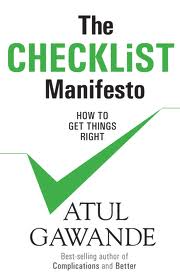
 Here is a popular book that deals with quality issues (Ch.6) in medicine by extolling the use of checklists. Dr. Atul Gawande’s The Checklist Manifesto: How to Get Things Right (Metropolitan Books,2009) will add to your TQM lecture with some interesting examples. Gawande points out that just as airline pilots use checklists before takeoff, surgeons need checklists, which are proven to reduce mortality from operations.
The medical culture, unfortunately, often includes doctors who are just plain rubbed the wrong way by such a tool. Surgeons, in particular, view themselves as individuals whose skill and reputation are all that is needed in the OR. Gawande uses a WHO study to show that surgical complications dropped by more that one-third when checklists were used.
The checklists includes such items as: making sure everyone in the OR knows everyone else’s name; that blood for a transfusion is on-hand; and that the pre-op was performed correctly. Medicine, he says, has become so incredibly complex that mistakes are virtually inevitable.
The Huffington Post (Jan. 6,2011) has a quick review of the book, followed by a 6 minute video clip of Gawande being interviewed recently on the Steven Colbert show. (Note that you have to scroll down about 6″ to get to the video link). I am not a huge fan of the show, but somehow I think your students will find it hilarious. They seem to understand his humor, and at the same time, Gawande does make his point about checklists.
Note that we cover Checklists as a type of Poka-yoke in the chapter on Managing Quality . Examples of Checklists are also noted in the airline and hospital photos and caption in Ch 6.
Even if instructors don’t want to show the whole interview with Stephen Colbert in class, they may want to retell the David Lee Roth story. You can watch the interview to get all the details, but, in short, the rock band Van Halen would visit small towns that weren’t used to putting on such large concerts. The band would provide a checklist to the organizers that included various safety checks regarding the building of the stage. In the middle of the checklist was a requirement that no brown M&Ms would be allowed in the dressing room. The point was not that David Lee Roth hated brown M&Ms. The point was that if the band showed up and found brown M&Ms in the dressing room, that would indicate that the checklist might not have been followed and the safety of the audience might not be guaranteed. In that case, the band would cancel the show. What a creative, quick, visual method to ensure quality, especially when working with new people!