OM in the News: Hospitals Printing 3-D Hearts to Help in Surgeries

A 3-D printed model shows cross sections of a child's heart
A 3-D printed model shows cross sections of a child’s heart

The night before operating on 2-year-old Myla Kramer, her surgeon held a copy of her heart, produced on a 3-D printer, in his hands. He studied it, trying to determine how to patch the many Swiss-cheeselike holes in the bottom of her heart — a potentially life-threatening condition. The next day, he knew exactly what to do. The surgery was a success, and Myla is thriving.  Without the 3-D printed heart, said Dr. Mark Plunkett, “There was a significant possibility that I would get in there, try to patch over this area, and not necessarily get all of the holes.”

Congenital heart defects are problems with the structure of the heart at birth. They’re the most common type of birth defect, affecting 8 out of every 1,000 newborns. The printed hearts can help doctors in tricky cases such as Myla’s, writes the Chicago Tribune (Oct. 23, 2016). Engineers typically take an MRI or CT scan of a patient’s heart and run the scan through computer programs that allow them to print plaster composite hearts in 3 dimensions. The process for Myla took 2 days at the R&D arm of the OSF HealthCare Hospital in Peoria. Jump’s 3-D printer cost $80,000.

With use of 3-D printed heart models expected to grow, OSF (a chain of 10 Illinois hospitals) and the National Institutes of Health (NIH) are partnering with the American Heart Association to improve the quality of printed hearts, with the goal of helping more patients. The groups want to create an online database of 3-D printed hearts from patients with congenital heart defects, reviewed by experts in the field. The idea is to help standardize the process of printing hearts. Practitioners, medical students and others would be able to download the models at no charge and print them or view them in 3-D using virtual reality tools. The Tribune article also links to a 50 second video describing the process.

Classroom discussion questions:

  1. How else can 3-D printing be used in medical care?
  2. How are manufacturers now using the technology?

OM in the News: Safer Surgery Through Operations Management

hospital data“Hospitals are trying to make it safer for patients to go under the knife,” writes The Wall Street Journal (Feb. 17, 2015). Surgery can be risky by its very nature, and 46% to 65% of adverse events in hospitals are related to surgery. Despite years of prevention efforts, procedures are still performed on the wrong body part and surgical tools are sewn up in patients. The consequences of surgical error are huge, both for patient health and hospital finances. Johns Hopkins estimates that there are 4,082 malpractice claims each year for “never events”—the type of shocking mistakes that should never occur. There are also 600 reported operating-room fires in the U.S. each year, though there may be many more that aren’t reported.

Many hospitals don’t collect reliable data on their own adverse events, and as industry experts say, “you can’t improve a hospital’s surgical quality if you can’t measure it.” In Tennessee, 10 hospitals participating in a data analysis program from 2009 to 2012 reported that they reduced complications by nearly 20% since 2009, saving at least 533 lives and $75.2 million in costs. Data analysis can also help prevent foreign bodies from being left in patients when they do undergo surgery. With new OM processes in place, if a count at the end of a procedure indicates sponges or instruments are missing, hospital policy requires an X-ray before the patient leaves the OR, which can’t be overruled by a surgeon.

Surgeons are also expected to follow strict infection-prevention processes, such as sterile procedures that include fully draping patients on the operating table and wearing caps and masks before putting in a central line, a tube inserted in the chest to administer IV fluids, drugs and blood. As briefings and checklists become part of the hospital culture, new doctors coming out of training know this is the expectation. Older doctors are often hard to convert.

Classroom discussion questions:

1. Why is it important to measure hospital quality?

2. What do checklists do in this setting?

OM in the News: Robots in Surgery Don’t Always Work

The da Vinci surgical system

Robotic surgery has grown dramatically, increasing more than 400% in the US between 2007 and 2011, reports The New York Times (Sept. 10, 2013). About 1,400 da Vinci systems, made by Intuitive Surgical Inc. of Sunnyvale, Calif. and costing $1.5- $2.5 million each, have been purchased by hospitals. On the market for more than a decade, more than a million procedures have been performed with the da Vinci.

But a new study follows a series of reports critical of robotically assisted surgery. Documents against Intuitive have outlined the aggressive tactics used to market the equipment and raised questions about the quality of training provided to surgeons, as well as the pressure on doctors and hospitals to use it–even in cases where it is not the physician’s first choice and he or she has little hands-on experience.

Almost 57% of surgeons surveyed anonymously said they had experienced irrecoverable operative malfunctions while using the da Vinci system. And between 2000 and 2012, thousands of da Vinci mishaps were reported to the F.D.A., including 174 injuries and 71 deaths, according to The Journal for Healthcare Quality (Aug. 27, 2013). Yet by combing news reports and court records, researchers at Johns Hopkins were able to find examples of botched operations that were not reported to the agency. They concluded that adverse events associated with the da Vinci were “vastly underreported.”

Reports made to the F.D.A. represent only “the tip of the iceberg” of surgical complications and adverse drug reactions, says the president of the National Research Center for Women and Families. “The consequence,” she states, “is that little is known of the real disadvantages of the equipment, and the injuries and deaths it may cause, even as robotic surgery is widely marketed to consumers.”

Discussion questions:

1. Is the da Vinci a successful product?

2. Are robots always useful in increasing productivity and accuracy?

Teaching Tip: Using Knee Surgery to Illustrate Learning Curves

One of my favorite OM topics is learning curves (covered in Module E).  It takes only an hour of class time to cover well and it’s also a subject that is very motivational. When I tell students that understanding learning curves may save their lives one day, it catches their attention.

While  learning curves originated in the aircraft industry– and continue to drive production rates at Boeing today– an equally important application is in surgical procedures. I usually mention my friend the urologist, who has done thousands of kidney transplants. Who would you rather have operating on you?  A rookie on his or her 3rd or 6th transplant–or someone who is well down the experience curve?

In the text, we discuss one -year death rates for heart transplant patients, which follow  a 79% learning rate. Yesterday’s Wall Street Journal (Feb.14, 2012) provides a second medical example, with an article titled “Study Shows Knee Surgeons Have a Learning Curve”.  Here we find that if a patient’s ACL (anterior cruciate ligament) surgery was among the first 10 such cases of a surgeon’s career, the patient had 5 times the risk of having another ACL repair within a year as a patient whose doctor had performed more than 150 of the operations.

While it isn’t surprising that there is a learning curve, “it was striking to see the figures shown in such a dramatic way,” says the orthopedic professor who did the study.  ACL surgery, while routine, he adds, “is fairly complex.”  Potential pitfalls include incorrectly placing the graft, not fixing it solidly, and not dealing with other damaged ligaments in the area. Given that the learning curve is inevitable, what can be done? Two solutions are: have an experienced doctor supervise surgeries early in a new surgeon’s career, or use medical simulators in training.

Meanwhile, my 1st question is always: “How many times have you done this procedure?”

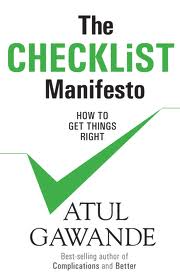
Good OM Reading: The Checklist Manifesto

Here is a popular book that deals with quality issues (Ch.6) in medicine by extolling the use of checklists. Dr. Atul Gawande’s The Checklist Manifesto: How to Get Things Right (Metropolitan Books,2009) will add to your TQM lecture with some interesting examples. Gawande points out that just as airline pilots use checklists before takeoff,  surgeons need checklists, which are proven to reduce mortality from operations.

The medical culture, unfortunately, often includes doctors who are just plain rubbed the wrong way by such a tool. Surgeons, in particular, view themselves as individuals whose skill and reputation are all that is needed in the OR. Gawande uses a WHO study to show that surgical complications dropped by more that one-third when checklists were used.

The checklists includes such items as: making sure everyone in the OR knows everyone else’s name; that blood for a transfusion is on-hand; and that the pre-op was performed correctly. Medicine, he says, has become so incredibly complex that mistakes are virtually inevitable.

The Huffington Post (Jan. 6,2011) has a quick review of the book, followed by a 6 minute video clip of Gawande being interviewed recently on the Steven Colbert show. (Note that you have to scroll down about 6″ to get to the video link). I am not a huge fan of the show, but somehow I think your students will find it hilarious. They seem to understand his humor, and at the same time, Gawande does make  his point about checklists.