OM in the News: Hospital Checklists and TQM

“Surgery checklists save lives,” reports The Washington Post (April 18, 2017). Hospitals in South Carolina that completed a statewide program to implement the WHO’s Surgical Safety Checklist had a 22% reduction in post-surgical deaths. The study, to appear in the August 2017 issue of Annals of Surgery, is one of the first to show a large-scale impact of the checklist on the general population.

Surgical care requires careful coordination of a variety of skilled health-care providers in a complex infrastructure using specialized tools. “Safety checklists are not a piece of paper that somehow magically protect patients, but rather they are a tool to help change practice, to foster a specific type of behavior in communication, to change implicit communication to explicit in order to create a culture where speaking up is permitted and encouraged and to create an environment where information is shared between all members of the team,” said the Harvard Medical School prof directing the study.

A total of 14 hospitals completed the program, representing 40% of the total inpatient surgery population in the state. Researchers compared the 30-day post-surgery mortality results between the checklist hospitals with those of the rest of the hospitals in the state. The report includes major inpatient surgical procedures from various specialties, such as neurological, cardiac and orthopedic surgery.

The 19-item checklist encourages surgical teams to discuss the surgical plan, risks and concerns. Most of the items are simple, such as “does the patient have a known allergy” or “is essential imaging displayed.” Following surgery, patients are at risk of complications and death from a variety of causes, such as infection and organ failure. The checklist ends with a requirement for a conversation among the surgeon, anesthetist and nurse about the patient’s recovery and management plan. As a whole, the checklist items create an operating room communication culture that improves overall surgical care and safety before, during and after an operation.

Classroom discussion questions:

  1. What other tools described in Chapter 6 could be used in operating rooms to improve quality?
  2. Why are checklists so valuable? What other industries use them regularly?


OM in the News: Safer Surgery Through Operations Management

hospital data“Hospitals are trying to make it safer for patients to go under the knife,” writes The Wall Street Journal (Feb. 17, 2015). Surgery can be risky by its very nature, and 46% to 65% of adverse events in hospitals are related to surgery. Despite years of prevention efforts, procedures are still performed on the wrong body part and surgical tools are sewn up in patients. The consequences of surgical error are huge, both for patient health and hospital finances. Johns Hopkins estimates that there are 4,082 malpractice claims each year for “never events”—the type of shocking mistakes that should never occur. There are also 600 reported operating-room fires in the U.S. each year, though there may be many more that aren’t reported.

Many hospitals don’t collect reliable data on their own adverse events, and as industry experts say, “you can’t improve a hospital’s surgical quality if you can’t measure it.” In Tennessee, 10 hospitals participating in a data analysis program from 2009 to 2012 reported that they reduced complications by nearly 20% since 2009, saving at least 533 lives and $75.2 million in costs. Data analysis can also help prevent foreign bodies from being left in patients when they do undergo surgery. With new OM processes in place, if a count at the end of a procedure indicates sponges or instruments are missing, hospital policy requires an X-ray before the patient leaves the OR, which can’t be overruled by a surgeon.

Surgeons are also expected to follow strict infection-prevention processes, such as sterile procedures that include fully draping patients on the operating table and wearing caps and masks before putting in a central line, a tube inserted in the chest to administer IV fluids, drugs and blood. As briefings and checklists become part of the hospital culture, new doctors coming out of training know this is the expectation. Older doctors are often hard to convert.

Classroom discussion questions:

1. Why is it important to measure hospital quality?

2. What do checklists do in this setting?

OM in the News: Checklists as a TQM Tool in Hospitals

surgeryHow can we use the TQM tools in Chapter 6 to reduce deaths in surgery? One tool is a kind of poka-yoke called a checklist (see p. 223). The Wall Street Journal (Dec. 13-14, 2014) quotes Dr. Atul Gawande describing how he worked with a team from the airline industry to design what emerged as just a checklist. Surgical blunders, says Gawande, are “most often basically failures of communications. The checklist had some dumb things—do you have the right patient ? But the most powerful components are: Does everybody on the team know each other’s name and role? Has the anesthesia team described the medical issues the patient has? Has the surgeon briefed the team on the goals of the operation, how long the case will take, how much blood they should be prepared to give? Has the nurse been able to outline what equipment is prepared? Are all questions answered? And only then do you begin.”

The result, after he tested in 8 cities around the world, was that in every hospital that used the checklist, complication rates fell. The average reduction in complications was 35%. The average reduction in deaths was 47%. The system has since been replicated in multiple places. Scotland has implemented it and taught it at the frontlines –and has now demonstrated that 9,000 people’s lives have been saved over the last 4 years.

“The hardest part,” says Gawande, “is to bring the culture that has the humility to recognize that even the most experienced people, even the most expert fail.” Doctors fear these kinds of checklist systems. When he surveyed surgeons 3 months after they adopted it and asked, “What do you think about this approach?” he found that about 20%  really dislike it—“It’s paperwork, it’s a pain in the butt, I don’t want to do this.” But when he asked, “If you’re having an operation, would you want the team to use the checklist?” 94% did.

Classroom discussion questions:

1. How else can checklists be used in hospitals?

2. What other TQM tools can be employed in a surgery process?

OM in the News: Quality Control in Intensive Care Units

If you want an example of how the tools of OM can result in major improvements in the field of health care, read The Wall Street Journal (Sept. 11, 2012) article on the use of checklists in hospital intensive care units. A national patient-safety program, sparked by the death a decade ago of an 18-month-old child, reduced the rate of a deadly  bloodstream infection by 40% in hospital ICUs.

The initiative, led by Johns Hopkins’ VP-Quality, Dr. Peter Pronovost,  was implemented in more than 1,100 ICUs in 44 states. It took aim at bloodstream infections associated with catheters used to deliver drugs directly into patients’ major veins. The result of the effort was a reduction in the rate of infections to 1.137 per 1,000 days of catheter use, from 1.903, over the first 18 months that hospitals implemented the program. This cut represented at least 2,000 infections avoided, more than 500 lives saved and $34 million in health-care cost savings.

One professor who helped with the rollout of the program in Rhode Island, said the results are “dramatic.” Though the ideas in the program weren’t new, its developers “figured out how to bundle those best practices and insert them into the daily practice of nurses, physicians and other health-care professionals.”

Mortality for central-line infections in the U.S. is 12% to 25%. The CDC estimated there were around 18,000 of the infections in ICUs in 2009, down from 43,000 in 2001. The entire program is built on checklists like pilots use. Key practices on the checklist include hand washing, properly covering up care givers and patients when a catheter is inserted, and using the right disinfectant at the site of insertion. But equally important, according to Dr. Pronovost, were cultural changes, such as authorizing nurses to ensure that doctors adhere to the lists.

Discussion questions:

1. How else can operations management tools be used in ICUs?

2. Ask students to report on Dr. Pronovost’s book, Safe Patients, Smart Hospitals, which we described in this blog last year.

Good OM Reading: Safe Patients, Smart Hospitals

After reviewing The Checklist Manifesto for our blog a few months ago, I wondered how Dr. Peter Pronovost’s  book, Safe Patients, Smart Hospitals would add to the important role  OM plays in hospital quality. Simple and avoidable errors in hospitals around the world are made each day that cost the lives of patients. Inspired by 2 tragic medical mistakes —  his father’s misdiagnosed cancer and  sloppiness that killed  an 18-month old child at Johns Hopkins– Pronovost has made it his mission, often swimming upstream against the medical culture, to improve patient safety and prevent deaths.

He began by developing a basic 5-step checklist (see Ch.6) to reduce catheter infections. Inserted into veins in the groin, neck, or chest to administer fluids and medicines, catheters can save lives. But every year, 80,000 Americans get infections from the central lines and 30,000-60,000 of these patients die.  Pronovost’s checklist has dropped infection rates at hospitals that use it down to zero, saving 1,000’s of lives and tens of millions of dollars.

His steps for doctors and nurses are simple: (1) wash your hands, (2) use sterile gloves, masks, and drapes, (3) use antiseptic on the area being opened for the catheter, (4) avoid veins in the arms and legs, and (5) take the catheter out as soon as possible. He also created a “central line cart”, where all supplies needed for the procedure are stored.

Provonost believes many hospital errors are due to lack of standardization, poor communications, and a non-collaborative culture that is “antiquated and toxic”. Whereas safety in the airline industry is a science, and where every crew member works as part of the team, he writes: “doctors think they are infallible”.

This is an inspiring book which shows how one person, with small changes, can make a huge difference in patient care. Your students in the health care areas will appreciate the OM insights provided. An interview with Dr. Pronovost appears in The Wall Street Journal (March 28,2011).

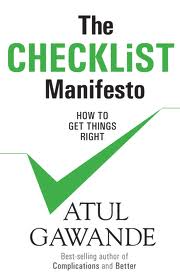
Good OM Reading: The Checklist Manifesto

Here is a popular book that deals with quality issues (Ch.6) in medicine by extolling the use of checklists. Dr. Atul Gawande’s The Checklist Manifesto: How to Get Things Right (Metropolitan Books,2009) will add to your TQM lecture with some interesting examples. Gawande points out that just as airline pilots use checklists before takeoff,  surgeons need checklists, which are proven to reduce mortality from operations.

The medical culture, unfortunately, often includes doctors who are just plain rubbed the wrong way by such a tool. Surgeons, in particular, view themselves as individuals whose skill and reputation are all that is needed in the OR. Gawande uses a WHO study to show that surgical complications dropped by more that one-third when checklists were used.

The checklists includes such items as: making sure everyone in the OR knows everyone else’s name; that blood for a transfusion is on-hand; and that the pre-op was performed correctly. Medicine, he says, has become so incredibly complex that mistakes are virtually inevitable.

The Huffington Post (Jan. 6,2011) has a quick review of the book, followed by a 6 minute video clip of Gawande being interviewed recently on the Steven Colbert show. (Note that you have to scroll down about 6″ to get to the video link). I am not a huge fan of the show, but somehow I think your students will find it hilarious. They seem to understand his humor, and at the same time, Gawande does make  his point about checklists.