OM in the News: Is 3M’s Product Design Pipeline Hitting a Dry Spell?

We open Chapter 5 (Design of Goods and Services) noting that leading companies generate a substantial portion of their sales from products less than 5 years old. And The Wall Street Journal (Oct. 6, 2023)  reminds us that “the 20th century belonged to the unruly minds at 3M,” with 30% of their profits from new products. 

Some 3M adhesive products, including the Post-it Note, medical tape and industrial adhesives

What a great company. From its early days, 3M gave its researchers a long leash to chase ideas, many to dead-ends. The hits, though, were indelible: Scotch tape. Masking tape. Videotape. Post-it Notes. N95 masks. Artificial turf. Heart medication. 3M patented adhesives and abrasives. Proprietary coatings and films —materials at the heart of highway signs, weatherproof windows and stain-resistant clothing and carpets. Its optical film brightened the screens of millions of laptops, smartphones and flat-screen TVs.

But of late, there are fewer new products and fewer still have been blockbusters–and the company has retreated from its traditional 30% goal. For decades, 3M released a cascade of new items on the market, confident most would be profitable and a few would become indispensable.

3M’s innovation principles took shape more than a century ago under its then president, William McKnight, who believed in worker autonomy and initiative. “Mistakes will be made, but if the man is essentially right himself, I think the mistakes he makes are not so serious as the mistakes management makes if it is dictatorial,” he said. He instituted the McKnight principles, one of which allowed researchers to spend 15% of their time on projects unrelated to their everyday tasks—even if their managers disapproved.

The principles championed collaboration, encouraging researchers to share findings. The Post-it Note came about after scientist Art Fry, bedeviled by paper bookmarks falling out of his church hymnal, remembered a semi-sticky adhesive discussed at a company seminar. The product was an instant success after it hit stores in 1980.

Now, researchers are encouraged to pursue incremental improvements to existing products rather than novel, swing-for-the fences breakthroughs. A recent CEO installed “Six Sigma,” a regimen used at GE to measure and standardize business practices (see Chapter 6) but loathed by 3M researchers as a creativity killer. Further, budget cuts have trimmed 8,500 employees this year.

Classroom discussion questions:

  1. What do you think of the McKnight principles?
  2. Why are new products so important?


OM in the News: Easing Worker Shortages with Automation

We used to ask whether robots will take over the jobs of humans. But that’s not quite the right question in 2022, as finding workers to fill the large number of jobs currently open in manufacturing is almost impossible. “There aren’t enough workers,” says a 3M exec. “And it’s not just large factories with low mix and high volume that are seeing this, it’s also medium-sized and small companies. Everyone is looking to automation to bridge the worker shortage.”

Operations managers are getting the message and in 2021, factories and other industrial users ordered 39,708 robots (valued at over $2 billion), a 28% increase from 2020. While robots have been in auto plants for a long time, orders from non-automotive companies now represent 58% of the North American totals.

A breakdown of industry orders is as follows:

  •  Food and Consumer Goods:  up 29%
  •  Semiconductors and Electronics/Photonics: up 2%
  • Plastics and Rubber: up 4%
  • Life Sciences/Pharma/Biomed: up 4%
  • All Other Industries:  up 65%

“There is a process we use to engage the operators and manufacturing employees to get them ready for automation,” says 3M. “It’s never about a 1-1 replacement of a worker.  We explain that if someone was doing a certain job and now the robot will do the job, the employee can learn how to operate them and troubleshoot them. This leads to a higher pay grade. It can be a real win-win situation.”

The skills of the workforce have been changing over the past few years, reports Industry Week (March 10, 2022). Manufacturing has tended to pay higher wages than the service sector and is seeing an increasing portion of operators having either associate degrees, technical degrees, or even bachelors degrees. The upskilling of talent was underscored by a 2021 study from the World Economic Forum that predicted that automation would result in an increase of 58 million jobs. And two-thirds of the jobs transformed by automation will become higher-skilled.

These differing degrees of education are going to be essential as U.S. manufacturing will grow. Given the recent supply chain problems, we will see an increase of more companies producing products in the U.S. and automation will play a key role. So it’s an important tool for companies. Contrary to the belief that automation is taking jobs away, it’s automation that will keep companies competitive, and stay in business and protect jobs.

Classroom discussion questions:

  1. Why does 3M say that robots will not replace workers? Is that true in all industries?
  2. Why are manufacturing companies looking for better educated employees?


OM in the News: 3M’s “Hairball” Supply Chain

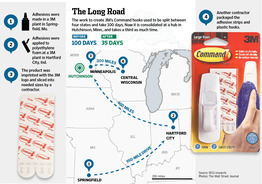
3M’s Command picture-hanging hooks, made of plastic and strips of sticky foam, don’t look complicated. The Wall Street Journal (May 17, 2012) reports, though, that until recently, the Command production process meandered more than 1,300 miles through 4 factories in 4 states.

3M’s recently retired CEO branded such convoluted production trails as “hairballs.” The man in charge of untangling, John Woodworth, 3M’s Supply Chain VP, characterizes the situation this way. “We had long supply chains.  It was and continues to be an issue.”

Every company tries to streamline manufacturing and supplier networks, of course. But few have a task as daunting as Mr. Woodworth’s.  3M makes 65,000 products, ranging from Scotch tape to film for solar-energy panels, dental braces and dog chews. They are produced in 214 plants in 41 countries. Mr. Woodworth, a 38-year veteran of 3M, figures he has been inside half of those plants.

3M’s long-term plan is to have fewer, larger, more efficient plants, and spread them out around the world. More production will be done in what 3M calls “super hubs,” plants capable of making scores of products for a region of the world. 3M now has 10 hubs, including six in the U.S. and one each in Singapore, Japan, Germany and Poland. It plans at least six more, all outside the U.S.

3M’s  stethoscopes, for example, used to be made in steps involving 14 outside contractors and three 3M plants. Now all processes are being brought into a plant in Columbia, Mo. The cycle time will fall to 50 days from 165. The company’s goal is to reduce cycle times—the period needed to go from ordering raw materials to delivering finished goods—by 25%.

Discussion questions:

1. Why did the 3M production process become so complicated?

2. Why is cycle time such an important OM concept?

OM in the News: New Products Drive Profits at 3M

I love reading The Wall Street Journal from cover-to-cover every day. Where else can you find an article on the importance of sandpaper and a quote from the 3M CEO, “Why can’t abrasives be sexy?” (Nov.1,2010)

I share this with you because the real gist of the article is not just how 3M spent three years trying to improve one of basic products, sandpaper (they did it by using new technology to make every grain on the material the exact same size and shape). Rather, the article ties directly to Figure 5.2 in our chapter called Design of Goods and Services.

For any company to be successful, a substantial portion of its sales must come from products less than 5 years old.  We give examples of Disney and Cisco as industry leaders, with almost 50% of sales from new services or goods. 3M falls just under this, expecting 30% of its sales to come from products introduced in the last 5 years. This places it in what we call the “top third”.

CEO George Buckley believes his firm’s edge is due to spending 5-6% of sales on R&D, even during the recession. On average, US manufacturers spent 3.4% of sales on R&D in 2008.

What other “sexy” products is 3M pursuing? Its masking tape, an old standby, now comes with an edge lock that keeps paint from seeping under the tape, which could spoil the straight line. 3M knows it must keep those improvements coming to stay in the top third.

Discussion questions:

1. Discuss the success rate for introducing new products in the marketplace.

2. What other approach is 3M taking to boost sales?

3. Where do new product ideas come from?