OM in the News: Toyota’s Assembly Line Advances

Today’s Wall Street Journal (Nov.29,2011) features the pressures facing Toyota–overcapacity, weak demand, an exchange rate for the yen that makes Japanese-made cars expensive, quality problems that forced the recall of 10 million vehicles, and the supply chain issues caused by the March earthquake and tsunami. Competitors like Honda and Nissan are moving more manufacturing overseas, to plants closer to customers. But Toyota, long a proponent of corporate social responsibility to protect Japanese jobs, has also pledged to build at least 3 million cars annually in Japan, with 1/2 for export. So the company, which wrote the book in the 1960’s on lean manufacturing and JIT, is looking for new ways to wring out efficiencies from its production systems.

Toyota sees its first new plant in Japan in 18 years as the answer. Here is why: The Miyagi factory is designed for advanced low-volume, hyperefficient production, with 1/2 the workers and 1/2 the square footage of Toyota’s 16 other plants. Inside, half-built Corollas and Yaris sit side-by-side, rather than bumper-to-bumper, shrinking the assembly line by 35% and requiring fewer steps by workers. Instead of car chassis dangling from overhead conveyor belts, they are perched on raised platforms. This is 50% cheaper, and also reduces cooling costs by 40% because of lower ceilings. Finally, the assembly line uses quiet friction rollers to move the cars along. The rollers use fewer moving parts than typical chain-pulled conveyor belts.

This is a timely article to share with your class when you discuss assembly line layout in Chapter 9. And if you show the Wheeled Coach layout video for this chapter, the 2 assembly lines make for a good comparison.

Discussion questions:

1. How can Toyota’s new layout help improve the challenges facing the company?

2. Why are other Japanese auto manufacturers moving production to the US?

OM in the News: Fiat Threatens to Quit Italy

Fiat CEO Sergio Marchionne has recently threatened to cease manufacturing in Italy if he cannot bring down operating costs and increase productivity. This article in Businessweek (Oct.28-Nov.4, 2011) can make for an interesting class discussion on a whole variety of OM issues, from efficiency to capacity to productivity to union relations to off-shoring. The standoff between Italy’s largest manufacturer and one its hard-line unions (metalworkers–who are 12% of the workforce) is emblematic of the challenges facing the country. Italy’s industrial competitiveness has been eroding steadily, while Eastern European rivals have been working hard to improve conditions for corporations. The World Bank just ranked Italy 87 th in terms of ease of doing business; Hungary, Poland, and the Czech Republic all scored better.

Let’s look at the productivity gap (see Chapter 1). Fiat’s 22,000 factory workers in Italy assembled 650,000 cars in 2009. But the 6,100 employees at its plant in Tychy, Poland, built 600,000 vehicles. The Italian workers, in effect, each made 30 cars a year on average, compared to about 100 in Poland. And auto workers in Italy earn $38.55 an hour, more than 3 times the wage paid in Poland.

This productivity gap has Marchionne pushing Italian unions to agree to more flexible hours and to limit strikes and curtail absenteeism. (12,000 workers took part in an Oct. 21st strike).  Says the union head: “Fiat workers, not its managers, want to keep the company in Italy”.    An impasse with unions could end up with production shifted to other locales in Europe and the US–a move made easier by Fiat’s ownership of a controlling stake in Chrysler. An Italian economist writes: “If Fiat moves abroad, it will become a metaphor for a country that cannot be reformed, that has lost all hopes in the future”.

Discussion questions:

1. How is this also an issue for American auto makers?

2. Relate the article to news regarding Greece’s economic problems.

OM in the News: Subaru–America’s Leanest and Greenest Auto Plant

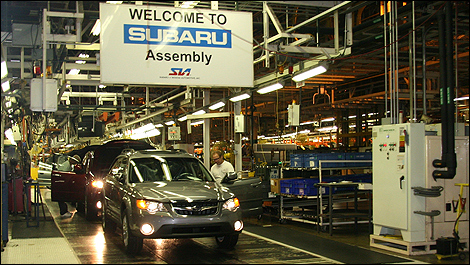
Our OM in Action box in Ch.6 (Managing Quality) highlights the  Lafayette, Indiana Subaru plant’s environmental leadership as it relates to ISO 14001. A good article about the same plant to reference when lecturing about lean (Ch.16) and green appears in the latest Businessweek (June 6-12, 2011). Here are a few facts about Subaru, which is perhaps the leanest car plant in the US: (1) in its 22 year history, Subaru-Indiana has rolled out 3 million cars and has never resorted to layoffs (this during a period that spanned 3 recessions  and the loss of 46,000 auto jobs in that state); (2) it has given workers a wage increase every year of operation; (3) it provides premium-free health care, lots of overtime (averaging $15,000 last year), financial counseling, and the ability to earn a Purdue U. degree on-site.

But whereas Toyota made kaizen famous, Subaru has created green kaizen. Going back almost a decade, Subaru decided to become the nation’s 1st zero-landfill car factory. It recycles  98% of the plant’s waste and incinerates the other 2% in an operation that sells power back to the grid. The plant abounds with well-reused parts containers. In 2010, Subaru saved $5.3 million by obsessively reducing, recycling, composting , and incinerating–and saved multiples of that using employee-sponsored ideas to reduce injuries and fatigue. The workers can get bonuses (up to a new car) for pointing out excess packaging and processes that can be cut from the assembly line.

To score a cherished “associate” position  at the factory, would-be employees are expected to put in long hours mastering Subaru’s low-impact manufacturing. They learn to scrutinize every byproduct for savings and to look for ways to slice seconds off the assembly process. The jobs pay $14 (starting) up to $25 (peak)/ hour, yielding a salary of $50-60,000 including mandatory overtime.

Discussion questions:

1. What happens when the plant needs to slow down (say from parts shortages)?

2. How does Subaru get such worker commitment that the UAW has failed 3 times to unionize the plant?

OM in the News: Volkswagen Rediscovers Manufacturing in the US

The  Wall Street Journal’s (May 25,2011) headline “VW Evaluates US Audi Plant” is more good news for American manufacturing. With its new $1 billion plant opening  2 days ago in Chattanooga, VW aims to triple its US auto sales.The complex is designed to build 150,000 Passat sedans and can be expanded to 300,000 units.

Why the American plant and why Tennessee? VW believes it cannot compete against rivals Ford, GM, and Toyota without the cost benefits from a factory here. The firm has lost money in the US for a decade (with cars made in Germany) because of unfavorable exchange rates. The new plant makes it possible to lower the price of  the mid-sized Passat by an amazing $8,000 –down to $20,000, in line with competitive vehicles. The VW plant  is paying $14.50 an hour, half of what auto workers make at older Toyota plants and at unionized Ford, GM, and Chrysler facilities. VW can now also produce 85% of its parts locally, lowering the impact of the currency translation.

With the new plant barely open, VW is already considering building its luxury Audi line in the US for the 1st time, for the same cost reasons. The firm thinks it can double Audi sales to 200,000 units with a facility closer to its customers. (Businessweek features a similar article called “VW Rediscovers America” ,May 21-27, 2011).

Discussion questions:

1. Why is VW interested in expanding its manufacturing to the US?

2. Why did it select Tennessee for its first US site?

OM in the News: Chrysler’s Gamble with Mass Customization

The year was 1973. Jay and I were both teaching at Boston U.’s brand new European  MBA program, just outside of Pisa, Italy. The most popular car on the Italian road was the “Cinquecento”, a midget of a  vehicle that could easily fit in the back of a Chrysler minivan. The Cinquecento had all the power of about 3 Vespa motorscooters, my vehicle of choice in college. When I left Italy I never thought I would see one again.

So yesterday’s Wall Street Journal article (Nov.22,2010) announcing that Chrysler was bringing the Cinquecento to the US–and planning to sell 50,000 of them in 2011–was a bit of news. The car will be called the Fiat 500 and be manufactured at a retooled Chrysler plant in Mexico. Five feet shorter than a Chevy Impala, the 500 will retail for $15,500. But the reason you may want to bring this topic to your class is Chrysler’s risky strategy of mass customization (Chapter 7). Where the Japanese mastered the global auto market by limiting production options (a typical Honda might have 2 transmission options, 6 paint choices, 2 interiors, etc.), the Fiat 500 will provide a dizzying array of features to choose from.

With 3 versions of body style, 14 exterior colors, 14 seat colors, 6 wheel styles, and so on, there will be about 1 million combinations of the new car. Chrysler hopes the chance to customize the 500 will draw a wide range of customers who may want a “one of a kind”. In the past, US auto makers learned the risks of mass customization: too many choices leave dealers with lots full of cars, but not the exact one a customer may want (and 80% of US customers want to drive their car off the lot the day they buy).

Further, suppliers are being asked to keep more parts on hand so they can more quickly build a seat or interior combination , then ship it to the plant within a few hours.

Discussion questions:

1. How interested are students in a unique, customized car that will take 30 days to deliver?

2. Why is Chrysler taking this approach?

3. What are the competing products and how do they fare?

OM in the News: Detroit Moves Up in Auto Reliability, But Asia Still Rules

People buy cars for all sorts of reasons: styling, prestige, safety, and even color. But a reputation for quality and reliability is the one constant to almost every consumer, according to The Wall Street Journal (Oct.27,2010). With this week’s  release of Consumer Reports’  rankings of new auto reliability, there is some good news for Detroit.

Ford and GM have greatly improved the reliability of their vehicles, and in some sectors are ranked better than their Asian counterparts. The Ford Fusion, for example, is now tops in the “family car” segment–bettering  the Toyota Camry, Honda Accord, and Nissan Altima. Ford is the top American company overall.

Chrysler, sadly, has still not taken off and is dead last in the rankings. Toyota’s once sterling reputation was also dinged;  its Prius hybrid fell to “average” from its once high-rating because of recalls and brake problems. BMW ranked only 24 out of 27 brands, underlining how luxury car makers face quality challenges as they insert advanced technologies (that don’t always work perfectly) into their vehicles.

Good quality, as we in OM all know, creates an upward circle: the more reliable the car, the more people are willing to pay, and then the  less discounts are needed. “It doesn’t take very long to lose a good  reputation, but it takes 5 or 10 years to gain one”, says a Consumer Reports director.

Discussion questions:

1. Give some examples of products (cars included) where it took years to rebuild a damaged quality reputation.

2. Why is the Honda family of vehicles ranked consistently high?

3. Ford is now ranked 10th out of the 27 auto makers. What will it take to move to the top of the pack?