OM in the News: Manufacturing’s Mirage

These are good times for Libbey, a 125-year-old American glassmaker that nearly went bankrupt 4 years ago, reports The New York Times (April 2, 2013). Its sales are at a record high and its energy-intensive factories saved more than $5 million in 2012 as natural gas prices fell. Despite all the upbeat news, however, Libbey recently announced it would lay off 200 workers at its Louisiana plant. Libbey’s decision is just one example of why manufacturing is likely to fall far short of the claims that millions of new factory jobs are about to be created in the U.S. because of the unlocking of abundant supplies of domestic energy.

“Even though the U.S. is more competitive globally, manufacturing doesn’t give you the kind of direct job creation it did in years past,” says one expert. “At the end of the day, there aren’t as many people on the factory floor.” Indeed, while the sector has added 500,000 jobs since the recession ended and the value of what the nation’s factories churn out is close to a high, there are nonetheless 2 million fewer manufacturing workers today than in 2007. The share of jobs in manufacturing has been on a nearly uninterrupted downward slope for 50 years, now accounting for less than 9% of all employment.

A recent study by the American Chemistry Council (ACA) estimated that increased gas production could create 200,000 jobs in the broader manufacturing sector, including several thousand in the glass industry. “It’s resulting in a renaissance in manufacturing,” says their economist. But glass industry veterans say cheaper natural gas isn’t a game changer in terms of jobs, however beneficial the cost savings are. Pressure from inexpensive imports remains intense, and labor in Mexico and China is still cheaper than here.

Other industries identified by ACA as potential winners from the energy boom, like paper producers and foundries, have continued to lose jobs. But nearly all of the U.S. manufacturers that survived the lean years of the last decade are globally competitive companies that depend on high productivity and advanced technology for their success more than masses of assembly line workers.

Discussion questions:

1. Will manufacturing job levels ever return to the 1960s levels? Why?

2. Which is more important–job creation or productivity?

OM in the News: Productivity Increases Are Driving the Trucking Industry

Average distance travelled by trucks is declining because of increased productivity

The road ahead for the nation’s 18-wheelers is shrinking, reports The Wall Street Journal (March 21, 2013), as rising fuel, driver and equipment costs have led shippers to devise ways to operate more efficiently. Truckers are driving fewer miles, allowing operators to squeeze more years out of vehicles already on the road and lessening the need to buy new trucks or expand fleets. While railroads have taken some freight from long-distance truckers, greater productivity is having a bigger impact. Lighter weight and smaller packages, better routing and fewer empty trucks on the road have affected productivity. Last year, the average distance traveled by tractor-trailers in the U.S. fell to 110,614 miles, a 12% decline from the late 1990s.

“We’ve been working through a period of super-productivity gains in trucking,” says the president of ACT Research. “Everybody has been trying to take costs out of transportation. If your productivity is strong enough, you don’t need a lot of new trucks.”

Hillyard Inc., for example, a Missouri cleaning products manufacturer, clocked 2.8 million miles of driving last year with its 21 trucks. But less than 10% of those miles were with empty trailers, compared with 25% four years ago. Increased use of smart phones has improved Hillyard’s ability to locate drivers on the road and dispatch them on the fly to pickup and delivery sites. “Nobody makes money sitting still,” says the firm’s transportation manager. “We’re doing more work with the same amount of trucks.”

This leaves truck makers pinning their hopes on more fuel-efficient vehicles to stimulate replacement demand. A loaded tractor-trailer typically uses a gallon of fuel every 5-6.5 miles. Getting just 1 mpg more saves thousands of dollars a year on the fuel cost for a single truck. Cummins and Peterbilt are developing a new model getting 10 mpg, using a high-efficiency engine and a more aerodynamic trailer and cab that reduce wind drag.

Discussion questions:

1. Using Equations (1-1) and (1-2) in Chapter 1, what are the productivity factors (inputs and outputs) in this story?

2. Why is productivity in trucking such an important OM issue?

OM in the News: Alaska Airlines’ Operations Success

alaska airAlaska Airlines is puny compared to the major carriers, says The New York Times (March 3, 2013): it has 124 planes, while United has more than 700 and four times as many passengers. But because of the state’s topography and extreme weather, it was the first to develop satellite guidance, a navigation technique that has transformed landing at Alaska’s tricky airports. The technique is now at the heart of the FAA’s plan to modernize the nation’s air traffic system.   The technology works much as GPS does in cars: it allows pilots to chart a precise course in the air and safely navigate hazardous terrain, weaving through valleys and around mountains with perfect accuracy right up to the edge of the runway. It opened a new landing approach for Juneau in 1996, allowing flights to come through the thickest fog. Jet wingtips practically graze the trees on the final stretch to the airport.

Largely because of that technology, flying in Alaska is now remarkably reliable — even in the dead of winter, when it is snowing, when there are just two hours of daylight, when runways are icy, when winds blow at more than 50 mph, and pilots can barely see out the windshield. Alaska Airlines, in fact, had the industry’s best on-time performance for the third consecutive year in 2012, with 87% of flights landing on time. And unlike carriers that have faced bankruptcy or acquisition, Alaska has turned a profit for 33 of the last 39 years.

The airline can keep costs down in part because it measures obsessively. It has established 50,000 points of data to improve its on-time performance, from the time bags are loaded and passengers board to when the pilot pushes back from the gate. Alaska also figured out that if it could shave just a minute of taxi time from each flight, it could save 500 minutes, or over 8 hours, a day — the equivalent of flying an extra plane daily, said COO Ben Minicucci. If such small efforts allowed the carrier to free up a plane, it could generate $25- $30 million in revenue a year.

Discussion questions:

1. How has technology helped drive Alaska Airlines’ success?

2. Why is productivity an important OM factor at Alaska?

Good OM Reading: GE’s American Manufacturing Comeback

For much of the past decade, GE’s storied Appliance Park, in Louisville, appeared less like a monument to American manufacturing prowess than a memorial to it. Six factory buildings, each one the size of a large suburban shopping mall, line up neatly in a row. The parking lot in front of them measures a mile long and has its own traffic lights, built to control the chaos that once accompanied shift change. But in 2011, Appliance Park employed not even a tenth of the people it did in its heyday.

Back in 1951, GE didn’t build an appliance factory so much as an appliance city–a facility so large it got its own ZIP code (40225). By 1955, Appliance Park employed 16,000 workers and by the 1960s, the workforce was turning out 60,000 appliances a week. Employment peaked at 23,000 in 1973, but by 1984, it had fewer employees than it did in 1955. Former CEO Jack Welch suggested shuttering it. Current CEO, Jeffrey Immelt, tried to sell the entire appliance business in 2008, but as the economy nose-dived, no one would take it. In 2011, the number of employees bottomed out at 1,863.

atlantic monthlyYet this year, writes The Atlantic (Dec., 2012)– in a great cover story article you may want your students to read–something exciting has begun to happen! Appliance Park opened an all-new assembly line (its 1st in 55 years) in Building 2— dormant for 14 years—to make low-energy water heaters, which had previously been made for GE in China. Then GE opened a 2nd new assembly line, this one in Building 5, to make new high-tech French-door refrigerators that had been made in Mexico.

Another assembly line is under construction in Building 3, to make a new stainless-steel dishwasher. Building 1 is getting an assembly line to make front-loading washers and matching dryers; GE has never before made those in the United States. And a new plastics-manufacturing facilities is now making parts for these appliances.

In the midst of this revival, Immelt made a startling assertion. Writing in Harvard Business Review, he declared that outsourcing is “quickly becoming mostly outdated as a business model for GE Appliances.” Just 4 years after he tried to sell Appliance Park, believing it to be a relic, he’s spending some $800 million to bring the place back to life.

OM in the News: Why It’s Hard to Find Qualified Employees in France

Employers in the U.S. complain they can’t find qualified workers. But, as BusinessWeek (July 23, 2012) reports, the problem is not unique to American industry. While French  unemployment rose to 10% recently, about 43% of French companies were unable to recruit the workers they need. In some industries, 2/3 of the companies encountered difficulties hiring. It’s not just high-level engineers who are in short supply. The shortfall for home nursing and cleaning jobs was the highest, at 67%; it was 62% for engineers, 61% for cooks, and 58% for nurses.

The skills mismatch reflects France’s inability to adapt its educational and vocational training to business needs, as neighboring Germany has done. Every year, half a million German businesses take on teenage apprentices to teach them a trade: The apprentices supplement their on-the-job training with classes at vocational schools. In Germany, not only are vocational training firms obligated to provide details to the government on their job placements, but trainers’ pay is partly dependent on how many trainees find a job, which forces them to build classes around well-identified needs. The result: Youth unemployment  in Germany is 8.5%; France’s is 22%.

France’s educational system, somewhat like ours in the U.S., looks down on vocational training (a topic in Chapter 1), perpetuating the notion that intellectual jobs are more worthy than manual work.  “For years, there has been a deep hatred in the education system regarding manufacturing,” says an industry leader.  The lack of mobility among factory hands even inside France adds to the skills mismatch. French employees are rarely willing to move, compared with the U.S. and the U.K., because the French housing market lacks fluidity. While France spends a bigger piece of its national income on education than Germany—6% compared with 4.8%—it gets less bang for its buck.

Discussion questions:

1. Why don’t we have more apprentice programs in the U.S?

2. Where are there shortages of skilled workers in the U.S., and why?

OM in the News: Germany Exports Jobs Training to the US

Germany’s transplant-factories, like the sprawling VW complex in Chattanooga, aren’t just cranking out cars, machinery and chemicals. They are also bringing, writes The Wall Street Journal (June 14, 2012), a German training system that could help narrow America’s skilled labor gap. VW, which will graduate its first class of U.S. apprentices next year, is one of dozens of companies introducing training that combine German-style apprenticeships and vocational schooling.

These programs are winning adherents as manufacturers grapple with a paradox: Though unemployment remains stuck above 8%, companies can’t find enough machinists, robotics specialists and other highly skilled workers to maintain their factory floors. An estimated 600,000 skilled, middle-class manufacturing jobs remain unfilled nationwide, even as millions of Americans search for work.

“In the U.S. we’ve evolved to the point where we think the only thing people should strive for is a four-year college education, and factory work is seen as dirty, dangerous and repetitive,” says the director of the Aspen Institute’s Manufacturing and Society program. “In Germany, the work that is done on the factory floor and prepared by its vocational education system is highly valued.”

In Germany, 2/3 of the country’s workers are trained through partnerships among companies, technical schools and trade guilds. Last year, German companies took on and trained nearly 600,000 paid apprentices. In the U.S., such close cooperation doesn’t often exist. One stumbling block has been companies’ fear of spending on training, only to see apprentices go elsewhere. Siemens spends approximately $165,000 an apprentice in its new three-year mechatronics training program in Charlotte.  VW warns that without training its own skilled workers, it will struggle to expand: As it ramped up production this year, it needed a nationwide advertising campaign to fill 100 of the more specialized new jobs at the Chattanooga plant.

Discussion questions:

1. Why is VW willing to invest so much money in an apprentice?

2. Why are these programs more popular in Germany than in the US?

OM in the News: Manufacturing Jobs Begin the Long March Back (From China)

For more than a decade, deciding where to build a manufacturing plant to supply U.S. markets was simple: China was the  answer. But the International Business Times (June 2, 2012) estimates that in the next 10 years, increased production from manufacturing re-shored from China will add  $20-$55 billion annually to the U.S. economy. And in 5 years, U.S. exports could increase by  $65 billion annually, creating  1.8-2.8 million new manufacturing jobs here.  In the next few years, rising Chinese wages, higher U.S. productivity, a weak dollar, and other factors will virtually close the cost gap between the U.S. and China.

The article, a good starting point for the semester, looks at 4 issues:

Labor Costs. In 2000, factory wages in China averaged just 52 cents an hour,  3% of what average U.S. factory workers earned. Since then, Chinese wages have risen by double digits each year, while costs for U.S. production workers increased by less than 4% annually. Since wages account for 20- 30% of a product’s total cost, manufacturing in China will soon be only 10-15% cheaper than in the U.S. — before inventory and shipping costs are considered. After those costs are factored in, the total cost advantage will drop to single percentage digits or be erased entirely.

Logistics. Logistical issues — such as shipping costs, the time it takes get a manufactured product to the market, and the proximity of production lines to engineering and design teams — are big factors in comparing China vs. U.S. manufacturing.

Supply-Chain Threats. There are the many costs and headaches of relying on extended supply chains. These include inventory expenses, quality-control problems, and the threat of supply disruptions. For example, the floods in Thailand last year left Apple with a shortage of  hard drives.

Currency Risk. In the past, the risk of currency fluctuation was minimal in China because the central bank kept the yuan rigidly pegged to the U.S. dollar. But in 2005, Beijing allowed the yuan to fluctuate. Since then, the yuan has appreciated about 30% against the dollar.

Discussion questions:

1. How can OM help the US recapture manufacturing jobs?

2. What advantages does China retain in manufacturing, and what are the advatages of producing here?

OM in the News: Flat US Wages and the Manufacturing Rebound

After a 35% decline in the number of U.S. manufacturing jobs between 1998 and  2010, the total since has risen by 4.3% to 11.9 million. But The Wall Street Journal (May 29,2012) writes that “wages for many manufacturing workers aren’t keeping up with inflation. The absence of wage growth may make manufacturers more likely to hire. For workers, though, it means less income, and thus less to spend.”

This wage lag is a key factor contributing to the rebounding competitiveness of U.S. industry. The  uptick in factory employment and the return of some production to U.S. shores from abroad both added jobs that probably otherwise wouldn’t exist. The U.S. has held manufacturing wages in check while there has been strong wage growth in China and moderate wage growth in Mexico.

At American Axle & Manufacturing Holdings Inc.’s plant in Three Rivers, Mich., new hires for assembly start at $10 an hour. Those hired before 2008 get a “legacy” rate of about $18 an hour. Similarly, at the Big Three U.S. auto makers, veteran workers make  $29 to $33 an hour in base pay; recent hires earn $16 to $19. Some unions are agreeing to the use of lower-paid temporary workers. The temporary, or “casual,” assembly workers at the Harley Davidson motorcycle plant in Kansas City get about $14 an hour while union members get $22 an hour. GE announced plans to move production of electric water heaters to Louisville, Ky., from Mexico after U.S. unions agreed to a $13-an-hour starting wage for new hires, $8 to $10 or more an hour below the previous contract.

The sluggish wage growth coincides with an impressive burst of rising factory productivity. Output per hour in American manufacturing has increased by 13% in the past five years and 21% in the five years before that.

Discussion questions:

1.What are the negatives of slow wage growth in the manufacturing sector?

2. How have lower wages helped US manufacturing?

.

OM in the News: How to Recoup American Manufacturing Jobs

Businessweek (April 15-22, 2012) reports that Gene Sperling, director of the National Economic Council, recently spoke before the Conference on the Renaissance of American Manufacturing,  making the case for manufacturing in the US.  Sperling  argued that manufacturing deserves special attention because it produces “positive spillovers” for the economy. (New research shows that when a factory locates in a county, the productivity of other plants in the county rises.)

Manufacturers also account for most innovation. And innovation tends to wither when it’s separated from production. “For example,” Sperling said, “when we lost consumer-electronics manufacturing, we gave up a claim on future innovation. We lost in follow-on products like advanced batteries, flat-panel display technology, and LED lighting. When we lost consumer-electronics manufacturing, we also lost the capability to make and design the batteries, including lithium-ion batteries, used in computers, cell phones, and other consumer devices.”

The U.S. lost 34 percent of its manufacturing jobs from 2000 through 2009, and employment in manufacturing has risen only about 4 percent since. Some experts claim  manufacturing employment is in an unstoppable downtrend because fewer workers can produce more. Sperling argued that higher productivity, far from being a job killer, can lower prices, thus increasing demand for the products and saving jobs. The problem, he said, is that output is down. The physical quantity of goods made in the U.S. declined 5 percent from 2000 to 2010.

To Sperling, the solution is to boost output—which will require faster productivity growth, not slower. His plan includes denying companies a deduction for moving costs when they shift jobs abroad; making the research and development tax credit permanent; funding manufacturing training programs in community colleges; and building regional hubs for manufacturing innovation that bring together industry, government, and academia.

Discussion questions:

1. Why are some industry leaders opposed to Sperling’s plans?

2. Why are manufacturing jobs important to the US economy?

OM in the News: US Manufacturing and the Skills Shortage

Today’s Wall Street Journal (Feb.27, 2012) reports that “following 12 straight years of declines, US manufacturers added 109,000 workers to their payrolls in 2010 and another 237,000 in 2011”, with more to come in 2012.  But this vibrant sector, it turns out, is being held back–and not by imports. American manufacturers claim that 5% of their jobs remain unfilled simply because they could not find workers with the right skills. That 5% vacancy rate means an astounding 600,000 jobs are left unfilled during a period where unemployment is over 9%.

According to manufacturers, work-force shortages or skill deficiencies in production positions are keeping them from expanding operations or improving productivity. The majority of US manufacturing jobs used to involve manual tasks such as basic assembly. But today’s industrial workplace has evolved toward a technology-driven factory floor that increasingly emphasizes highly skilled workers.

“In the 1980’s,” says the president of a technical college in Kentucky, “US manufacturing was 80% brawn and 20% brains, but now its 10% brawn and 90% brains.”  This new trend in advanced manufacturing  leans heavily on computers, software, sensors, networking, and the use of emerging capabilities from the physical and biological sciences.

What’s the solution? The National Association of Manufacturers (NAM) has endorsed a Manufacturing Skills Certification System, which already has 35 states showing support and interest behind it.  It would develop credentials for advanced manufacturing in 10 areas–ranging from production and automation to distribution and logistics. Last year, the US government announced a national goal of credentialing 500,000 community college students with skill sets similar to those of the NAM initiative.

“For manufacturers to continue expansion, it’s critical that our shortage of skilled workers be addressed,” concludes the Journal.

Discussion questions:

1. Would any of your OM students consider a high-tech, high-paying factory job?

2. Why is there such a shortage of skilled workers?

OM in the News: US Productivity Gains Make Manufacturing More Competitive

Two recent articles in the Wall Street Journal provide some good talking points as you start your new semester, discussing productivity in Chapter 1. The first piece (Jan.12,2012), reminds us that manufacturing employment in the US has declined steadily in the past 6 decades. And despite a growth of 334,000 jobs in the past two years, we are still down 2.3 million factory jobs since the recession began. “That’s not to say American manufacturing is withering,” writes the Journal. “Factories have been producing more with fewer workers.” Productivity is up an amazing 40% since 2007 as producers have adopted new technologies, with  better-skilled workers whose wages are staying low.  And,  “Productivity, in the long run, is good. US manufacturing may do ok in the  decade ahead,” especially as the cost of manufacturing overseas  narrows. Modern factory  jobs that require “brainpower often pay well and are secure.”

The second Journal  piece (Jan.6,2012)  cites sharply lower costs in the US relative to Canada and describes how US manufacturers have become more competitive globally because of efficiency, flexible work standards, and increased automation. The US, with a decrease of 13% per unit of output since a decade earlier, has outperformed Germany (where costs are up 2% ), Canada (up 18%), and Korea (up 15%). This means some manufacturers are bringing production back to the US, partly to reduce logistical snarls and to take advantage of the cheap dollar and cheap natural gas.

In particular, the article cites Caterpillar (moving  jobs from Ontario, to Illinois, where wages are 1/2 of what they are in Canada),  Navistar (from Ontario to Ohio  for lower wages and more flexible work rules), Electrolux (from Quebec to Tennessee), and Siemens (from Ontario to North Carolina). There is a short video embedded in the Journal article.

Discussion questions:

1. Will the US ever recover the full number of manufacturing  jobs lost?

2. Why has productivity increased so dramatically in US factories?

OM in the News: Fiat Threatens to Quit Italy

Fiat CEO Sergio Marchionne has recently threatened to cease manufacturing in Italy if he cannot bring down operating costs and increase productivity. This article in Businessweek (Oct.28-Nov.4, 2011) can make for an interesting class discussion on a whole variety of OM issues, from efficiency to capacity to productivity to union relations to off-shoring. The standoff between Italy’s largest manufacturer and one its hard-line unions (metalworkers–who are 12% of the workforce) is emblematic of the challenges facing the country. Italy’s industrial competitiveness has been eroding steadily, while Eastern European rivals have been working hard to improve conditions for corporations. The World Bank just ranked Italy 87 th in terms of ease of doing business; Hungary, Poland, and the Czech Republic all scored better.

Let’s look at the productivity gap (see Chapter 1). Fiat’s 22,000 factory workers in Italy assembled 650,000 cars in 2009. But the 6,100 employees at its plant in Tychy, Poland, built 600,000 vehicles. The Italian workers, in effect, each made 30 cars a year on average, compared to about 100 in Poland. And auto workers in Italy earn $38.55 an hour, more than 3 times the wage paid in Poland.

This productivity gap has Marchionne pushing Italian unions to agree to more flexible hours and to limit strikes and curtail absenteeism. (12,000 workers took part in an Oct. 21st strike).  Says the union head: “Fiat workers, not its managers, want to keep the company in Italy”.    An impasse with unions could end up with production shifted to other locales in Europe and the US–a move made easier by Fiat’s ownership of a controlling stake in Chrysler. An Italian economist writes: “If Fiat moves abroad, it will become a metaphor for a country that cannot be reformed, that has lost all hopes in the future”.

Discussion questions:

1. How is this also an issue for American auto makers?

2. Relate the article to news regarding Greece’s economic problems.

OM in the News: Ten US Industries Still Hanging On

Although for much of the 20th century the US dominated global manufacturing, recent  years have not been as kind. We have seen the last US silverware company close its doors, as did the last coat-hanger maker, sardine cannery and shirt maker. But MSM Money (Oct.10, 2011) just found 10 pockets of  manufacturing that  are still hanging tough. It’s an interesting list to share in class when covering Chapters 1 and 2. The question is whether we should celebrate these limited successes–or are they dinosaurs that are still walking?

1. Bowling balls: Down from 12,000 bowling alleys in 1960, today 5,800 still operate as the sport has remained a  family pastime. Ebonite, in Hopkinsville, KY, makes 4 popular brands of bowling balls and is one of several small firms still  manufacturing in the US.

2. Sparklers: Diamond Sparkler, of Youngstown, is one of the few producers of fireworks to survive the onslaught of cheaper Chinese imports.

3. Compact discs: Although CD sales are falling, Sony just spent $72 million to expand its Terre Haute, Ind., plant where 1,300 employees plan to churn out disks for us old-timers for another decade.

4. Pianos: 98% of concert pianists still demand a grand piano from Steinway, consisting of 12,000 parts assembled by 450 workers in NYC.

5. Socks: Formerly known as the “Sock Capitol of the World”, Fort Payne, Ala., still has 20 mills and 600 employees–but certainly off from its peak of 120 mills and 8,000 workers.

6. Ironing boards: Indiana’s HPI-Seymour pumps out 720 boards/hour with 200 employees, thanks to steep tariffs to protect it from Asian competitors.

7. Pencils: General Pencil, of Jersey City, NJ, has ceded the yellow #2 pencil to China, but produces special graphic and colored drawing pencils.

8. Sneakers: With 1,000 workers in 5 New England plants, New Balance is the last standing athletic footware maker.

9. Electric relays: Struthers-Dunn, in SC, is also the final surviving maker of customized relays and controls. The rest have gone to India and other Asian nations.

10. Chopsticks: Georgia Chopsticks, as we blogged recently, is actually ramping up production, making millions per day for export to China.

Discussion questions:

1. What will OM managers have to do to help these businesses continue to operate in the US?

2. Why are many of these businesses surviving ? How many will be here in a decade?

Teaching Tip: American Productivity–a Double-Edged Sword

Last Saturday, we had a bunch of friends over for dinner and the talk turned to  productivity, about which we write in Chapter 1 (p.13): “Productivity is an excellent way to evaluate a country’s ability to provide an improving standard of living for its people. Only through increases in productivity can the standard of living increase“.

But here was the gist of the conversation— From a pediatrician: “We have a practice of 22 doctors and business is stable. Six staff turned over this year, but because of the economy, we only replaced two. The  work was split among the rest, who each got more hours”. From an ophthalmologist: “I am a sole practitioner, but when two staff left this year, I only replaced one.” From a lawyer: ” My firm made offers to two dozen new associates this year. But with the downturn, we rescinded the start dates by one year. Current associates will pick up the slack”. From a second attorney: “We did exactly the same with new hires. But we  placed each of them with a non-profit for the year and picked up their ( lower) salaries”.

The Wall Street Journal writes about “superjobs“, a situation where employees do more than one job’s worth of work. (More than 1/2 of workers surveyed said their jobs had expanded, but usually without a raise). So it’s no wonder that US productivity increased twice as fast in 2009 as it did in 2008, and twice as fast again in 2010. This makes American workers the world’s most productive. We not only work longer hours (Americans put in an average of 122 hours more per year than Brits and 378 hours more than Germans), but technology investments have increased their rates of return, and companies have become more efficient.

With more productive workers supporting a growing population, the employment rate and living standards are falling. This can make for a good classroom discussion as your students provide their view of our productivity gains. Perhaps this is lean management at its best.

OM in the News: What is the Future of American Manufacturing?

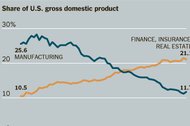
A lead article in today’s The New York Times (Sept.11,2011) questions whether the US can recover from its decline in manufacturing.   Was the tipping point reached in 2009 when China ousted America’s century long lead by generating $1.7 trillion of “value added” vs. the $1.6 trillion here? Or was it when manufacturing’s contribution to GDP declined to 11.7%  last year, down from 28% in the 1950s? (Countries over the 20% threshold are in Asia and Europe now, with China at 25%).

“We’re going to make sure the next generation of manufacturing takes root not in China or Europe, but right here, in the US”, President Obama told a joint session of Congress this week. An MIT prof counters: “The US today is alone among industrial powers in not having a strategy for thinking through what must be done in manufacturing”. “An advanced manufacturing policy is what this country must have”, adds Dow Chemical’s CEO Andrew Liveris. Liveris believes manufacturing needs government support to expand its dwindling share of the nation’s economy. He even advises the President to “pick winners” and “not let free markets rule”.

And although GE’s Jeff Immelt (co-chair of the President’s Council on Jobs, with Liveris) also expresses concern over the decline in jobs, multinationals like theirs have contributed mightily to the problem by shifting  jobs abroad. Half of Dow’s $58 billion in revenue comes from overseas operations and GE has just moved its Medical Imaging HQ from Wisconsin to China. The damage doesn’t end with factories overseas. With 40% of our engineers working in manufacturing, such jobs also decline. Innovation often originates in research centers near factories and “this trend”, writes The Times, “challenges the view that the US has the best scientists and research centers”.

Discussion questions:

1. Do Congress, the White House, and students see making an engine or scissors as important as  investment banking or retailing ?

2. Can the trend be reversed, and how?