Guest Post: Using POM for Windows’ Powerful Normal Distribution Calculator

Our Guest Post today comes from Prof. Howard Weiss, at Temple University. Howard is the developer of the superb POM for Windows and Excel OM problem solving software that we provide free with our OM texts.

One of the very useful features of POM for Windows is a Normal Distribution Calculator. This tool makes these computations much easier than using a calculator. It is also more meaningful for your students than using Excel because of the graph that is presented. The Normal Distribution Calculator can be found in the Tools menu in POM or on the toolbar and is useful for solving problems in the Project Management, Forecasting, Quality Control and Inventory (safety stock) chapters.  Example 10 from Chapter 3, Project Management, is displayed below.
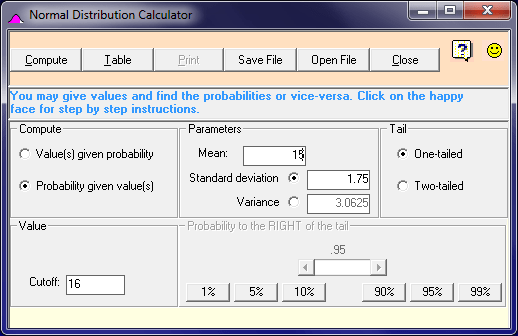
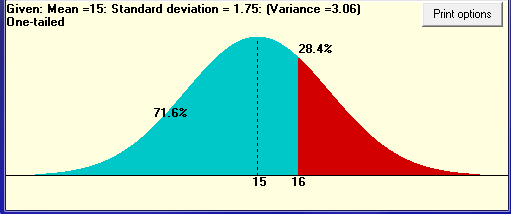
The students indicate the type of problem – compute a probability as in this example or find cutoff values given a probability, enter the mean and standard deviation, indicate whether the problem is one or two-tailed,  and either give the cutoff(s) or give the probability. POM displays a very readable, meaningful curve which enables the students to quickly identify the answer.
Video Tip: Watching The Chinese Build a 30-Story Hotel in 15 Days

Here is a great 6 minute video to show your class when covering Project Management (Chapter 3), as we watch a 30-story hotel being built in a record 15 days in the Hunan Province of China. The Los Angeles Times (March 7, 2012) describes the process and provides the video link.

Builders in China completed the 170,000 square foot, prefabricated hotel, ending on New Year’s Eve – and posted a time-lapse video (above) to show off their impressive feat.

Construction workers bolted together the new hotel from pre-made modules put together in a factory and then placed them on steel structures at the construction site.  It can reportedly withstand an 9.0-magnitude earthquake.


The Chinese company behind the speedy process, Broad Sustainable Building Corporation, has some former success with building quickly. Once the world’s largest producer of air conditioning equipment, it previously built the 15-story Ark Hotel in Changsha, China, in just six days.

The implications of the latest project go beyond simply adding to the Chinese skyline in a speedy fashion. “Construction is just about the only industry that has not been exported,” one architect explained. “But now the Broad Sustainable Building Corporation has designed a system that will let them build anywhere, to construction tolerances of +/- 0.2 mm. It completely changes the way buildings are constructed and, I believe, is about to change the entire industry.”

Will this mean that American hotels will soon be added to the growing list of things that come with a “made in China” stamp?

Video Tip: Project Management at Arnold Palmer Hospital

From talking to OM professors around the country, I have found that the 7 video case studies dealing with Arnold Palmer Hospital for Women and Children are probably the most popular in the video series we created for you to show in class. The other videos cover Hard Rock, Frito-Lay, Wheeled Coach Ambulance, Regal Marine, and Darden Restaurants. (But wait till you see what we have in store for the next edition of our OM texts: an inside look at OM in an NBA team!)

If you teach Project Management (Ch.3) in your course, here is a great 8.5 minute video to show– with a case full of real data to assign. Some of the points to make with the building of  the new 11 story Arnold Palmer Hospital addition are: (1) planning took place for over a year before the first dirt was shoveled; (2) there were a thousand plus meetings  to allow doctors, nurses, patients, staff, and others have a say in what the new facility should look like; (3) a warehouse a mile away was turned into a mock floor of the hospital so visitors could walk in and evaluate the placement of beds, bathrooms, windows, and even electrical outlets; and (4) MS Project was used to manage the whole project.

This latter point is important. In today’s weak job market, I encourage students to take advantage of the copies of MS Project (full-blown, but time-limited) that Pearson-Prentice Hall  provides with our book. Included is a self-paced tutorial , which together with the printouts at the end of Ch.3, can help students master this useful software–and beef up their resumes at the same time. You might even give extra credit to a student who solves the case study using MS Project, as opposed to using Excel OM or POM for Windows, the other free programs that come with the text.

OM in the News: The Japanese Nuclear Cleanup–A 20 Year Project?

When the senior Nuclear Regulatory Commission (NRC) engineer at Three Mile Island’s cleanup compares our 1979 explosion to  the Japanese  disaster, and says ours “was a walk in the park compared to what they have”, we know we are talking about a massive project. And the TMI cleanup took 14 years! “The cores are probably very similar, partially melted”‘ he adds, but in Japan 4 separate reactors are damaged, and fixing each one is complicated by the presence of its leaking neighbors.

Today’s New York Times (April 20,2011) describes the steps project managers must follow in the lengthy cleanup. But before they even begin, Tokyo Power has only 3 weeks to patch up smashed containment units before the rainy season starts and more contamination is washed into the environment. And the company has to watch that its small staff of skilled workers  does not absorb too much radiation doing so.

Here are the 6 main steps that may take  20 years to complete:

1. Clean up the water in the basements of the buildings.

2. Install new pumps to recirculate the water in the reactors (to end radioactive releases).

3. Decontaminate the walls and floors.

4. Rebuild the containments for units 1,2, and 4, so workers can defuel the reactors. (That step took 5 years at TMI, where no buildings had to be rebuilt).

5. Remove the wrecked fuel in the core. This involves creating new remote-controlled tools to cut through the metal and get to the material below.

6. Reprocess the radiated debris (or bury it as we did in shielded casks in Idaho).

This massive task makes our project management examples in Ch. 3 (like rebuilding Iraq) look trivial. We can only hope they first read the article “What Great Projects Have in Common” in MIT Sloan Review that we reviewed last week.

Discussion questions:

1. Why is this project more complex than rebuilding New Orleans after Katrina?

2. How do the Japanese benefit from TMI?

Good OM Reading: What Great Projects Have in Common

Every once in  a while, a “great” project comes along. The last one I have memories of was the rebuilding of the Pentagon after the 9/11 terrorist attacks. Jay and I wrote about “Project Phoenix” in Ch.3, describing how the estimated 3-year, $3/4 billion  project was completed in 11 months for only $501 million with handshake contracts, creativity, teamwork, and ingenuity.

So when the MIT Sloan Management Review article (March 23,2011), “What Great Projects Have in Common”  just came out, it caught my eye as a good teaching tool. Authors Dov Dvir and Aaron Shenhar use the creation of the IBM AS/400 computer and the Apple iPod as their examples of “great projects”, and then ask:  “Why are such projects so rare”? 

Their answer after analyzing 400 projects: 7 managerial characteristics were held in common.

Here they are: (1)They all created a unique competitive advantage or exceptional value for stakeholders. (2) They had lengthy periods where the project was defined. (3) There was a revolutionary (and different)project culture. (4) The project leader was highly qualified and had support of top management. (5) The project maximized use of existing knowledge, often with the cooperation of outside organizations. (6) The projects had integrated development teams with fast problem-solving capability. (7) The teams had a strong sense of partnership and pride…which was indeed the case when the Pentagon was being rebuilt.

This 3-page article is short enough to ask your students read it when you cover Chapter 3 and it complements our coverage of this important topic.

To see other articles in MIT Sloan Management Review go to sloanreview.mit.edu.

Teaching Tip: Why Do So Many Large Projects Overrun?

While most OM texts cover Project Management (see Chapter 3), there is little discussion as to where the time estimates for activities  in PERT and CPM come from or how accurate they are. This question arises in, of all places, an easily overlooked article in The Wall Street Journal (Oct.16-17,2010).

Here we learn that “planners underestimate costs in nearly 9 out 0f 10 projects” and “cost overruns for building projects are typical”. From my decades of teaching MIS and working as a consultant in IT, I can add that completion times in software development projects are also regularly underestimated.

Why is this the case? Research, according to the WSJ, shows that “people allow their best hopes to dominate the planning process”. This case of  “irrational optimism” suggests that project managers would do well to keep data from prior projects. “Looking forward makes you more optimistic”, says a Norwegian researcher in the article. “Looking backward makes you more realistic”.

So when you and your students are discussing large projects that suffered major overruns (like Boston’s “Big Dig” and others they will bring up), you may want to remind students that doing PERT charts and running MS Project is all well and good, as long as the inputs are meaningful.

Finally, did you ever wonder about the  the empirical basis of PERT’s 3 time estimates and the use of the Beta distribution in project management? If large projects do consistantly underestimate activity times, should we be giving more weight in the PERT formula to the “pessimistic” time estimate, b? Perhaps the formula in Equation (3-6) in our text should be  t=(1a+3m+2b)/6  instead of  t=(1a+4m+1b)/6?