Guest Post: Drinking Graywater Beer?

Prof. Misty Blessley, at Temple U., raises an interesting sustainability issue.

Every drop of water on Earth is part of a continuous cycle. The same water brewed into beer eventually  travels through wastewater systems before being treated and returned to the environment, ready to be consumed again. Gray water is defined as: wastewater from showers, baths, bathroom sinks, and washing machines, excluding toilet water (blackwater) and water from kitchen sinks/dishwashers.

A San Francisco firm, Epic Cleantec, makes this cycle explicit by brewing beer with recycled graywater from showers and laundry. Buildings globally use 15% of all potable water, yet almost none reuse it. Partnering with nearby Devil’s Canyon Brewing Company, it created two beers—Shower Hour IPA and Laundry Club Kölsch, using water purified through a multi-stage system until it meets or exceeds potable water standards. Their approach demonstrates how scarce resources can be sourced in new and innovative ways.

Reusing waste water can help counteract climate change

The supply chain implications are significant. Brewing is water-intensive, requiring several gallons of water for every gallon of beer produced. As climate volatility and drought increasingly pressure municipal water supplies, integrating recycled water helps mitigate supply risk. Pairing this with drought-tolerant barley and hops further enhances supply chain resilience by mitigating upstream agricultural vulnerabilities.

Epic Cleantec’s model represents circular economy principles in action: closing loops, recapturing resources, and turning waste streams into valuable inputs. Many other food and beverage companies are embracing similar strategies. Rubies in the Rubble (UK) creates condiments from surplus produce that would otherwise be discarded. Upcycled Foods, Inc. (U.S.) produces SuperGrain flour to make bread from spent brewing grain. Planetarians (U.S.) transforms spent yeast and soybeans into a vegan meat product that is competitively priced compared to chicken and below beef.

Epic Cleantec emphasizes the circularity of its inputs to build consumer acceptance, hoping customers celebrate the closed loop. For details on the “circular economy” see Supp. 5 of your Heizer/Render/Munson text.

Classroom Discussion Questions:
1.  Forecasting is covered in Ch 4 of the Heizer/Render/Munson textbook. How would you forecast demand for beers made with recycled graywater, given potential consumer hesitation?
2.  TQM Tools are covered in Ch 6. Which tools should the two firms use to ensure water quality and process reliability throughout treatment and brewing?

OM in the News: Europe Tells Textile Producers to Manage Their Own Waste

Producers that sell textiles in the European Union will have to cover the cost of collecting, sorting and recycling those materials, under a new directive to reduce waste in the fashion industry. The EU is adopting a new law whereby producers will have to oversee the management of waste from clothing to blankets to curtains, reports The Wall Street Journal (Sept. 11, 2025). The directive covers the full life cycle of a product and aims to motivate producers to “reduce waste and increase the circularity of textile products,” since they will be bearing the cost of managing that waste.

EU Pushes Rules for Circular Economy

The EU is looking to reduce the environmental impact of the fast-fashion industry. Some 12.6 million tons of textile waste are generated in the EU each year. It estimates that just 1% of textiles are recycled worldwide.

 The law will apply to all producers, including those using e-commerce tools and irrespective of whether they are established in an EU country or outside the bloc. Smaller companies will have an additional year to comply with the requirements.

“This legislation will accelerate the move towards circular business models and more sustainable consumption,” said a recycling consultant. “The requirements will bring added costs and operational pressures for producers at a time when many are already under strain.”

Elsewhere, the EU is to set new targets on food waste. From 2031, member states will be required to reduce food waste generated during processing and manufacturing by 10%, while the target for shops, restaurants and households will be 30%. Every year, almost 60 million tons of food waste, amounting to about 291 pounds per person, is created within the EU.

Classroom discussion questions:

  1. Supplement 5 in your Heizer/Render/Munson text introduces the term “circular economy.” What does that mean and how does it apply in this EU case?
  2. Discuss the OM implications of this new directive? Does it impact U.S. firms?

OM in the News: The Future of Trash Pickup and AI

Americans are among the top producers of trash per capita. Each person in the U.S. disposes of nearly a ton of refuse annually. Simplifying trash day, and diverting the 80% of reusable material that still ends up in landfills, is one key to solving our problems.

Urban planners, the refuse industry and cities across the country are reimagining how we manage and dispose of our waste, reports The Wall Street Journal (Aug. 28, 2025). The New York City and MIT are among those leveraging AI, robotics and electric power to tackle a growing garbage crisis fueled by cheap products and throwaway culture.

Most of Americans don’t recycle regularly, citing the inconvenience and confusion involved in sorting their trash. To help people up their sustainability game, sanitation engineers are promoting a new system: the single-stream model. The operation is simple—residents throw everything into one trash bin. Then, that waste is transported to a remote facility, where AI-powered cameras and robots sort it, diverting items that can be recycled. The goal is to have a system that’s more circular, that can reuse and recycle things more.

AI can also identify items such as electronics that contain hazardous or valuable materials—including copper, silver, gold and rare-earth minerals—and send them on for disassembly and harvesting before they enter the waste stream.

Individual garbage bins or piles of plastic bags aren’t only an all-you-can-eat buffet for rodents—but also malodorous, leaky and inefficient, requiring endless noisy stops from garbage trucks on collection day.

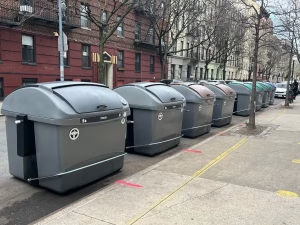
The new NYC shared Empire Garbage Bins.

To solve these problems, cities are moving toward containerization: large, centralized bins shared by a street or neighborhood. One NYC neighborhood  is already piloting a program of such containers, with plans for citywide expansion in the future.

Smart bins could even ping dispatch offices when they are ready for pickup. Large collection vehicles could be used more sparingly, and with fewer stops—thus decreasing noise, pickup time and pollution. In the future, the parameters that we use could be, ‘Is it full? Or is it smelly?’ Then collection on that bin can take place only if the contents meet those conditions.

AI-optimized routing and trash-loading technologies could also help make pickups shorter, less frequent and less disruptive.

Classroom discussion questions:

  1. How could AI be used to help recycle?
  2. What are the major inefficiencies of most garbage collection and recycling systems?

OM Podcast #24: Andreas Wieland’s New Book–Supply Chain: A System in Crisis

Welcome to our newest podcast.  In this podcast Barry Render interviews Andreas Wieland, a professor of Supply Chain Management at the Copenhagen Business School and Editor of the Journal of Supply Chain Management.  Andreas and Barry discuss Andreas’ new book, Supply Chain: A System in Crisis, as well as other topics such as the circulator economy and the latest trends in journals.


Did you know our podcast is now available on Apple podcasts? Just go to your Apple podcasts app, search “Heizer Render OM Podcast,” and subscribe to get all our podcasts on your mobile device as soon as they come out!

Transcript

A Word document of this podcast will download by clicking the word Transcript above.

Instructors, assignable auto-graded exercises using this podcast are available in MyLab OM. See our earlier blog post with a recording of author and user Chuck Munson to learn how to find these, or contact your Pearson rep to learn more! https://www.pearson.com/en-us/help-and-support/contact-us/find-a-rep.html

OM in the News: The Growth of Electronic Waste

Supplement 5 in our text, Sustainability in the Supply Chain, stresses the important roles of  product design and circular economy in protecting our planet. But a new report by the U.N. in Earth.com (March 21, 2024) documents the escalating global challenge of electronic waste (e-waste) generation  and how it significantly outstrips the pace at which we are recycling these materials.

E-waste is defined as any discarded product with a plug or battery that harbors toxic additives and hazardous substances, such as mercury. A staggering 62 million tons of e-waste was generated in 2022 –an amount that could fill a line of 40-ton trucks encircling the equator.

Just 22% of this e-waste is known to have been recycled properly, spotlighting the vast amount of valuable resources – worth an estimated $62 billion – that remain untapped, and highlighting the increased pollution and health risks to global communities. The annual rise of 2.6 million tons in e-waste production, with predictions set to soar to 82 million tons by 2030, underscores the problem.

The widening gap between e-waste production and recycling is attributed to several factors, including rapid technological advancements, higher consumption rates, limited repair options, shorter product life cycles, shifts towards EVs, design challenges, and insufficient e-waste management infrastructure. (It is even worse when the extremely dangerous discharged batteries from EVs, not included in the U.N. report, are considered). This complex web highlights the need for integrated solutions that encompass technological innovation, policy reform, and community engagement.

“With less than half of the world implementing and enforcing approaches to manage the problem, this raises the alarm for sound regulations to increase collection and recycling.” writes the U.N. One of the report’s revelations is the current inefficiency in reclaiming valuable materials from e-waste, which presents both an economic loss and a missed opportunity for reducing reliance on rare earth/mineral extraction. “No more than 1% of demand for essential rare earth elements is met by e-waste recycling,” it states.

The report calls for collective action from policymakers, industry leaders, researchers, and consumers to reimagine our approach to electronics consumption and waste management.

Classroom discussion questions:

  1. Why do EVs pose a major challenge?
  2. Identify a product and how its production, use, and end-of-life could be more sustainable.

OM in the News and Video Tip: A Circular Economy Hub for Automaker Stellantis

Stellantis opens its first circular economy hub.

Stellantis–the global automaker with brands including Chrysler, Fiat, Jeep, Maserati and Peugeot– has inaugurated a Circular Economy Hub at its manufacturing complex in Turin, Italy, demonstrating its commitment to a “360-degree approach” to automotive production, involving a strategy of remanufacturing, repair, reuse, and recycling (4R‘s.) Stellantis says it is adopting capabilities and facilities “to change its consumption model to reduce the environmental impact and better manage the company’s aggressive decarbonization target of reaching carbon net zero by 2038.”

“Circular economy,” a topic in Supplement 5 of your Heizer/Render/Munson text, describes an economic concept for production and consumption that preserves the value of energy, materials, and labor as products move from design through to end-of-use handling and recycling. The Hub represents a $40 million investment, covering 785,000 sq. ft.  The site will employ 550 workers by 2025.

“The Circular Economy Hub brings together a powerhouse of skills and activities aimed at creating a high-performing center of excellence in Europe,” stated Stellantis in American Machinist (Nov. 28, 2023). “We are industrializing the recovery and sustainable reuse of materials, building new technologies and advanced capabilities as we grow in this area.”

The primary objectives for the Hub are to extend the life of parts and vehicles, ensuring that they last for as long as possible; or, failing that, to recycle those materials and others from end-of-life vehicle dismantling for remanufacturing as new parts and/or vehicles. The goal for the first operation, “Reman,” is to manage over 50,000 remanufactured parts annually by 2025, rising to 150,000 by 2030. For the Hub’s Sorting Center, the target is to process an estimated 2.5 million worn parts annually by 2025, increasing to 8 million by 2030.

The Vehicle Reconditioning activity will undertake aesthetic and/or mechanical repair of remanufactured or used parts and then reintroduce those to the supply chain through Stellantis’ manufacturer-certified used-vehicle program and services network. Last, the Vehicle Dismantling activity will convert end-of-life vehicles into resources for parts to be remanufactured, reused, or recycled.

Stellantis intends for the Hub to generate “efficiencies and synergies” among these activities, and through vertical integration of materials and processes. Here is a 3.5-minute video showing the 4R process in action.

Classroom discussion questions:

  1. What is meant by “circular economy?” Give an example with an iPhone as the product.
  2. What auto parts will be hard to repurpose?

OM in the News: What It Takes to Go to a Circular Economy

We take resources from the earth. We make things out of them for use. And then, we throw away whatever is left. The cost is borne out not only in landfills, but also through emissions, as our consumption fuels the climate degradation.

 Shifting a “linear economy” toward circularity requires major changes to business and operating models, supply chains, and B2B and B2C consumer behavior. Yet circular solutions can contribute to a better future. We discuss this “circular economy” in Supp. 5 (see p. 197).

The World Economic Forum recently brought together four industry leaders whose ideas on what it takes to go circular are summarized below:

First exec: For mature companies, the mindset shift means making investments in areas where there may not be imminent business value or impact. For those at the beginning of this journey, it can start with small steps towards replacing existing materials (such as packaging) with more sustainable and economically viable alternatives. These small steps can have huge short-term impacts and set the path toward more systemic changes in the future.

Second exec: Start by developing a clear picture of global end-to-end impact, including supply, production and use of material flows. Embed a circularity mindset and principles across all parts of the company, starting with business strategy, innovation process, capital allocation, HR management and rewards, brand positioning, marketing, etc. Sustainability commitments then become an integral part of a company’s purpose and culture.

Third exec: It is important to look at your pillars and targets day by day. Success isn’t measured overnight, and each milestone resets with a new target. Staying committed to the course is what ultimately changes behaviors and mindsets and garners results. Five key pillars underpin the strategy: (1) understanding organizational resource flows to reduce waste; (2) implementing internal systems to maximize the value of resources: (3) supporting supply chain to progress towards circularity; (4) engaging with customers to help them make circular choices; and (5) supporting innovation to accelerate the global transition to a circular economy.

Fourth exec: The transformation spans decades, so there is a “before” the transformation, but not yet an “after”. To start the transformation, it will help to define circular objectives for the company overall as well as for all areas of the company, so all areas of the company can contribute. Attention has to be paid to sustainability and circular economy. Messaging has to be consistent and repeated by line management.

Classroom discussion questions:

  1. How has a company you are familiar with moved towards circularity?
  2. Summarize the key points of the executives quoted.

OM in the News: Manufacturing’s Circular Economy

With a raging pandemic, disrupted supply chains, and a growing scarcity of raw materials, 2021 will present serious challenges to the global manufacturing industry. American Machinist (Jan. 6, 2021)  sees a renewed resolve among manufacturers to focus on sustainability and join the circular economy the strategic effort to eliminate waste and the maintain a continual use of resources. Manufacturers are approaching the circular economy model by rethinking how they design and produce their products with as little waste as possible, how they ship them, and how they approach the growing after-market repair and recycling market.

The circular economy is putting pressure on companies to reexamine their business processes; not only to improve quality and profitability, but because an efficient supply chain consumes less energy, uses fewer resources, and produces less waste. In short, gearing production toward sustainability is good business.

One example is DyeCoo, a textile company that has partnerships with Nike and IKEA, has developed a water-free process for dyeing. Using highly pressurized, recyclable carbon dioxide instead of water, the company can produce its product in half the time, using a fraction of the energy of traditional methods. Another example is Cambrian Innovation. This U.S. company treats wastewater contaminated by industrial processes, not only turning it into clean water, but even producing biogas that can be used to generate clean energy.

Manufacturers also will need to reengineer, and in some cases reimagine, their products. This means building for longevity in a sustainable business plan. If you are a lighting fixture manufacturer selling light as a service to an airport, you will want to produce lightbulbs to last long as possible, to maximize ‘uptime’ and revenue.

 Manufacturers are also taking serviceability into account in the design phase. Consider Dell and its Latitude laptop computers, which have been designed with recycling in mind. Using removable batteries, standardized fasteners, and by eliminating mercury and adhesives, Dell is able to produce laptops that are 97% recyclable.

Classroom discussion questions:

  1. How does Supp. 5 in your Heizer/Render/Munson OM text define “circular economy?”
  2. Provide examples of how product design teams can use alternative materials to improve sustainability.

OM in the News: Strained Supply Chains and Circularity


In a fast-moving, understaffed crisis, medical facilities produce lots of items that may not be easily recyclable.  Remanufacturing and circular economy experts are anticipating an increased need for recycling, writes Supply Chain Dive (June 10, 2020). Some are targeting the healthcare sector specifically while others think the coronavirus crisis highlights how essential recycling and reuse can be for other industries struggling to cope with ruined supply chains. All this upheaval could reveal how circularity may serve everyone better than pre-pandemic protocol did.

Stunted (or overwhelmed) supply chains partially explain why “reuse” has become integral to coping with this pandemic. “Anytime there’s a resource-constrained situation, it’s important to extend the lifespan of products,” says the U.S. Chamber of Commerce, an organization that works with businesses to help them pursue circular economy practices. For example, mask shortages prompted interest in sanitizing N95 masks with vaporized hydrogen peroxide.

There will be plenty of remanufacturing needs once the pandemic is over. Many ventilators made for desperate hospitals will get put in storage, for example, and someone will have to figure out how to keep them in good condition in case the machines need to get rolled out again.

Pressure comes as recycling access in the U.S. has deteriorated in certain ways, and the balance between reuse and disposal could shift in a post-pandemic world. Single-use items, like the stretchy plastic gloves that gum up recycling facilities, could boom when people are hyper-concerned about sanitation.

Reuse might be a future need in some industries — but others have to adopt its companion, recycling, even more quickly. Paper mills that produce packaging for General Mills, Pillsbury and other food suppliers still need raw materials to meet customer demand and higher grocery store sales. Residents are also moving forward with at-home construction projects, and regional suppliers of plastic or wood-composite lumber still need those supplies. Recycling fills those supply chain needs, and importantly, keeps paper mills and other manufacturing facilities open.

Classroom discussion questions:

  1. What is the “circular economy”? (Hint: See Supp. 5 of your Heizer/Render/Munson OM text)
  2. Why has recycling “deteriorated in certain ways”?