
Americans are among the top producers of trash per capita. Each person in the U.S. disposes of nearly a ton of refuse annually. Simplifying trash day, and diverting the 80% of reusable material that still ends up in landfills, is one key to solving our problems.
Urban planners, the refuse industry and cities across the country are reimagining how we manage and dispose of our waste, reports The Wall Street Journal (Aug. 28, 2025). The New York City and MIT are among those leveraging AI, robotics and electric power to tackle a growing garbage crisis fueled by cheap products and throwaway culture.
Most of Americans don’t recycle regularly, citing the inconvenience and confusion involved in sorting their trash. To help people up their sustainability game, sanitation engineers are promoting a new system: the single-stream model. The operation is simple—residents throw everything into one trash bin. Then, that waste is transported to a remote facility, where AI-powered cameras and robots sort it, diverting items that can be recycled. The goal is to have a system that’s more circular, that can reuse and recycle things more.
AI can also identify items such as electronics that contain hazardous or valuable materials—including copper, silver, gold and rare-earth minerals—and send them on for disassembly and harvesting before they enter the waste stream.
Individual garbage bins or piles of plastic bags aren’t only an all-you-can-eat buffet for rodents—but also malodorous, leaky and inefficient, requiring endless noisy stops from garbage trucks on collection day.
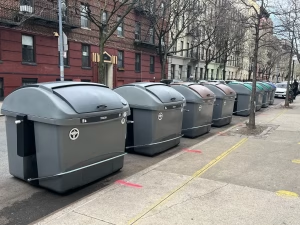
To solve these problems, cities are moving toward containerization: large, centralized bins shared by a street or neighborhood. One NYC neighborhood is already piloting a program of such containers, with plans for citywide expansion in the future.
Smart bins could even ping dispatch offices when they are ready for pickup. Large collection vehicles could be used more sparingly, and with fewer stops—thus decreasing noise, pickup time and pollution. In the future, the parameters that we use could be, ‘Is it full? Or is it smelly?’ Then collection on that bin can take place only if the contents meet those conditions.
AI-optimized routing and trash-loading technologies could also help make pickups shorter, less frequent and less disruptive.
Classroom discussion questions:
- How could AI be used to help recycle?
- What are the major inefficiencies of most garbage collection and recycling systems?
