OM in the News: Junk Is Needed for the New Electric Era

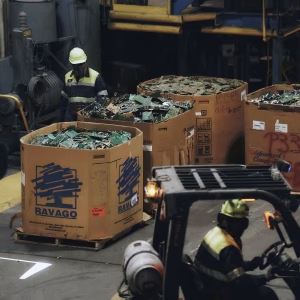
Circuit boards from thousands of different products arrive at Glencore’s Rhode Island facility, where the company determines the copper content and the value of the waste.

One of the world’s largest miners is digging into America’s junk drawers, old phones and landfills. The quarry: bits of copper to meet the needs of the energy transition and data boom.  Shredded cellphones, obsolete computer cables and chewed-up cars are heaped 30 feet high outside Glencore’s 97-year-old copper smelter deep in Canada’s boreal forest. There, the scrap is melted with copper concentrate from mines to produce fresh slabs of metal.

Shifting from fossil fuels to more renewable electricity promises to remake commodity markets, writes The Wall Street Journal (Nov. 21, 2024). If America requires less crude oil and coal, it will in turn need copper for everything electric. “In the next 25 years we will consume more copper than humanity has consumed until now,” says Glencore’s  recycling head.

Data centers being built to facilitate AI and store smartphone videos are full of copper. So are the phones. Even if rich mine deposits are found, it takes decades to bring them online. That prevents miners from responding quickly to new demand, which leaves scrap to balance the market. Copper never goes away and is infinitely recyclable.

Miles worth are strung through homes and cars and along rights of way, carrying electricity and drinking water. But a lot sits in junk yards and landfills. When prices rise, there is more incentive to get it. Copper prices are currently among the highest ever. Nearly half of demand will be met with recycled copper by 2050, up from about a third today.

Germany’s Wieland began construction in 2022 on a $100 million recycling facility in Shelbyville, Ky. Another German firm, Aurubis, is building an $800 million recycling facility in Augusta, Ga. Glencore recently bought a failed electronics recycling facility in Arkansas and will use it, too, to gather scrap. Glencore found that the concentration of copper in landfilled auto fluff can be more than twice that found in geologic mines.

Classroom discussion questions:

  1. Why the demand for copper?
  2. What makes copper recycling attractive?

OM in the News: The Green Transition Challenge

Copper is the new lithium, writes The Wall Street Journal (April 19, 2023). But a lack of new mining activity has added to worries that there won’t be enough of the red metal for the energy transition to electric vehicles.

Sheets of copper cathode at a mine in Chile.

Copper is used in wiring and construction as well as EVs, solar panels and other green technologies. Electrification is expected to increase annual copper demand to over 36 million metric tons by 2031, with supply forecast to be around 30 million tons, creating at least a 6 million ton shortfall at the start of the next decade. In 2021, refined copper demand stood at 25 million tons.

South America currently dominates copper production and Chile is the largest mined producer. Increasing mine output has proved a challenge, warning of a serious supply shortfall over the next decade. Some projects are coming online in Peru and in Chile, which will add incremental supply, but there is little in terms of pipeline for the long run. Copper metal exports from Congo and Zambia, the two other sources, totaled 2.3 million tons in 2022, up slightly from 2021, but less than half of Chile’s output.

“There’s a narrative around resource scarcity and the green transition with EVs and renewables as well as the build-out of electricity grids. On paper it’s quite a substantial supply gap opening up over the next 10 years,” says an industry expert. And there is no slack in the system.

“Green” uses of copper now account for about 4% of consumption, but this is expected to rise to 17% by 2030. A “net-zero emissions” path would mean the world would need an additional 54% of copper by 2030 on top of that forecast. EVs cannot take off before the charging infrastructure is set, and the necessary electrification is very copper intensive. Copper features heavily in energy transition proposals.

Sales of electric cars in 2022 in creased 55% over 2021 to bring the total number of EVs in the world to around 26 million. That means the EV-charging ecosystem will have to be significantly ramped up.

Classroom discussion questions:

  1. Why is this an OM issue?
  2. What might be done to solve the problem?