OM in the News: Junk Is Needed for the New Electric Era

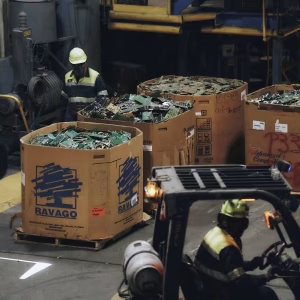
Circuit boards from thousands of different products arrive at Glencore’s Rhode Island facility, where the company determines the copper content and the value of the waste.

One of the world’s largest miners is digging into America’s junk drawers, old phones and landfills. The quarry: bits of copper to meet the needs of the energy transition and data boom.  Shredded cellphones, obsolete computer cables and chewed-up cars are heaped 30 feet high outside Glencore’s 97-year-old copper smelter deep in Canada’s boreal forest. There, the scrap is melted with copper concentrate from mines to produce fresh slabs of metal.

Shifting from fossil fuels to more renewable electricity promises to remake commodity markets, writes The Wall Street Journal (Nov. 21, 2024). If America requires less crude oil and coal, it will in turn need copper for everything electric. “In the next 25 years we will consume more copper than humanity has consumed until now,” says Glencore’s  recycling head.

Data centers being built to facilitate AI and store smartphone videos are full of copper. So are the phones. Even if rich mine deposits are found, it takes decades to bring them online. That prevents miners from responding quickly to new demand, which leaves scrap to balance the market. Copper never goes away and is infinitely recyclable.

Miles worth are strung through homes and cars and along rights of way, carrying electricity and drinking water. But a lot sits in junk yards and landfills. When prices rise, there is more incentive to get it. Copper prices are currently among the highest ever. Nearly half of demand will be met with recycled copper by 2050, up from about a third today.

Germany’s Wieland began construction in 2022 on a $100 million recycling facility in Shelbyville, Ky. Another German firm, Aurubis, is building an $800 million recycling facility in Augusta, Ga. Glencore recently bought a failed electronics recycling facility in Arkansas and will use it, too, to gather scrap. Glencore found that the concentration of copper in landfilled auto fluff can be more than twice that found in geologic mines.

Classroom discussion questions:

  1. Why the demand for copper?
  2. What makes copper recycling attractive?

OM in the News: The EV Battery’s Supply Chain Problems

The Swiss mining giant. Glencore, is suspending production at an unprofitable nickel operation in New Caledonia

The global EV revolution has been losing momentum as buyers are more aware of the vehicles’ higher prices, range limitations, and charging station shortages. So automakers such as Ford, GM and Volvo are delaying investments and striking a more cautious tone about the outlook for EV consumer demand.

But a big part of that revolution has been in the development of the core of EVs, namely the batteries. “Producers of lithium and nickel, which are used in lithium-ion batteries for EVs, have been stalling projects and closing mines to save cash,” writes The Wall Street Journal (Feb. 20, 2024). Prices of lithium are down as much as 90% since the start of last year, while the price of nickel has halved.

When Albemarle, the world’s most valuable lithium company, last year announced plans for a $1.3 billion plant in South Carolina, it was hailed as transformative for the state. The high-tech project was designed to process different sources of lithium and serve as a supplier of the critical mineral for South Carolina’s burgeoning EV industry, producing enough lithium for 2.4 million vehicles annually. Less than a year later, those plans have been hobbled by the crash in battery metal prices, undercut by a slowdown in EV sales in the U.S. and China. Albemarle has deferred spending on the project, amid companywide cost-cutting that includes layoffs.

Now the world is suddenly awash with the metals after producers ramped up new projects to feed the global EV industry and compete with China. (We note that boom-and-bust cycles are commonplace in metals markets, given demand can be unpredictable and new mines typically take many years to develop).

In the more-established nickel industry, some miners say they have been left with no choice but to close unprofitable mines. The downturn has wiped out more than a fifth of Australia’s mine supply. Mothballing any mine is a difficult choice, as companies pay ongoing maintenance costs that can run into millions of dollars a month when they aren’t producing anything to sell.

Classroom discussion questions:

  1. What is the US doing to create supply chains for EV  battery components? Is it working?

      2. How do mining firms forecast the demand for minerals that are so dependent on auto demand?

OM in the News: The Transition to Electric Vehicles Sustainability Dilemma

A mining exploration camp in the Ring of Fire

The pace of the global transition to electric vehicles depends on the future of a remote region in Canada known as the Ring of Fire. Located underneath a distant, swampy expanse in Northern Ontario that is cut off from major roads, the Ring of Fire is seen as one of the world’s most important untapped sources of nickel, copper and cobalt—metals essential for making the batteries that power EVs.

But the precious commodities are buried under a vast ecosystem of peat bogs that hold more carbon per square foot than even the Amazon rainforest. Digging them up could trigger the release of more greenhouse gas than Canada emits in one year, turning one of the earth’s biggest carbon sinks into a major source of emissions.

A debate over how, or whether, to tap in to this mother lode, has touched off a fight between mining companies, climate advocates, and indigenous groups as demand for cleaner energy and EVs has surged worldwide, reports The Wall Street Journal (Sept. 29, 2023).

“If I have to hop on a bulldozer myself, we’re going to start building roads to the Ring of Fire,” said the head of Ontario province, which recently signed deals with automakers VW and Stellantis to build battery-making factories in the province. Opponents warn that disturbing the area could have far-reaching consequences.

The Ring of Fire, an area larger than Rhode Island, was formed 3 billion years ago. A retreating ice sheet left sodden, boggy terrain that covers a wealth of minerals. This deposit is “the most valuable nickel deposit, undeveloped, in the world,” said one mining CEO. “We’re not going to be able to switch off fossil fuels, which are destroying the planet, unless we have abundant supplies of nickel.” He estimates the deposits of platinum, palladium, copper and chromite could be worth $67 billion. As EV production has increased, demand has surged for such metals, which are key components in making EVs and military equipment.

Projects like the Ring of Fire represent a new era for the mining industry. Long considered a dirty and often unfortunate legacy of the industrial economy, mining has taken on a green sheen. Extraction is an essential component of the global movement toward electrification.

Classroom discussion questions:

  1. What is the pro mining stance?
  2. The anti-mining position?

OM in the News: Europe Is Embarking on a Mining Renaissance

 Governments and companies around the world are scrambling to secure resources needed to power the energy transition, but some European countries are now thinking it may be better to look closer to home, reports The Wall Street Journal (Aug. 10, 2023). Copper, lithium, nickel, and rare earths are all key minerals crucial to powering wind turbines, electric vehicles and other clean tech, but largely have been imported from abroad in recent decades.

With demand for critical minerals surging, European governments want to exploit resources closer to home.

“No doubt there is a real demand story,” said a mining expert. “We are talking about a 35-fold increase in lithium demand and we do not have any large-scale lithium mines in Europe. It’s a massive problem.” But as governments fast-track approvals on such projects and struggle to convey the importance of efforts to secure materials for the green-energy transition, resistance is growing among locals who stand to feel an impact and environmentalists who urge caution when moving forward with projects in sensitive ecosystems.

In Germany, Vulcan Energy Resources is looking to open a lithium mine, harnessing a new technology for extracting the battery metal from brine. In Sweden, Copperstone Resources is hoping to reopen a brownfield mine site to extract the red metal, while Adriatic Metals has just started mining for silver and zinc in Bosnia, with more projects planned from Finland to Greece. In Portugal, Savannah Resources is planning  to dig out one of Europe’s richest lithium deposits.

In Europe, the mining renaissance comes after years of nearly no new mining activity on the continent. Usually, opening a new mine takes 10 to 15 years, often because permitting can take years. Local backlash against new mines isn’t uncommon. The industry has a long history of environmental destruction, poor relations with local communities and deadly disasters. In 2021, local opposition derailed Rio Tinto’s lithium project in Serbia.

However, governments want and need a secure supply chain of metals and minerals. Most critical minerals are processed in a relatively small number of countries with the threat made more apparent last month after China said it would introduce export restrictions to germanium and gallium—two critical minerals used to make semiconductors. Prices skyrocketed as consumers were suddenly unsure if they would have the raw materials needed to make chips for cars, phones and other tech.

Classroom discussion questions:

  1. What is China’s role/position in the rare earths and minerals supply chain?
  2. What is the status of that supply chain in the U.S.?

OM in the News: Demanding a Bigger Piece of the EV Pie


Electric vehicles require six times the mineral inputs of conventional cars, and it is estimated that mineral demand for use in EVs and battery storage could grow 30 times by 2040, reports The Wall Street Journal (July 3, 2023).

Across the developing world, mineral-rich nations are demanding a bigger piece of the EV pie, saying they are moving to end the era of extract and export.  Countries with vast deposits of the ingredients essential to making EVs are digging in and trying to take advantage of the boom.

In parts of Latin America, Africa and Southeast Asia, governments are restricting the export of raw minerals, demanding that miners build processing plants locally and looking to tighten control over foreign-operated mines. The steps are sometimes described as resource nationalism, and their increasing popularity is reshaping supply chains that underpin the shift toward cleaner forms of energy.
Lithium production in Chile, where greater state control of the resource has become a priority.

Guinea, a major African bauxite producer, has imposed a minimum export price and urged companies to build local refineries. Namibia just banned the export of unprocessed lithium and other critical minerals, including cobalt, manganese and graphite. Indonesia banned the export of unprocessed nickel, pushing foreign companies to build billion-dollar facilities in the country that are turning ore into higher-value materials for EV batteries. Zimbabwe is doing the same with lithium. Chile and Mexico are seeking greater state control over their countries’ lithium reserves. These ore-rich countries are looking to move up the value chain instead of simply providing the primary inputs or commodities.

State actions aimed at that goal bring risks for the transition, potentially deterring investment in new mines needed to keep up supply. They could also raise the cost of critical materials, increase regulatory burdens for companies and lead to shortages in the future. “It’s got to be an all-around negative factor for the energy transition,” said one expert. Indonesia, a mineral powerhouse, infuriated trade partners with its 2020 ban on the export of raw nickel, but it worked. Companies from across Asia and the U.S. are pouring investments into building nickel-processing plants in the country, making Indonesia a significant player in the EV supply chain.

Classroom discussion questions:

  1. How does resource nationalism relate to the issue of core competencies that we discuss in Chapter 2?
  2. What keeps the U.S. and other developed nations from mining their own minerals?

OM in the News: The “Nickel Pickle” and Other Electric Vehicle Tales

The Wall Street Journal (June 5, 2023) led with a front page article called the “Nickel Pickle” and then went on with two more stories about EV headwinds. Let’s summarize: To make batteries for EVs, companies need to mine and refine large amounts of nickel. The process of getting the mineral out of the ground and turning it into battery-ready substances is particularly environmentally unfriendly. Reaching the nickel means cutting down swaths of rainforest. Refining it is a carbon-intensive process that produces waste slurry that’s hard to dispose of.

Mining and refining nickel is a dirty business

The nickel issue reflects a larger contradiction within the EV industry: Though EVs are designed to be less damaging to the environment in the long term than conventional cars, the process of building them carries substantial environmental harm. One Indonesian miner, for example, said that rainforest clearing caused greenhouse gas emissions equivalent to 56,000 tons of carbon-dioxide. That’s equal to driving 12,000 conventional cars for a year.

Tesla adds that EVs cause more emissions during the manufacturing phase than conventional vehicles, due in part to the process of extracting and refining minerals.  Nickel is responsible for 1/3 of the carbon emissions generated from making a battery cell.

The second piece states that battery-powered EVs “are not the only way to achieve the world’s carbon neutrality goals.” Toyota is promoting its hybrids and plug-in hybrids as alternatives to battery-powered EVs. Plug-in hybrids contain an engine that can kick in when the battery runs low and are cheaper than EVs. That firm has pledged  to make all its vehicles carbon neutral by 2050.

Toyota’s CEO made news when he claimed that a “silent majority” in the auto industry “is wondering whether EVs are really OK to have as a single option.” He added that “the amount of raw materials in one long-range battery EV could instead be used to make 6 plug-in hybrid electric vehicles or 90 hybrid electric vehicles.” For that anti-EV comment, progressive investors and government pension funds have moved to oust him.

The 3rd article reports that VW “is searching the world, from Canada to Indonesia, for supplies to make the batteries in EVs it sells less dependent on Chinese components,” especially nickel. China dominates global production of refined battery materials used in EV batteries. “Today we are 100% dependent on China,” says a VW exec.

Classroom discussion questions:

  1. Why is nickel a supply chain problem?
  2. Why is the Toyota position controversial?

OM in the News: A Green Mining Mirage

The history of the mining industry is littered with environmental destruction, pollution and detrimental impacts on local populations. But the raw materials it provides—including nickel, cobalt and lithium—are crucial to the transition for electric vehicles. The global race to secure a supply of these critical materials is on, but can it be done sustainably?

A nickel mining site in Sorowako, Indonesia

The big global miners’ stark message: Recycling is the only green source because most deposits contain such low concentrations of metals and minerals that, while methods can be improved to minimize damage, recovering the materials will always be messy and destructive. Most miners have been making efforts to clean up their practices. Some are even investing in recycling, but these aren’t likely to produce a meaningful supply any time soon.

Eventually, the collection infrastructure, recovery processes and recycling facilities may be developed and scaled up to the task, reports Wall Street Journal Pro ( May 11, 2023). There are plenty of old electronic devices cluttering up our drawers that could yield some metals, but it will take at least a decade or two for electric-vehicle batteries to be exhausted and become a sizable feedstock for recycling. Until then, we have mining.

Indonesia supplies about half the world’s nickel, a crucial input for EV batteries. Ford and VW are investing billions of dollars into the local supply chain as a low-cost source that they can directly control. But there are serious questions about destruction of the country’s rainforests in pursuit of the metal. Russia also mines nickel, but westerners are wary of buying from the country after its forces invaded Ukraine. New Caledonia—a French island group in the Pacific—is another possible source, but there are concerns about environmental impact there too.

Another option is to mine nickel from the seabed. It is less destructive than Indonesian sources, but environmental groups worry about damage to the relatively untouched deep sea ecosystem. A major problem is—ironically—that heightened scrutiny of new projects on environmental and social grounds is significantly raising the costs of the new mines necessary to fuel a low-carbon global economy.

Until there are significant developments in recycling, battery technologies, or both, there are tough trade-offs to be made in the transition to EVs.

Classroom discussion questions:

  1. Why is there a shortage of mines to produce the minerals needed in EV batteries?
  2. What are the ethical issues involved in the transition to EVs?

OM in the News: The Green Transition Challenge

Copper is the new lithium, writes The Wall Street Journal (April 19, 2023). But a lack of new mining activity has added to worries that there won’t be enough of the red metal for the energy transition to electric vehicles.

Sheets of copper cathode at a mine in Chile.

Copper is used in wiring and construction as well as EVs, solar panels and other green technologies. Electrification is expected to increase annual copper demand to over 36 million metric tons by 2031, with supply forecast to be around 30 million tons, creating at least a 6 million ton shortfall at the start of the next decade. In 2021, refined copper demand stood at 25 million tons.

South America currently dominates copper production and Chile is the largest mined producer. Increasing mine output has proved a challenge, warning of a serious supply shortfall over the next decade. Some projects are coming online in Peru and in Chile, which will add incremental supply, but there is little in terms of pipeline for the long run. Copper metal exports from Congo and Zambia, the two other sources, totaled 2.3 million tons in 2022, up slightly from 2021, but less than half of Chile’s output.

“There’s a narrative around resource scarcity and the green transition with EVs and renewables as well as the build-out of electricity grids. On paper it’s quite a substantial supply gap opening up over the next 10 years,” says an industry expert. And there is no slack in the system.

“Green” uses of copper now account for about 4% of consumption, but this is expected to rise to 17% by 2030. A “net-zero emissions” path would mean the world would need an additional 54% of copper by 2030 on top of that forecast. EVs cannot take off before the charging infrastructure is set, and the necessary electrification is very copper intensive. Copper features heavily in energy transition proposals.

Sales of electric cars in 2022 in creased 55% over 2021 to bring the total number of EVs in the world to around 26 million. That means the EV-charging ecosystem will have to be significantly ramped up.

Classroom discussion questions:

  1. Why is this an OM issue?
  2. What might be done to solve the problem?

OM in the News: New York Goes After Cryptocurrency Miners

Bitcoin mines need cheap and plentiful electricity

Bitcoin mining the process by which powerful computers solve complex mathematical equations to validate transactions is a crucial part of the cryptocurrency economy. And while amateurs could once mine coins at home, the complexity of equations, and the energy needed to solve them, has soared with the growing popularity and value of BitcoinWe have twice posted blogs regarding cryptocurrency mining and its need for massive computers. (See “Going Crazy with Bitcoin Mining” on Nov. 15, 2021 and “Cryptocurrency’s Damage to the Environment” on April 19, 2021.)

But climate advocates have long said that the value of cryptomining operations were not worth the environmental costs. The process requires an immense amount of electricity so much so that China banned the practice last year in an effort to meet its climate goals

New York became the first state to enact a temporary ban on new cryptocurrency mining permits at fossil fuel plants, a move aimed at addressing the environmental concerns over the energyintensive activity, reports the New York Times (Nov. 22, 2022). The move in NY comes months after some other states (Montana and Georgia) and Quebec, Canada had adopted more friendly policies toward the industry, offering tax incentives in hopes of luring crypto-mining operations after China cracked down. This bill will create the pause we need in the current trend of purchasing old power plants in New York for corporate profits and allow us to properly evaluate the impact of this industry on our climate goals before it is too late,” says a NY State legislator.

But it also comes at a moment of intense turbulence, and a potential crossroads, for the cryptocurrency sectorEarlier this month, the crypto exchange known as FTX suffered a swift and public collapse that led to its declaration of bankruptcy. The fall of what had been a trusted player in the new market has led to broader questions about the future of cryptocurrency.

The Chamber of Digital Commerce, a crypto advocacy group, denounced the NY bill as unfairly targeting the cryptocurrency industry, saying: To date, no other industry in the state has been sidelined like this for its energy usage. This is a dangerous precedent to set in determining who may or may not use power.” 

Classroom discussion questions:

1. Chapter 8 in your Heizer/Render/Munson text discusses location decisions based on government incentives. Relate that political issue to crypto mining.

2. What is your position on NY’s ban?


OM in the News: Inside the Race to Power Electric Vehicles

Atop a long-dormant volcano in northern Nevada, workers are preparing to start blasting and digging out a giant pit that will serve as the first new large-scale lithium mine in the U.S. in more than a decade — a new domestic supply of an essential ingredient in electric car batteries and renewable energy. The mine, on federal lands, could help address the near total reliance on foreign sources of lithium.

But the project, known as Lithium Americas, has drawn protests from a Native American tribe, ranchers and environmental groups because it is expected to use billions of gallons of precious ground water, potentially contaminating some of it for 300 years, while leaving behind a giant mound of waste

lithium mines

The fight over the Nevada mine is emblematic of a fundamental tension surfacing around the world: Electric cars and renewable energy may not be as green as they appear, writes The New York Times (May 7, 2021). Production of raw materials like lithium, cobalt and nickel that are essential to these technologies are often ruinous to land, water, wildlife and people. In addition to Nevada, businesses have proposed lithium production sites in California, Oregon, Tennessee, Arkansas and North Carolina.

Traditional mining is one of the dirtiest businesses out there. Its environmental toll has often been overlooked in part because there is a race underway among the U.S., China, Europe and other major powers. Echoing past contests and wars over gold and oil, governments are fighting for supremacy over minerals that could help countries achieve economic and technological dominance for decades to come.

“Our new clean-energy demands could be creating greater harm, even though its intention is to do good,” says the head of a group that vets mines for carmakers.

Classroom discussion questions:

  1. Why is this an OM issue?
  2. What is China’s strategy regarding “rare earths” such as lithium?

OM in the News: Blockchain and Strategic Mineral Supply Chains

Congo mines are in the hands of rebels at times

Ford, Huayou Cobalt, IBM, LG Chem and RCS Global are beginning to use blockchain technology to trace and validate ethically sourced minerals, reports Mining Review (Jan. 16, 2019). The group, which includes participants at each major stage of the supply chain from mine to end-user, will begin with cobalt in exploring an open, industrywide blockchain platform that could ultimately be used to trace and validate a range of minerals used in consumer products.

Cobalt is in high demand for its use in lithium-ion batteries, which power a wide range of products such as laptops, mobile devices and electric vehicles. By 2026, demand is expected to multiply eightfold. The typical electric car battery requires up to 20 pounds of cobalt and a laptop requires an ounce of the mineral.

Cobalt produced at Huayou’s industrial mine site in the Democratic Republic of Congo will be traced through the supply chain as it travels from mine and smelter to LG Chem’s cathode plant and battery plant in South Korea, and finally into a Ford plant in the U.S. An audit trail will be created on the blockchain, which will include data to provide evidence of the cobalt production from mine to end manufacturer. An important objective is to help increase transparency in small-scale mining and enable these operators to sell their raw materials in the global market, while they meet their internationally ratified responsibility requirements.

Built on the IBM Blockchain Platform, the platform is designed to be adopted across industry and to allow parties of all sizes and roles in the supply chain easy access, including manufacturers across the automotive, electronics, aerospace and defense industries and their supply chain partners such as mining companies and battery manufacturers. Work is expected to be extended beyond cobalt into other battery metals and raw materials, including minerals such as tantalum, tin, tungsten and gold, which are sometimes called conflict minerals, as well as rare earths.

Classroom discussion questions:

  1. Why is blockchain an important OM tool?
  2. What other products are experimenting with or using blockchain?

OM in the News: Everything You Should Know About Lithium

Lithium is neither cheap nor easy to mine at this Nevada site

Lithium: “a metal crucial to what bankers, regulators, and clean-energy advocates see as the imminent transformation of the transportation sector and the electric grid,” writes Businessweek (April 3-9, 2017).

The lightest metal on the periodic table of the elements and a superb conductor, it’s what gives the lithium ion batteries in our cell phones, laptops, Priuses, and Teslas the ability to recharge more times, last longer, and provide more energy per weight or volume than other battery chemistries. (The lithium in a Tesla costs around $500). It’s also what makes devices explode if their battery-management systems aren’t working properly, as in many hoverboards or Samsung’s Galaxy Note 7.

How is lithium changing transportation? Chinese battery and auto manufacturer BYD just build its first American bus factory near LA. The buses are lithium-intensive; each uses about 8 times as much as an average electric vehicle, which in turn uses about 10,000 times as much as an iPhone. The vehicles are more expensive than ones that run on diesel or natural gas, but only initially. After 3 to 5 years, customers save $50,000 to $75,000 per year per bus on fuel and maintenance.

In Shenzhen, 20 miles north of Hong Kong, thousands of electric buses draw wind power from the grid overnight, when residential and business customers aren’t using it, and then disperse it during the day as they drive around the city. A shift toward electric vehicles is under way in Europe, as well. BMW and Daimler have each invested hundreds of millions of dollars in electrifying their fleets, moves that help drive the European Union’s policies. And China’s broader electric auto market will soon dwarf them all. Although electric vehicle adoption has been slower in the U.S. than expected, the price of battery packs has been dropping fast, to the point that electric cars are poised to become cost-competitive with gas-powered vehicles.

Classroom discussion questions:

  1. Why is lithium so important in manufacturing?
  2. Lithium prices have increased from $4,000 per metric ton in 2014 to $20,000 today. Why?

OM in the News: Lean Also Works in the Mining Industry

Mines are borrowing cost saving ideas from other industries

Global mining companies have scoured deserts, mountains and jungles for resources to rev up their profits, writes The Wall Street Journal (July 28, 2014). More recently, the search has taken them to a different environment: the factory floor. “We’re certainly looking outside of our own industry, and shamelessly stealing and implementing ideas where it is possible,” said Lucas Dow, head of a coal alliance in Australia. He said he’s taking on many ideas from Toyota, the company that rewrote the book on lean manufacturing with techniques like JIT inventory, designed to wring out efficiencies. He wants to run mines using simple, repeatable processes that can flow without hitting bottlenecks, like a car assembly line.

At one large coal mine, an employee recently suggested setting up several Formula One-style pit stops around the more than 12-mile-long mine site to improve refueling of dump trucks, which haul some 300 tons of raw material at a time. That change came after Mr. Dow, praising the open communication between workers and management at Toyota, asked staff to provide feedback at the end of every shift.

Mines are also using “big data” to fine-tune maintenance schedules so that the engines in their $5 million trucks can be replaced just in time, rather than as prescribed by the manufacturers. And they increased output by as much as 13% through improving productivity—managers say a modular building style traditionally used in the oil-and-gas sector saved time and money in the construction of the company’s latest processing plant.

Food-processing technology, such as machines that sort rice, are also a big help. Equipment that uses color sensors to sort rice into white and nonwhite grains, before pressurized air is fired at unwanted grains to get rid of them is being adapted to sort rocks containing iron or copper from barren material.

Classroom discussion questions:

1. Why are mines looking to lean factories for ideas?

2. Is lean only useful in manufacturing and mining?