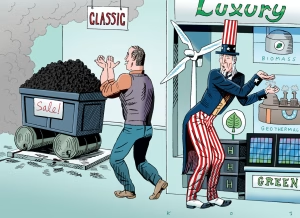
OM in the News: The Green Energy Transition Isn’t Easy

“Despite extravagant hype, the green-energy transition from fossil fuels isn’t happening. Achieving a meaningful shift with current policies is too costly,” writes The Wall Street Journal (June 25, 2024).

Globally, we spent almost $2 trillion in 2023 to try to force an energy transition. Over the past decade, solar and wind energy use has soared to record levels. But that hasn’t reduced fossil-fuel use, which increased even more over the same period.

Research shows that when countries add more renewable energy, it does little to replace coal, gas or oil. It simply adds to energy consumption. For every 6 units of green energy, less than one unit displaces fossil-fuel energy. While renewable energy sources worldwide will dramatically increase up to 2050, that won’t be enough even to begin replacing fossil fuels—oil, gas and coal will all keep increasing, too.

During the 19th-century transition to coal from wood, overall wood use increased even as coal assumed a greater percentage of energy needs. The same thing happened during the shift to oil from coal: By 1970, oil, coal, gas and wood all delivered more energy than ever before.

With a thirst for affordable energy, oil and coal energy use has doubled, hydro power has tripled and gas has quadrupled in the last 50 years. The use of nuclear, solar and wind power has surged.  During past additions of a new energy source, researchers found it has been “entirely unprecedented for these additions to cause a sustained decline in the use of established energy sources.”

Solar and wind aren’t better, because unlike fossil fuels, which can produce electricity whenever we need it, they can produce energy only according to the vagaries of daylight and weather. They are cheaper only when the sun is shining or the wind is blowing at just the right speed.

When we factor in the cost of 4 hours of storage, wind and solar energy solutions become uncompetitive with fossil fuels. Further, solar and wind are almost entirely deployed in the electricity sector, which makes up only 1/5 of all global energy use. As we struggle to find green solutions for most transportation, we have yet to address the energy needs of heating, manufacturing or agriculture. And we are ignoring the hardest sectors like steel, cement, plastics and fertilizers.

Classroom discussion questions:

  1. What can managers do to help the need for sustainable operations given these statistics?
  2. Will solar, wind, and nuclear take over the bulk of energy production? Why or why not?

OM in the News: The Green Transition Challenge

Copper is the new lithium, writes The Wall Street Journal (April 19, 2023). But a lack of new mining activity has added to worries that there won’t be enough of the red metal for the energy transition to electric vehicles.

Sheets of copper cathode at a mine in Chile.

Copper is used in wiring and construction as well as EVs, solar panels and other green technologies. Electrification is expected to increase annual copper demand to over 36 million metric tons by 2031, with supply forecast to be around 30 million tons, creating at least a 6 million ton shortfall at the start of the next decade. In 2021, refined copper demand stood at 25 million tons.

South America currently dominates copper production and Chile is the largest mined producer. Increasing mine output has proved a challenge, warning of a serious supply shortfall over the next decade. Some projects are coming online in Peru and in Chile, which will add incremental supply, but there is little in terms of pipeline for the long run. Copper metal exports from Congo and Zambia, the two other sources, totaled 2.3 million tons in 2022, up slightly from 2021, but less than half of Chile’s output.

“There’s a narrative around resource scarcity and the green transition with EVs and renewables as well as the build-out of electricity grids. On paper it’s quite a substantial supply gap opening up over the next 10 years,” says an industry expert. And there is no slack in the system.

“Green” uses of copper now account for about 4% of consumption, but this is expected to rise to 17% by 2030. A “net-zero emissions” path would mean the world would need an additional 54% of copper by 2030 on top of that forecast. EVs cannot take off before the charging infrastructure is set, and the necessary electrification is very copper intensive. Copper features heavily in energy transition proposals.

Sales of electric cars in 2022 in creased 55% over 2021 to bring the total number of EVs in the world to around 26 million. That means the EV-charging ecosystem will have to be significantly ramped up.

Classroom discussion questions:

  1. Why is this an OM issue?
  2. What might be done to solve the problem?

Good OM Reading: The Unlikely Story of Wal-Mart’s Green Revolution

It was clear that Wal-Mart was taking a leadership stand in sustainability when we wrote the Supplement 5 case study Environmental Sustainability at Wal-Mart 2 years ago. However,  an excellent  book called Force of Nature: The Unlikely Story of Wal-Mart’s Green Revolution, by Edward Humes (Harper Business, 265 pages), has just been published that will bring the case alive to your students. If you are to read one book on the company that is leading this unlikely second industrial revolution, this would be it.

That’s because Wal-Mart, long the target of environmentalists who hate its big-box footprint,  and others who feel it has destroyed small town businesses by the 1,000’s, has created nothing less than a green revolution. And as we see in Force of Nature, it is spreading this unprecedented makeover worldwide.  But the real story behind the changes at one of the world’s least earth-friendly companies is when river-guide turned consultant, Jib Ellison, enters CEO Lee Scott’s office.

Ellison singlehandedly persuades Scott that sustainability isn’t just for tree huggers–that it really meant eliminating waste and saving money. Hitting Wal-Mart at just the right moment, when it was plagued by bad PR and a slew of lawsuits, Ellison  convinced the firm’s execs that building sustainability into the business would create a powerful competitive edge. Wal-Mart did not embark, as the author says, on this course out of a sense of doing-good, but started with the attitude that it would give a PR boost…and also be profitable. It also was meant to appeal to a new generation of female shoppers who would leave for Target if Wal-Mart did not embrace sustainability.

Just a few of the recent changes: reducing packaging sizes (saving $3.4 billion a year while reducing trash), installing electric generators in refrigerated trucks (so they don’t have to idle overnight), donating 127 million pounds of food (that would otherwise be destroyed) to food banks, cutting printouts at stores (and saving 350 million pieces of paper and $20 million), making organic, earth-friendly, and natural products widely available, and forcing 100,000 manufacturers who supply products Wal-Mart sells to become more sustainable!